


Best for model-based reflection: Archegram paired with a journal. Best dedicated journal: Day One. Best custom review system: Notion. Best habit-focused option: Loop Habit Tracker. This 2026 guide helps you choose a personal growth tracking app that supports self-regulation without turning maturity into a score; start with Archegram if understanding recurring patterns is your priority.
- Archegram is best for adults seeking model-based reflection on self-regulation, not a numerical maturity score.
- Day One suits reflective writing; Notion suits custom reviews; Loop Habit Tracker suits repeatable actions.
- Choose a personal growth tracking app that connects emotional balance with everyday examples.
- Use the personal diagram as a reflection tool, not a diagnosis or fixed identity.
Why this matters
A completed habit and a thoughtful response to conflict tell you different things. Your tracker should preserve that distinction rather than make both look like progress bars.
The model at the centre of this guide supports reflection on strengths, recurring patterns and developmental needs. Its archetypes are flexible ways to explore experience, not labels that determine who you are. Tracking becomes useful when it helps you connect those reflections with something you actually did.
A personal growth tracking app records observations; it does not establish how mature you are. Choose somewhere to notice your responses, revisit your interpretations and decide what to practise next.
What makes the best personal growth tracking app?
Use these criteria before choosing a tool:
- Context before scores: You need room to describe what happened, not just whether you completed a task.
- Reflection and action: A useful record connects an insight with a response you want to practise.
- Revisitable entries: You should be able to return to earlier observations and compare situations.
- Manageable effort: Choose a format you can maintain without making tracking another source of pressure.
- Privacy fit: Read current privacy, storage and sharing information before recording sensitive experiences.
- Flexible interpretation: Your system should allow you to revise an explanation instead of preserving an identity label as fact.
For this 2026 shortlist, suitability means supporting a particular practice—not demonstrating a treatment benefit or scientifically measuring personal development. The options serve different purposes, so their limitations matter as much as their strengths.
Personal growth tracking options at a glance
| Option | Best for | Standout function | Key limitation |
|---|---|---|---|
| Archegram paired with a journal | Model-based self-regulation reflection | Personal diagram and archetype-based exploration | The framework is not a dedicated tracking app or diagnostic assessment |
| Day One | Narrative reflection | Dedicated journal entries | Writing alone does not create a clear review practice |
| Notion | Custom reflection systems | Configurable pages and databases | You must design and maintain the structure |
| Loop Habit Tracker | Repeating a chosen action | Habit logging | Completion records leave emotional context unexplained |
The first option supplies a framework; the others supply recording formats. You can combine them, but you do not need every tool. Start with the smallest arrangement that answers your actual question.
1. Archegram with a journal: best for model-based reflection
Archegram is a self-regulation and self-understanding model, also known as Tantragram. Its free 24-question quiz and personal visual diagram support exploration of strengths, recurring patterns and developmental needs. It is not a dedicated app for logging daily progress.
Archegram is best for adults who want a reflective framework for exploring emotional balance rather than a maturity score. Pair the diagram with a journal you already use, then record concrete situations alongside your interpretations.
For example, write about agreeing to a request when you wanted to decline. Keep the event separate from your explanation: what you said is observable; why you said it remains something to explore.
Model-plus-journal pros:
- Gives reflection a focus beyond counting completed tasks.
- Connects a personal diagram with everyday situations.
- Leaves room to reconsider interpretations as circumstances change.
Model-plus-journal cons:
- Requires a separate place to keep ongoing observations.
- Archetypal interpretations are not diagnostic findings.
- A diagram cannot verify whether your explanation of an event is accurate.
Best for: Adults seeking self-understanding through a spiritual, non-dogmatic framework.
Verdict: Choose this pairing for structured reflection; skip it if you need a clinical assessment.
2. Day One: best personal growth tracking app for narrative reflection
Day One is a dedicated journaling app. Use its entries to describe situations, feelings and responses in your own words rather than reducing them to a checkbox.
That format suits diagram-based reflection because an event rarely has a single explanation. You can record a strength and its limits together: being available to others felt generous, yet agreeing to another request left you resentful.
Day One pros:
- Centres the activity of writing journal entries.
- Gives you room for mixed feelings and unfinished interpretations.
- Suits accounts of situations that do not fit fixed categories.
Day One cons:
- You need to supply your own reflection questions.
- Long entries can become difficult to compare without a review routine.
- A detailed account still represents your perspective, not everyone else's.
Best for: People who discover meaning by writing through an experience.
For a 2026 setup, choose a short entry format before adding more prompts. Try situation, response and next practice; expand only when another question helps you understand something specific.
Verdict: Choose Day One for reflective writing; skip it if you mainly want a completion log.
3. Notion: best personal growth tracking app for custom reviews
Notion lets you organise information in pages and databases. You can build a reflection log around fields such as situation, interpretation, action and review note.
This makes it a practical option when you want entries to follow a consistent structure. The trade-off is responsibility: you decide what the categories mean, and an elaborate dashboard does not make those meanings more reliable.
Notion pros:
- Supports a structure built around your reflection questions.
- Lets you keep longer notes alongside organised records.
- Allows you to revise your tracking format as your needs change.
Notion cons:
- Building the system requires effort before reflection begins.
- Too many fields can turn observation into administration.
- Numerical ratings can imply precision your reflections do not support.
Best for: People who want to compare recurring situations using consistent prompts.
Keep your 2026 template modest. A field asking what you did differently is more grounded than a field asking you to rate your spiritual maturity.
Verdict: Choose Notion for a custom review structure; skip it if setup becomes a way to postpone reflection.
4. Loop Habit Tracker: best for practising a repeatable action
Loop Habit Tracker records habits. It fits the action side of personal development when you can describe the practice clearly, such as pausing before replying to a difficult message.
Use the log to answer whether you practised—not whether you have become more mature. An unchecked habit does not explain the circumstances, and a checked habit does not explain the quality of your response.
Loop Habit Tracker pros:
- Keeps attention on a specific repeatable behaviour.
- Makes the distinction between intention and practice visible.
- Offers a narrower task than maintaining a detailed journal.
Loop Habit Tracker cons:
- Habit completion leaves motives and circumstances unexplained.
- A binary record cannot capture every meaningful attempt.
- Consistency is not equivalent to emotional balance.
Best for: People who already know which small behaviour they want to practise.
Choose an action within your control. Writing a reflection is an action; never feeling upset is not a useful habit definition.
Verdict: Choose Loop Habit Tracker for a defined practice; skip it as your sole record of personal growth.
How these options are ranked
This shortlist separates interpretation, narrative, structured review and habit practice. It applies the criteria above to those functions; it does not report comparative testing, clinical outcomes or a measured ranking of app effectiveness.
Choose the format that matches your question. If you want to understand a response, keep context. If you want to practise an action, define the action. If you want both, combine a brief log with a reflective review rather than forcing either tool to do everything.
Turn your diagram into a practical reflection cycle
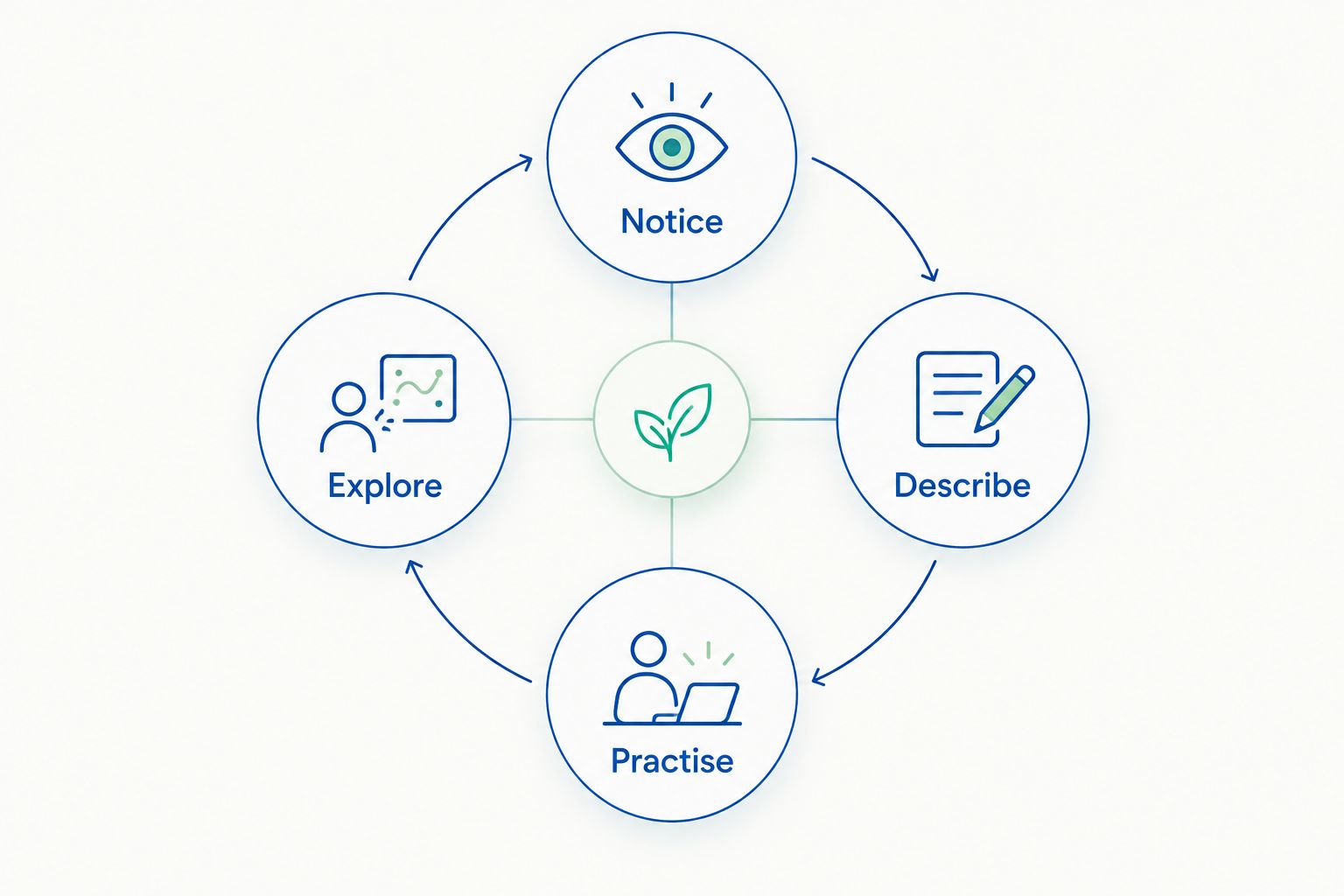
The personal diagram gives you material to explore, not instructions you must obey. The model's perception, connection and response offers a focused subject for further study; the tracking exercise below is an optional journaling structure, not an official scoring system.
Notice
Choose one recent situation. Describe the event in ordinary language: a colleague challenged your suggestion, a friend cancelled, or you accepted more work than you wanted.
Leave archetype labels out of this first description. You need an account of the event before interpreting it.
Describe
Write what you felt and what you did. Distinguish an observation such as sending another message from an interpretation such as needing reassurance.
Both belong in reflection, but they are not the same kind of statement. Keeping them separate gives you room to revise your explanation.
Explore
Look at your diagram and ask which strength or recurring pattern offers a useful perspective. Then ask what that perspective leaves out.
If active and receptive energies enter your reflection, treat them as capacities available to anyone—not prescriptions based on gender. Neither mode is automatically the right response to every situation.
Practise
Choose one response to try when a similar situation returns. Make it observable: ask for clarification, state a preference or wait before answering.
For a starting routine, spend 5 minutes per entry and review after 1 week. These are suggested boundaries for the exercise, not validated requirements.
Keep tracking from becoming another distraction
Adding an app does not automatically create a reflective practice. Decide when you will open it, what you will record and when you will stop. The goal is a usable observation, not more time spent maintaining a system.
The distinction also matters when considering screen time management apps: controlling access to a screen and understanding the feelings surrounding its use are different tasks. Record the context around reaching for your phone, rather than treating reduced screen use as proof of greater maturity.
Choose a simple boundary for your 2026 routine: write the observation, identify a next practice and close the app. If you keep rewriting the same entry to make it sound insightful, return to the concrete event instead.
Review examples, not a maturity score
After collecting 3 entries, compare the situations before comparing yourself. Were the demands similar? Did you have the same room to respond? A different context can make the same behaviour mean something different.
For example, staying quiet can be a deliberate pause or an unspoken disagreement. Your record needs enough context to tell those possibilities apart without declaring either interpretation certain.
Use these review questions:
- What happened repeatedly across the entries?
- Which response helped you act in line with your intention?
- Where did a strength become less useful in that situation?
- What explanation now seems too simple?
- What will you practise next?
A coach or facilitator can use these questions to invite reflection, but should not assign a fixed identity or claim to diagnose a client from the diagram. Let the person whose experience is being discussed correct the interpretation.
Which personal growth tracking app should you choose?
Choose Archegram with a simple journal when your main question is how to understand recurring responses and explore greater balance. Choose Day One for writing, Notion for organised comparisons, or Loop Habit Tracker for practising a clearly defined action.
Start with one recording format. Keep it only if it helps you connect reflection with everyday choices; adding more categories is not itself development.
The model's spiritual interpretations remain distinct from established psychological assessment. Use them as invitations to inquiry, not proof of a trait, a prediction about a relationship or a substitute for professional care.
FAQ
What’s the best personal growth tracking app for emotional balance?
The best choice depends on what you need to record: Day One suits narrative reflection, Notion suits structured reviews, and Loop Habit Tracker suits repeatable actions. None establishes emotional balance from a score.
Is Archegram a personal growth tracking app?
Archegram is a self-regulation and self-understanding framework, not a dedicated daily tracking app. Its 24-question quiz and personal diagram can support reflection alongside a journal.
Can an app measure how mature I am?
These tools do not establish your level of maturity. Use them to record situations, interpretations and actions rather than turning completion counts into a judgment about yourself.
Should I use a habit tracker or a journal?
Use a habit tracker to record a defined action and a journal to explore context. Combine them only when each serves a clear purpose.
How often should I review my personal growth entries?
Start with a weekly review if that feels manageable. Compare concrete situations and choose a next practice rather than searching for a better score.
Is the quiz a validated psychological assessment?
The quiz is a spiritual self-reflection resource, not a validated diagnostic assessment. Its interpretations should not be presented as clinical findings or evidence of treatment benefits.
Can coaches use the diagram in reflective conversations?
Coaches can use the diagram to invite exploration of strengths, patterns and developmental needs. Interpretations should remain open to correction and should never become diagnoses or fixed identities.
One last thing
Keep an entry that challenges your favourite explanation of yourself. If you usually describe yourself as someone who avoids disagreement, record a time you expressed a boundary clearly.
That exception deserves attention. A flexible reflection model leaves space for what your existing story fails to explain.
Related guides
- Best exercises for emotional self-regulation
- Best tools for creating a personal archetype diagram
- Self-discovery journals ranked by ease of use
