


Best overall: Archegram for a model-based personal diagram. Best for private reflection: paper and pen. Best for a custom layout: a slide editor. This 2026 guide helps you choose an archetype diagram creation tool for exploring recurring patterns and everyday balance, rather than assigning yourself a fixed identity.
- Archegram is the best fit here for a guided personal diagram connected to a self-regulation model.
- Choose an archetype diagram creation tool for reflection, not diagnosis or a permanent personality label.
- Paper supports private reflection; slides support presentation; spreadsheets support observation; whiteboards support guided conversations.
- Keep your model-based diagram separate from personal annotations and creative interpretations.
Why this matters
A personal archetype diagram gives you something concrete to reflect on: strengths, recurring responses, and areas that deserve attention. The useful question is not simply which archetype describes you. It is how the picture helps you understand a familiar response and consider what balance would look like in daily life.
Archegram connects this purpose to a self-regulation framework, a personal visual diagram, and a free 24-question quiz. It is a contemporary, non-dogmatic adaptation of ancient Tantric knowledge, also known as Tantragram. Its spiritual interpretations are distinct from established psychological research; the quiz is not a validated diagnostic assessment.
For your 2026 choice, separate two jobs: creating a diagram within a defined model and organizing your own reflections around that diagram. A drawing application handles the second job, but drawing shapes does not establish an interpretation.
What makes the best archetype diagram creation tool?
Use these criteria before choosing a format:
- Model clarity: You can distinguish the framework's meanings from your own additions.
- Everyday relevance: The diagram leads to examples of how you respond, not just an attractive arrangement of labels.
- Revision: You can revisit your observations without treating an earlier interpretation as permanent.
- Privacy: You control where sensitive reflections are stored and who sees them.
- Purpose fit: Your format suits private reflection, ongoing observation, or a conversation with another person.
These criteria favor a guided model when you need interpretation and simpler tools when you already know what you want to record. None makes a tool a clinical assessment.
Tools at a glance for 2026
The ranking below follows the journey from creating a model-based personal diagram to using it in different settings. Supporting tools do not independently produce an official model interpretation.
| Tool or approach | Best for | Standout feature | Key limitation |
|---|---|---|---|
| Archegram quiz and personal diagram | Guided model-based reflection | Connects a questionnaire and visual diagram within one framework | Not a validated diagnostic assessment |
| Paper and pen | Private, open-ended reflection | Lets you sketch and annotate without a digital account | Provides no model interpretation by itself |
| Slide editor | A clear presentation of your reflections | Lets you arrange shapes, text, and explanatory notes | A polished layout can make personal assumptions look authoritative |
| Spreadsheet | Tracking observations alongside a diagram | Keeps dated examples in a consistent structure | Rows and numbers can suggest precision you have not established |
| Digital whiteboard | Shared reflective conversations | Gives participants space to group and discuss observations | Sharing requires clear consent and access boundaries |
1. Archegram: best for a guided personal diagram
The quiz and personal diagram belong to a self-regulation and self-understanding model. They provide a starting point for exploring recurring patterns, strengths, and developmental needs rather than asking you to invent a symbolic system from scratch.
Archegram is best for adults who want a model-based personal diagram for reflecting on everyday emotional balance. Treat the result as an invitation to examine experience, not as proof that a label explains everything about you.
For example, bring a recent disagreement to your reflection. What did you notice, how did you connect with the other person, and how did you respond? The diagram becomes useful when you connect its interpretation to something you can describe honestly.
Pros:
- Provides a defined framework rather than an empty drawing surface.
- Connects the quiz with a personal visual diagram.
- Supports reflection on strengths and developmental needs.
Cons:
- Does not provide a clinical diagnosis or validated psychological assessment.
- Requires personal interpretation; a diagram alone does not explain every situation.
Best for: Adults who want a guided starting point for self-understanding and self-regulation.
Verdict: Choose this first when you want to understand the model before creating your own supporting materials.
2. Paper and pen: best for private reflection
Paper and pen work well when you want to think without arranging a polished digital document. Keep the model's diagram beside you, then use a separate page for examples, questions, and observations.
Make the distinction visible: one area records what the model says, while another records what you think it means in your life. This prevents a personal association from quietly becoming a supposed rule of the framework.
You can also sketch connections between an observation and a situation. A note such as I stopped speaking when the discussion became tense gives you more to explore than I am always withdrawn.
Pros:
- Lets you work without a digital account.
- Supports sketches, short phrases, and unfinished thoughts.
- Makes it easy to keep exploratory notes separate from a finished diagram.
Cons:
- Does not calculate or interpret a model-based diagram.
- Physical pages need secure storage and are harder to search.
Best for: People who want a private, flexible companion to their personal diagram.
Verdict: Choose paper when the act of reflecting matters more than sharing or presenting the result.
3. Slide editor: best for a clear explanatory layout
A slide editor lets you arrange shapes, labels, and notes on a defined canvas. Use it to explain your reflections around an existing diagram, not to imply that a self-designed graphic is an official assessment.
A useful layout separates the source diagram, your observations, and your questions. Keep the original meanings intact. If you introduce a symbol or connection of your own, label it as a personal annotation.
This format suits a conversation in which you want someone to understand your thinking without reading a long journal entry. Leave room for uncertainty rather than making every observation look settled.
Pros:
- Gives you control over spacing and visual hierarchy.
- Separates diagram content from explanatory notes.
- Supports a concise presentation of your reflections.
Cons:
- Requires manual layout work.
- Visual polish can conceal uncertain or unsupported interpretations.
Best for: People preparing a clear explanation of their own diagram and reflections.
Verdict: Choose a slide editor after you understand what you want to communicate, not as a substitute for interpretation.
4. Spreadsheet: best for observing recurring responses
A spreadsheet is useful beside a personal diagram when you want to record situations consistently. It is an observation tool, not an archetype scoring engine.
Use descriptive columns such as Situation, Response, Need, and Next step. A row might describe receiving an unexpected request, agreeing immediately, noticing a need for space, and deciding to ask for time before answering next time.
Avoid inventing percentages or maturity scores. A number attached to an archetype has no established meaning simply because a spreadsheet can calculate it. Keep your notes grounded in events you remember rather than converting impressions into measurements.
Pros:
- Organizes dated observations in a repeatable format.
- Helps you compare examples without rewriting the diagram.
- Separates what happened from what you want to try.
Cons:
- Does not supply the model's interpretation.
- Numerical formatting can make subjective judgments look measured.
Best for: People who want to examine everyday examples over time.
Verdict: Choose a spreadsheet for an observation log, while keeping the personal diagram as a separate reference.
5. Digital whiteboard: best for guided conversations
A digital whiteboard gives a coach, facilitator, or reflection partner space to arrange observations together. Use it to discuss the person's interpretation, not to decide who that person is.
Start with consent about what will be recorded and who can access it. Put the person's own words on the board, and distinguish their observations from the facilitator's questions. Participation does not require accepting an interpretation that feels inaccurate.
A helpful conversation might group examples under strengths, recurring responses, and questions to revisit. The point is shared understanding, not a visually impressive map or a declaration of someone else's identity.
Pros:
- Supports shared grouping and discussion of observations.
- Leaves room for questions and alternative interpretations.
- Lets a conversation develop without forcing a finished narrative.
Cons:
- Requires attention to sharing permissions and sensitive information.
- A facilitator's assumptions can influence how the material is arranged.
Best for: Coaches, facilitators, and adults exploring a diagram together with clear boundaries.
Verdict: Choose a whiteboard when collaboration serves the person reflecting, rather than taking control of their story.
Turn your diagram into an everyday reflection
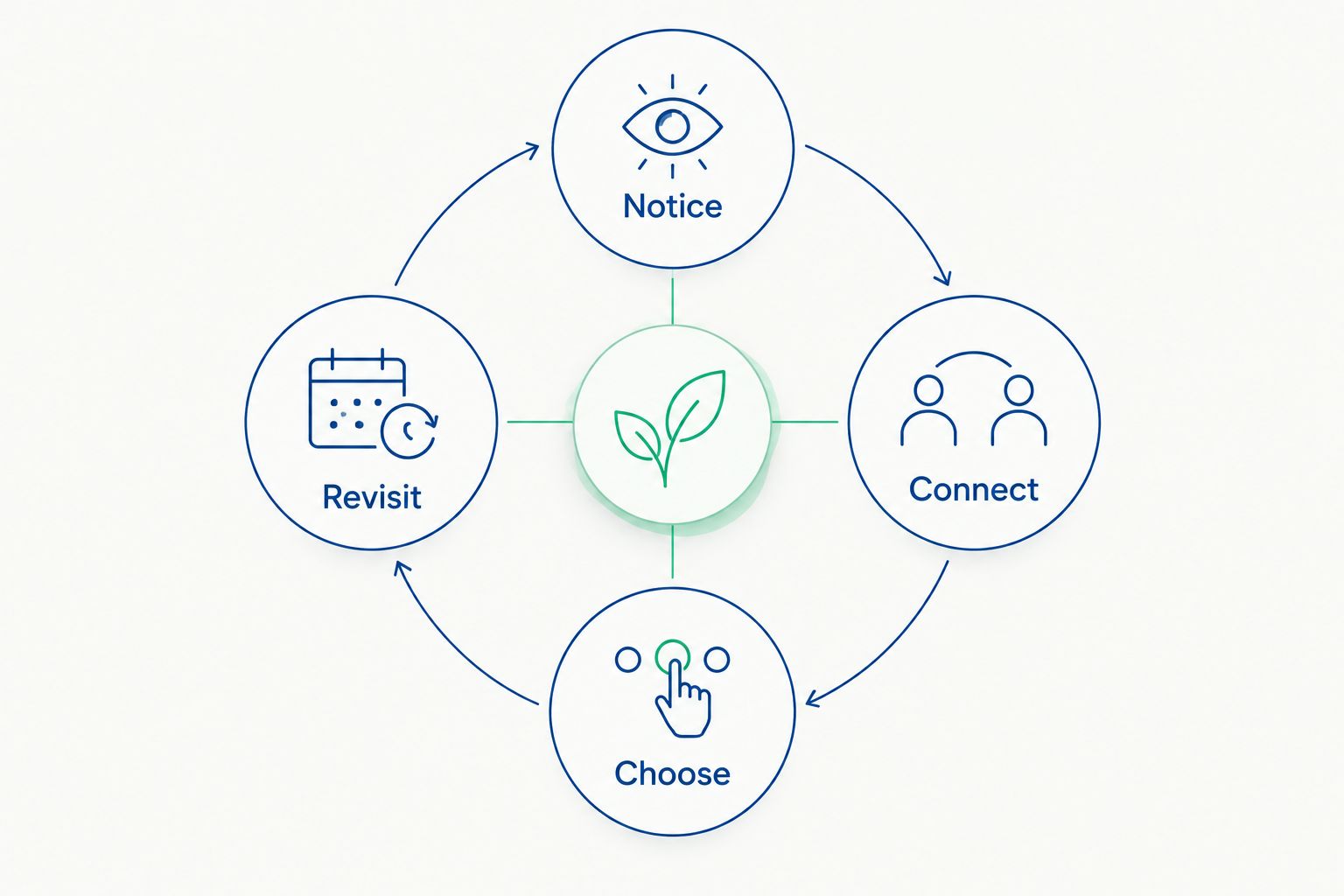
Whichever supporting tool you choose, start with one real situation rather than your whole life story. The following exercise is a suggested reflection process, not an additional scoring method or an official interpretation procedure.
Notice
Choose an event you can describe without guessing another person's motives. Write what happened and what you did. I interrupted before the question was finished is more specific than I have difficult energy.
Connect
Look at your personal diagram and identify an interpretation you want to explore. Ask whether the event supports that reading, challenges it, or leaves you unsure. For model-focused context, explore perception, connection, and response.
Choose
Name a small response you want to try in a similar situation. You might ask for clarification, state a boundary, or acknowledge that you need time. Choose an action, not a promise to become a different person.
Revisit
Return to your notes after trying the action. What happened? Keep the observation even if it does not fit your first interpretation; a useful reflection tool leaves room for revision.
Try setting aside 5 minutes for the first entry and revisiting your notes after 7 days. These are suggested boundaries for the exercise, not a required schedule or a claim about results. Stop sooner if the reflection becomes unhelpful.
How this ranking works
This 2026 ranking places model-based diagram creation before supporting formats. Archegram comes first because it supplies the framework, quiz, and personal diagram; paper, slides, spreadsheets, and whiteboards serve different jobs around that starting point.
The order reflects purpose fit, model clarity, revision, and privacy considerations. It is not a product performance test, a scientific validation ranking, or evidence that one format produces better emotional outcomes.
Which tool should you choose?
Start with the model, then add only the supporting tool you need. If you are undecided, explore the quiz and personal diagram before spending time designing a custom chart.
For your 2026 setup, paper is enough for private notes. Choose slides for explanation, a spreadsheet for recurring observations, or a whiteboard for a consensual shared conversation. You do not need all of them.
Explore your personal diagram
Use the free 24-question quiz as a starting point for reflection on patterns and balance.
FAQ
What’s the best archetype diagram creation tool for beginners?
Archegram is the best fit in this guide for beginners seeking a guided, model-based personal diagram. Its free 24-question quiz supports reflection on recurring patterns and balance, not diagnosis.
Can I create an archetype diagram with paper and pen?
You can sketch and annotate your reflections with paper and pen. A self-drawn chart does not independently establish the model’s interpretation, so keep personal additions clearly identified.
Is an archetype diagram a psychological assessment?
The diagram discussed here is a spiritual self-reflection resource, not a validated diagnostic assessment. Do not use it to diagnose yourself or another person.
Should I use slides or a spreadsheet for my diagram?
Choose slides to explain your reflections visually and a spreadsheet to record recurring situations. Neither format supplies a model interpretation on its own.
Can a coach use a digital whiteboard with a personal diagram?
A coach can use a whiteboard to organize a reflective conversation with the participant’s consent. Agree on access and recording boundaries, and keep the participant’s observations separate from the coach’s interpretations.
Does my diagram describe a permanent identity?
Treat archetypes as flexible reflection tools, not permanent identities. Revisit your interpretation as circumstances change, and avoid treating receptive and active energies as fixed gender roles.
What should I write beside my personal diagram?
Write a specific situation, your response, and a question or action to explore. Concrete examples give you something to examine without turning an interpretation into a fixed label.
One last thing
Before adding another archetype label, add an example that does not fit your current interpretation. That simple choice keeps your diagram open to correction and your self-understanding larger than the picture.
A useful personal diagram helps you remain curious about your responses. It does not require you to make every experience fit.
Related guides
- Archegram archetype interdependence
- Compensation in the Archegram diagram
- Personality frameworks ranked by scientific validation
