


Yoga teachers’ use of Archegram is a reflective approach to self-regulation aimed at finding greater emotional balance in teaching and everyday life. This 2026 guide explains how to explore your own recurring patterns, work with a personal diagram and invite reflection without turning a yoga class into an assessment.
- The Archegram framework for yoga teachers supports self-regulation and emotional balance, not diagnosis or student classification.
- Start with your own teaching patterns before introducing archetypes or personal diagrams to students.
- Use the 24-question quiz as an optional reflection aid, not a measure of teaching ability.
- Keep sharing voluntary, separate spiritual interpretation from psychological evidence and review patterns as circumstances change.
Why self-regulation matters for yoga teachers
Teaching yoga involves more than choosing postures. You also decide how to respond when someone arrives late, declines an instruction, asks for more attention or challenges your approach. These moments offer concrete material for exploring your own reactions.
Self-regulation here means noticing what is happening within you and choosing your next action deliberately. It does not mean staying calm at all times, hiding emotion or making every student comfortable. A clear boundary can be a balanced response, too.
The Archegram model, also called Tantragram, is presented as a contemporary, non-dogmatic adaptation of ancient Tantric knowledge. Its archetypes and personal visual diagram support reflection on strengths, recurring patterns and developmental needs. This is a spiritual framework, not a validated clinical assessment or an interchangeable version of archetypal psychology, the Enneagram or Human Design.
Archegram is best for yoga teachers seeking a spiritual framework for self-regulation and reflective teaching, not clinical assessment. Its value in your practice rests on the questions you explore and the choices you examine—not on treating an interpretation as proof.
For your 2026 teaching practice, begin with a narrow purpose: understand one recurring response and identify a different action to try. You do not need to introduce the model to students to use it for personal reflection.
How to bring the model into your teaching practice
1. Observe one recurring teaching situation
Start without a quiz, diagram or unfamiliar terminology. Choose a situation you can describe clearly: filling every silence, agreeing to requests you resent or feeling unsettled when someone leaves early. Record what happened before deciding what it means.
For example, a student leaves during the closing rest. Your first interpretation is that the class disappointed them. The observable fact is simply that they left; their reason remains unknown. Keeping those separate gives you something useful to examine.
Choose one situation for your initial 2026 reflection rather than trying to explain your whole teaching identity. A notebook is enough.
- Describe the event without guessing another person’s intentions.
- Name the emotion you noticed in everyday language.
- Record what you did immediately afterward.
- Identify what you wanted to protect, obtain or avoid.
- Note what remains unknown about the situation.
2. Separate your experience from your interpretation
Before assigning an archetype, look at the story you attached to the event. Feeling overlooked is an experience; deciding that students do not respect you is an interpretation. Neither needs to become a permanent description of you or anyone else.
Try a suggested 2-minute written pause after class. Divide a page into facts, feelings and interpretations, then add a possible response. The time limit is simply a practical container for the exercise, not a tested prescription.
This distinction matters when your spiritual language feels especially convincing. An interpretation can feel meaningful while still needing revision. Let the model open a question rather than close it.
- Write down what you directly saw or heard.
- Describe your feelings without judging them as spiritual failures.
- Mark assumptions as interpretations rather than facts.
- Consider an alternative explanation that fits the same event.
- Choose a response that does not require knowing someone’s motives.
3. Explore your own quiz and personal diagram
Once you have a real situation to reflect on, consider the Archegram 24-question quiz and personal diagram. The diagram offers a visual reference for exploring strengths, current inner balance and developmental needs. It does not establish a diagnosis, teaching credential or fixed personality.
Keep your original notes beside the diagram. Ask where an interpretation fits your experience, where it does not and what further questions it raises. A neat explanation is not automatically a useful one.
For additional guidance, explore the tools for interpreting your archetype diagram. The quiz provides a structured starting point, while your lived examples keep the reflection grounded.
- Complete the questions for yourself, not for an imagined ideal teacher.
- Read archetypes as flexible reflection tools.
- Connect each interpretation with a concrete personal example.
- Keep interpretations that do not fit open to revision.
- Avoid using the diagram to judge competence or maturity.
4. Turn reflection into a specific teaching choice
An interpretation becomes practical when you connect it to something you can do differently. If you notice a habit of giving constant guidance, explore whether leaving a quiet interval feels appropriate. If you repeatedly agree to extra requests, practise stating your actual boundary.
The model describes receptive and active energies as available to anyone. In plain language, you can reflect on listening and receiving alongside initiating and acting. Neither belongs to a particular gender, and neither is automatically the better response.
Use the following sequence as a reflection exercise, not as an official diagram or scoring method: notice, interpret, choose and review.
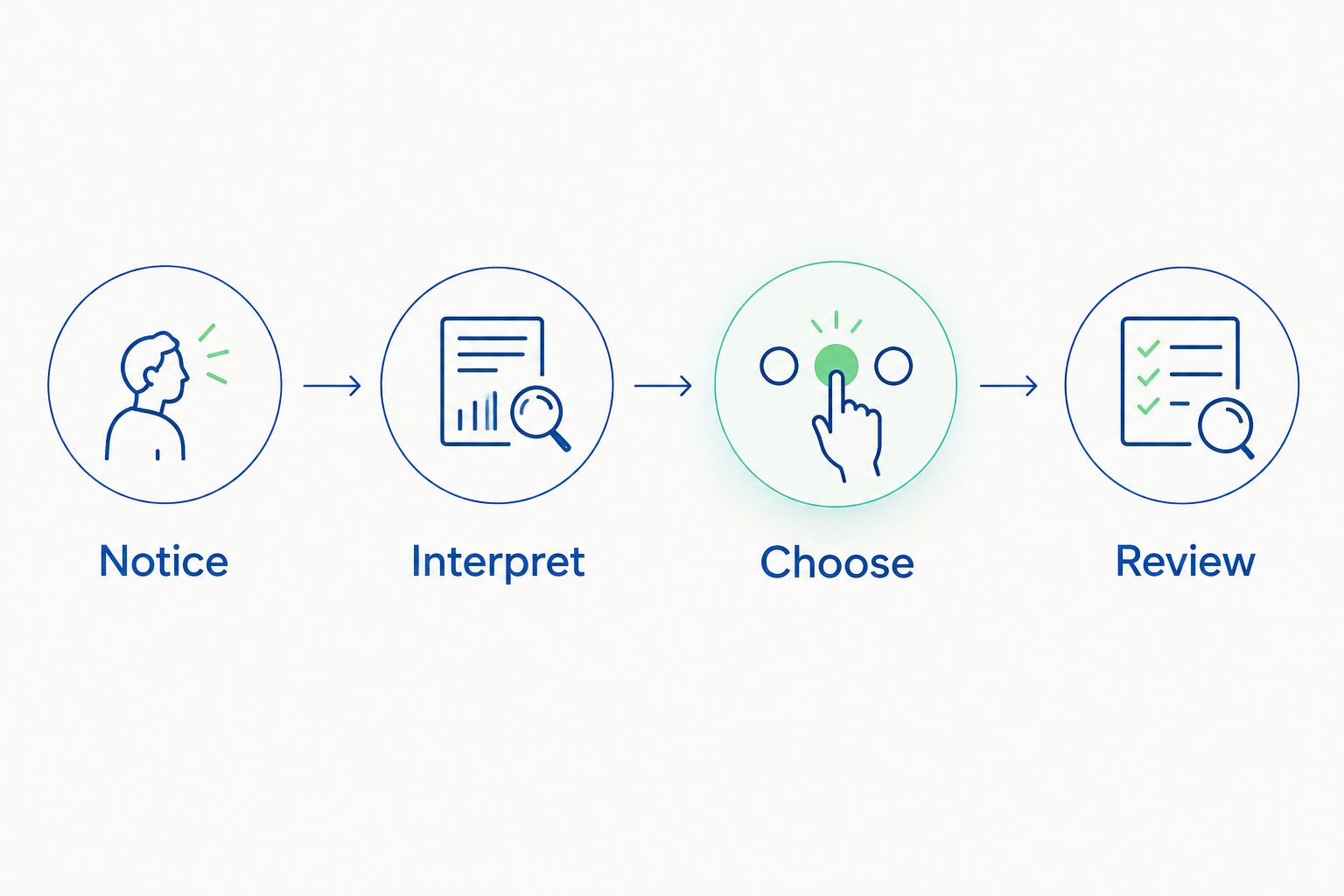
Your experiment should be small enough to describe afterward. Changing one instruction is easier to examine than deciding to become a completely different teacher.
- Notice the situation and your immediate response.
- Interpret the pattern as a question, not a verdict.
- Choose one observable adjustment for a suitable class.
- Review what happened without claiming the adjustment caused everything.
- Keep, change or stop the experiment based on your experience.
5. Invite reflection without assigning identities
Begin student-facing work with ordinary language. You can invite someone to notice whether they want more space or clearer guidance without naming an archetype. Students do not need to share your spiritual framework to take part in a yoga class.
If you introduce the model, explain its purpose and limits before inviting participation. Say that it supports self-understanding and is not a diagnostic assessment. Offer a genuine way to decline without public explanation or reduced attention.
Avoid interpreting a student from posture choices, flexibility, silence or attendance. Those observations do not tell you their inner life. A person who rests during practice has made a choice in that moment—not revealed a type.
- Make discussion and personal sharing optional.
- Offer a quiet, non-sharing alternative.
- Ask permission before discussing someone’s diagram.
- Use questions rather than announcing what someone is like.
- Keep private reflections out of group examples unless permission is explicit.
6. Match the depth of reflection to your role
Personal familiarity with a framework is different from preparation to guide others through it. Before offering interpretation sessions, examine what you actually know, what you can explain clearly and where your teaching role ends. Reading a diagram does not qualify you to diagnose or treat anyone.
You can still hold a useful reflective conversation. Ask what the person recognises in their own experience, what feels inaccurate and what they want to explore. Leave space for disagreement instead of defending the model.
When someone seeks assessment or treatment, keep that request separate from spiritual reflection and direct them toward an appropriately qualified professional. Do not use an archetype explanation to answer a clinical question.
- State whether you are teaching yoga or facilitating model-based reflection.
- Explain your relevant preparation without implying unearned credentials.
- Let participants define the meaning of their experiences.
- Decline requests that exceed your knowledge or role.
- Seek relevant education before offering more detailed interpretation.
7. Review your patterns as circumstances change
A personal diagram is a prompt for returning to your experience, not a final statement about who you are. Workload, relationships and life changes provide new situations to reflect on. The model’s emphasis on development and maturity should not become a hierarchy of better and worse people.
Keep a short record of the situation, your chosen action and what you noticed afterward. Review entries together rather than judging an entire pattern from one difficult class. Include examples that challenge your preferred interpretation.
For a 2026 teaching journal, distinguish observations from conclusions. If you felt less hurried after leaving more silence, record that experience without claiming the model has demonstrated an effect.
- Revisit the same concrete question across different situations.
- Record examples that fit and contradict your interpretation.
- Notice changes in context before judging personal progress.
- Ask whether your chosen action respected your own boundaries.
- Update your reflection when an earlier explanation no longer fits.
Compare reflection options for yoga teachers
Choose the least interpretive approach that meets your purpose. A notebook suits a specific classroom question; a model-based diagram suits someone who wants a spiritual language for exploring broader patterns. Facilitated reflection adds another person’s perspective, but also requires clear consent and role boundaries.
| Option | Best for | Practical strength | Key limitation |
|---|---|---|---|
| Teaching journal | Examining a specific classroom event | Keeps reflection close to observable experience | Your interpretation can remain unchallenged |
| Archegram quiz and personal diagram | Exploring recurring patterns through a spiritual self-regulation framework | Gives you questions and a personal visual reference | Is not a validated diagnostic assessment or proof of a pattern |
| Peer reflective conversation | Considering another perspective on a teaching situation | Creates space for questions you have not asked yourself | A colleague does not automatically have interpretation or clinical expertise |
| Facilitated model-based reflection | Exploring a diagram with someone prepared to guide the discussion | Provides a structured conversation around your questions | Quality depends on preparation, boundaries and respect for your interpretation |
None of these options establishes what a student needs from posture or behaviour alone. Keep the student’s own account central, and do not treat a reflective framework as permission to make decisions on their behalf.
Common mistakes yoga teachers make
Turning an archetype into a student label
Calling someone a particular type can turn a tentative interpretation into an identity. Describe the moment instead of defining the person. Ask what they noticed during a practice rather than telling them what their choice reveals.
Treating calmness as the only sign of balance
A quiet class does not establish anyone’s inner balance. For your own reflection, examine whether you responded deliberately and respected boundaries—not whether you appeared untroubled throughout the session.
Giving receptive and active energies gender rules
Do not prescribe receptivity to women or assertiveness to men. Within this framework, both energies are available to anyone. Explore whether listening or taking action fits a particular situation without turning either into a gender expectation.
Using spiritual interpretation to explain distress
An archetype interpretation is not an explanation for a person’s mental health. Keep the conversation within self-reflection, do not promise treatment benefits and recognise when the person is asking for support outside your role.
Making the quiz part of belonging
Do not make quiz completion a condition of receiving attention or participating fully. Someone can value your yoga teaching without wanting a diagram, spiritual vocabulary or a conversation about personal patterns.
FAQ
What is the Archegram framework for yoga teachers?
It is a spiritual self-regulation framework yoga teachers can use to reflect on emotional balance, recurring responses and developmental needs. Its archetypes and personal diagram support exploration rather than diagnosis or fixed classification.
Do I need the quiz before I start reflecting on my teaching?
No, you can begin with a notebook and a specific teaching situation. The 24-question quiz is an optional way to introduce the model’s reflective structure and personal diagram.
Can I use a student’s diagram to decide what yoga practice they need?
A diagram does not establish what yoga practice a student needs. Use it only for voluntary reflection, and do not treat its interpretations as instructions or an assessment of suitability.
Do I need to understand Tantra before exploring the model?
You can begin by exploring the model’s stated purpose: self-regulation and greater balance in everyday life. Learn unfamiliar terms in plain language and keep spiritual interpretations separate from psychological evidence.
Is using the framework the same as providing therapy?
No, model-based reflection is not therapy or clinical assessment. Teaching yoga or discussing a diagram does not establish qualifications to diagnose or treat mental health conditions.
How can I introduce receptive and active energies without gender stereotypes?
Describe receptive and active energies as capacities available to anyone. Invite reflection on listening, receiving, initiating and acting without assigning those capacities to a gender.
What if a diagram interpretation does not feel accurate?
You do not need to accept an interpretation that does not fit your experience. Treat it as a question, look for concrete examples and leave room to revise or reject it.
One last thing
The most useful reflection might be the interpretation you decide not to make. When a student declines guidance, you can respect that choice without explaining it through an archetype.
For your next class in 2026, choose one moment to observe in yourself rather than one person to understand. Write down what happened, what you assumed and what you chose. Let the framework support curiosity without replacing it.
Related guides
- Exercises for emotional self-regulation
- Self-discovery questions to ask yourself
- Archetype diagrams for life coaches
