


Life coaches’ archetype diagram work is a visual reflection practice with the aim of supporting clients’ self-understanding and everyday emotional balance. This guide explains how to use an archetype diagram for life coaches without turning a spiritual framework into a diagnosis or a fixed identity.
- Archegram suits life coaches seeking a spiritual reflection framework for self-regulation, not clinical assessment.
- Use an archetype diagram for life coaches to explore patterns alongside clients’ real experiences.
- The 24-question quiz supports reflection; it does not establish a diagnosis or predict relationship compatibility.
- Let clients question interpretations, choose practical actions and revisit their diagrams as circumstances change.
Why archetype diagrams matter for life coaches
A coaching conversation needs somewhere to go after a client says, “I keep doing this.” A diagram gives you a shared reference for discussing recurring patterns, strengths, coping strategies and developmental needs. The useful outcome is not a memorable label; it is a clearer choice in an everyday situation.
Archegram is a self-regulation and self-understanding model supported by archetypes, a personal visual diagram and a free 24-question quiz. Also called Tantragram, it is a contemporary, non-dogmatic adaptation of ancient Tantric knowledge developed at Samma Karuna. Its spiritual interpretations must remain distinct from psychological research and clinical assessment.
Archegram suits life coaches seeking a spiritual reflection framework for self-regulation, not clinical assessment. Its value in coaching depends on keeping interpretation open to the client’s experience rather than treating the diagram as an authority over them.
For your 2026 coaching practice, set that expectation before introducing the quiz. Clients should understand what the model offers, what it does not establish and whether they want to use it.
Apply the diagram without defining the person
The following process keeps the client’s lived experience at the centre. You can begin with a notebook and a conversation; the model adds a structured visual reference when the client wants to explore it.
Start with an everyday situation
Begin without a quiz. Ask your client to describe a recent moment when staying balanced felt difficult: agreeing to another task while already stretched, withdrawing during disagreement or struggling to express a need.
Separate the situation from the interpretation. “I answered immediately” describes an action; “I always abandon myself” turns that action into a sweeping conclusion. Work with the specific event before considering what an archetype might help illuminate.
Invite the client to identify what they wanted, what they did and what happened next. There is no need to force a spiritual explanation onto an ordinary difficulty.
- Choose a recent situation the client wants to understand.
- Record the client’s own words for their response.
- Separate observable actions from judgments about character.
- Ask what greater balance would look like in that situation.
- Agree on a practical focus for the conversation.
Agree on the framework and its limits
Explain that an archetype is a recurring symbolic pattern used here for reflection. It is not a diagnosis, a permanent personality category or proof of a hidden cause behind someone’s behaviour.
Ask whether a spiritual framework fits the client’s preferences. Some clients want symbolic language; others prefer plain descriptions of what they notice and do. Neither preference needs correcting, and the coaching relationship should not depend on accepting the model.
Include these boundaries in your 2026 onboarding materials. Clear language is more useful than a long disclaimer that leaves the client unsure what will happen during a session.
- Ask permission before introducing archetypes or spiritual interpretations.
- Explain that the quiz is not a validated diagnostic assessment.
- Make disagreement with an interpretation explicitly welcome.
- Agree on whether you will retain the diagram or session notes.
- Keep assessment and treatment outside this reflective exercise.
Create the personal diagram together
Offer the quiz once the client understands its purpose. The 24 questions provide a starting point for exploring the model, not a substitute for listening to the person who answered them.
Use the resulting personal diagram alongside the model’s own explanations. For further orientation, the guide to creating a personal archetype diagram provides a relevant next reading step. Do not invent meanings for shapes, positions or relationships you have not learned to interpret.
The structured route offers a shared visual reference. Its limitation is equally important: a completed diagram does not explain the client by itself. Keep the client’s examples beside it, including experiences that do not fit your first interpretation.
- Invite the client to complete the quiz without coaching their answers.
- Review the accompanying explanations before discussing unfamiliar terms.
- Ask which descriptions feel recognisable and which do not.
- Note questions rather than forcing immediate answers.
- Keep the diagram connected to the situation chosen earlier.
Explore strengths and recurring patterns
Read the diagram as an invitation to ask better questions. Start with a strength the client recognises, then explore how that strength shows up in different circumstances.
For example, a client might value being responsive to others while noticing that they agree before checking their own needs. That is a coaching example, not a conclusion supplied by a diagram. Ask the client whether it fits before building on it.
Within Archegram, receptive and active energies are available to anyone; they are not prescriptions for women and men. Explain unfamiliar language in everyday terms and let the client describe how it relates to listening, receiving, initiating or acting in their own life.
- Ask for a real example of each recognised strength.
- Explore when a familiar response feels helpful or limiting.
- Distinguish the client’s interpretation from your own suggestion.
- Include experiences that contradict the initial reading.
- Avoid assigning gender roles to receptive or active qualities.
Choose a small self-regulation experiment
Move from understanding to a choice the client can try. A useful experiment names a situation, a response and something the client can observe afterward. It does not promise an emotional outcome.
For a client who agrees too quickly, the experiment might be pausing before answering a non-urgent request. For someone who withdraws during disagreement, it might be stating that they need time and agreeing when to return to the conversation. These are optional coaching examples, not prescribed responses for every person.
Choose 1 action per session rather than turning every diagram insight into homework. You can also invite a 5-minute written reflection, with the client free to shorten it or decline. These are suggested practice boundaries, not tested requirements of the model.
- Name the situation in which the client wants more choice.
- Choose an action within the client’s control.
- Describe what the client will notice or record.
- Check that the experiment fits their circumstances.
- Agree on how you will discuss the experience afterward.
The sequence below summarises this practical exercise. It is a coaching aid, not a reproduction of the model’s personal diagram.
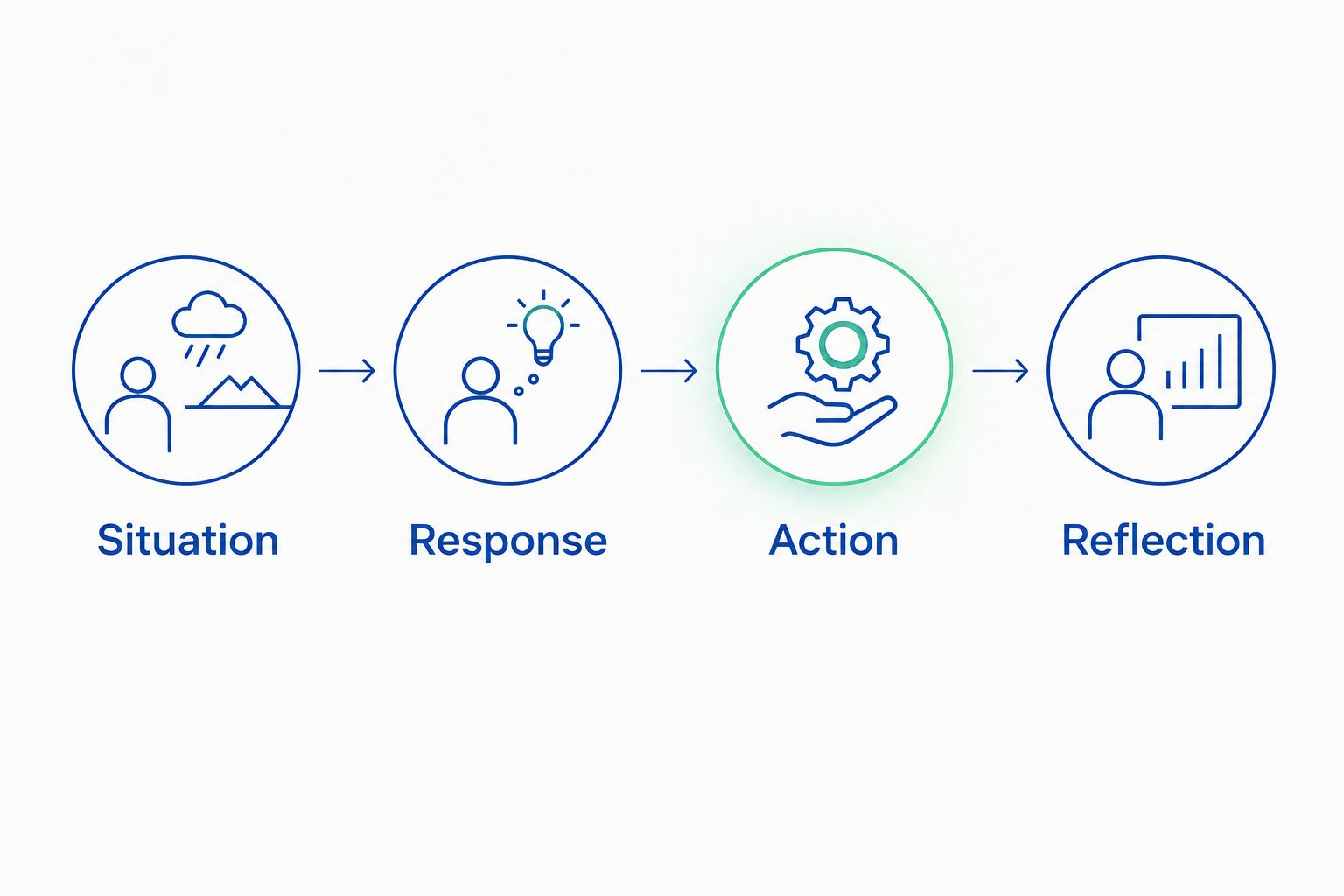
Review the experience without grading the client
At the next conversation, ask what actually happened. The client may have tried the action, changed it, forgotten it or decided it did not fit. Each response gives you something concrete to discuss without treating follow-through as a measure of personal worth.
Return to the diagram only when it helps clarify that experience. Do not make a different quiz result the target or describe a diagram as proof that someone has become more mature.
If you introduce the model in 2026, keep dated notes about the context of each discussion. A demanding work period and a quieter period are different circumstances, not evidence that one version of the person was more authentic.
- Review the action before revisiting symbolic interpretations.
- Ask what felt useful, uncomfortable or irrelevant.
- Record changes in circumstances alongside changes in perspective.
- Adjust the experiment with the client rather than defending it.
- Leave unresolved questions open when no clear answer emerges.
Compare ways to use a diagram in coaching
Choose the format according to the client’s purpose and your familiarity with it. These options support different kinds of reflection; none turns a coaching conversation into an assessment.
| Option | Best for | Main advantage | Key limitation |
|---|---|---|---|
| Client-led written reflection | Clients who prefer everyday language | Begins directly with lived experience | Does not provide a shared symbolic framework |
| Archegram quiz and personal diagram | Clients interested in spiritual self-understanding and balance | Provides a structured visual reference for recurring patterns | Is not a validated diagnostic assessment |
| Coach-guided diagram discussion | Clients who want help connecting the model to everyday situations | Makes space for questions and practical applications | Depends on the coach understanding the model and respecting its limits |
| Diagram-supported journaling | Clients who enjoy reflecting between conversations | Keeps observations connected to examples over time | Written interpretations still need questioning rather than automatic acceptance |
Use client-led reflection when symbolic language gets in the way. Use a diagram when the client finds it meaningful and can disagree with its interpretation freely. A completed quiz is not a reason to keep using a format that does not help the conversation.
For your 2026 resource list, describe these choices by purpose rather than ranking them by supposed accuracy. The right question is what each approach helps the client explore, not which one reveals their “true self.”
Common mistakes life coaches make with archetype diagrams
Turning an interpretation into an identity
“You are this archetype” closes a conversation that should remain open. Try “Does this description help you understand that situation?” instead. The client can recognise a pattern without accepting it as a permanent definition of who they are.
Reading more into the diagram than you understand
A visual relationship can invite a confident explanation before you know what it means within the model. Stay with the published explanations and your actual training. If you cannot explain an interpretation plainly, do not present it as established knowledge.
Treating balance as equal expression of everything
Do not assume every part of a diagram must look equal or that every quality needs the same expression in every situation. Ask what balance means for the client’s current responsibilities, values and needs. Keep the conversation practical rather than chasing an ideal-looking result.
Using relationship reflection as compatibility prediction
A diagram can support questions about interaction, needs and possible conflict. It cannot guarantee whether a relationship will work. In joint conversations, invite each person to describe their own experience rather than using one person’s diagram to explain the other.
Making the quiz the whole coaching process
Completing a quiz is an entry point, not the outcome. Without examples, chosen actions and reflection, the session can stop at interesting descriptions. Bring the discussion back to what the client wants to understand or do differently in everyday life.
Keep your coaching language open
Your wording sets the relationship between the person and the model. In 2026 session materials, use phrases such as “a pattern to explore,” “your experience of this” and “a possible interpretation.” These expressions keep uncertainty where it belongs: in the interpretation, not in the client’s right to describe their own life.
Avoid claiming that a diagram uncovers trauma, measures psychological health or proves spiritual development. No symbolic explanation should override the client’s account. When someone needs assessment or treatment, keep that need separate from diagram-based reflection and stay within your professional scope.
FAQ
What is an archetype diagram for life coaches?
An archetype diagram for life coaches is a visual reference for exploring recurring patterns, strengths and developmental needs with a client. Used reflectively, it supports questions about everyday balance rather than defining a fixed identity.
Is Archegram a validated psychological assessment?
Archegram is a spiritual self-regulation and self-understanding model, not a validated diagnostic assessment. Its quiz and diagram should not be presented as measures of psychological health or substitutes for assessment or treatment.
Do clients need to take the quiz before a coaching session?
Clients do not need to take a quiz before beginning reflective coaching. Start with a real situation and introduce the diagram only when the client understands the framework and wants to explore it.
How many questions are in the quiz?
The quiz contains 24 questions. Treat the resulting personal diagram as a starting point for discussion and read it alongside the model’s explanations and the client’s lived experience.
Can a coach use the diagram to predict relationship compatibility?
A coach should not use the diagram to predict relationship compatibility. It can support reflection on dynamics and possible conflicts without guaranteeing how a relationship will develop.
Do masculine and feminine archetypes describe gender roles?
Within this model, masculine and feminine refer to active and receptive energies available to anyone, not fixed gender roles. Explain these terms plainly and avoid prescribing behaviour according to gender.
Should a client repeat the quiz to prove personal growth?
Repeating the quiz should not be used as proof of personal growth. Review concrete experiences, choices and changing circumstances instead of treating a different diagram as a maturity score.
One last thing
Ask your client, “Where does this diagram fail to describe your experience?” before you close. An exception is not something to explain away; it is a reminder that the person is larger than the framework.
A useful coaching conversation leaves room for both recognition and disagreement. Let the client leave with a choice they understand, not a label they feel obliged to carry.
Related guides
- Tools for interpreting your archetype diagram
- Exercises for emotional self-regulation
- Quizzes for identifying your coping strategies
