


Group facilitators’ shadow work is guided reflection on overlooked reactions and recurring patterns, with the aim of supporting self-understanding and everyday emotional balance. This 2026 guide centres Archegram as a reflection framework, with optional exercises that protect privacy rather than invite public disclosure.
- Archegram is best for group facilitators seeking a spiritual self-regulation framework, not a diagnostic assessment.
- Shadow work exercises for group facilitators should make participation, sharing and diagram interpretation optional.
- Use private writing before discussion; connect archetype reflection to one practical response in everyday life.
- Treat a personal diagram as a conversation starter, never evidence of hidden motives or fixed identity.
Why shadow work matters for group facilitators
In this guide, shadow work means noticing reactions, needs or qualities you tend to overlook or reject. It does not mean uncovering another person’s unconscious mind. Your role is to offer a reflective structure, not decide what someone secretly feels.
Groups introduce a particular constraint: participants hear one another’s interpretations. A tentative observation can become a label when someone else repeats it confidently. Keep the participant, not the facilitator or the group, in charge of meaning.
The Archegram self-regulation model offers archetypes and a personal visual diagram for exploring patterns, strengths and developmental needs. Also called Tantragram, it is a contemporary, non-dogmatic adaptation of ancient Tantric knowledge developed at Samma Karuna. Its spiritual interpretations are distinct from established psychological research; the quiz is not a validated diagnostic assessment.
For a 2026 workshop, make that distinction explicit in the invitation. Participants should understand whether they are joining spiritual reflection, learning a model or seeking a clinical service. This guide concerns the first two, not treatment.
How to facilitate model-centred reflection
The following exercises are suggested workshop structures, not an official curriculum or a tested intervention. Begin with ordinary language and private writing. Introduce the model only after participants understand their choices and the limits of the activity.
Establish choice before inviting reflection
Start with a plain-language agreement. Explain that participants can write privately, listen without speaking, decline an interpretation or leave an exercise. Do not ask anyone to justify passing.
Describe confidentiality as an agreement you request, not something you can guarantee across a group. Explain any recording or note-taking arrangements before the activity begins. Avoid collecting personal writing simply because you supplied the prompts.
A useful opening sentence is: “You decide what this means for you, and you decide what stays private.” It gives participants a clear alternative to performing openness for the group.
- Offer writing, silent reflection and passing as equal choices.
- Ask participants not to repeat another person’s story outside the session.
- State that nobody will interpret another participant without permission.
- Explain that the activity is educational reflection, not assessment or treatment.
Describe a small recurring moment
Begin without a quiz or diagram. Invite participants to choose an ordinary situation: agreeing to an unwanted task, becoming impatient during a conversation or avoiding a straightforward request. Do not ask for their most painful memory.
Suggest 2 minutes of private writing. Ask participants to separate what happened from the meaning they attached to it. “A colleague interrupted me” describes an event; “Nobody respects me” describes an interpretation.
This distinction gives later model exploration something concrete to return to. Instead of asking which archetype defines a person, you are examining a particular response in a particular setting.
- Write one observable event without explaining another person’s motives.
- Name the feeling in everyday language, such as irritation or disappointment.
- Describe what you did next, including silence or withdrawal.
- Note what you wanted but did not communicate.
Introduce the diagram as a question
Once participants have their own observations, offer the free 24-question quiz as an optional structure for reflection. The resulting personal visual diagram can support discussion of strengths, recurring patterns, coping strategies and developmental needs. It does not reveal an objective hidden self.
Archegram’s self-regulation model is best for facilitators seeking structured spiritual reflection, not clinical assessment. Its advantage here is a shared visual starting point; its limitation is that a visual result still requires personal interpretation.
Ask participants to read any unfamiliar archetype name as a symbolic description rather than an identity. Avoid supplying meanings you have not learned from the model’s educational resources. The guide to interpreting your archetype diagram can support that learning without making interpretation compulsory.
- Invite quiz participation without requiring public results.
- Ask which part of the diagram feels relevant to the chosen situation.
- Welcome disagreement with a result instead of correcting the participant.
- Keep personal notes separate from any group discussion record.
Explore the strength beneath the pattern
Use the chosen moment and diagram together, without assuming the diagram explains the event. Ask: “What was this response trying to protect or preserve?” Treat the answer as a possibility supplied by the participant, not a conclusion supplied by you.
For example, someone who repeatedly takes over a shared task might value responsibility. The reflection can acknowledge that strength while asking whether taking over left room for others. Another person might recognise the same behaviour but give it a different meaning.
Allow 5 minutes for private writing before inviting voluntary discussion. Keep the focus on behaviour and context; a strength does not excuse its effects on other people.
- Name a strength you recognise in the response.
- Describe where that strength served the situation.
- Identify where the same response became limiting.
- Ask what need remained unspoken or unmet.
Practise a different response
Bring the reflection back to self-regulation: what would a more balanced response look like in the same ordinary situation? Start with an action the participant can describe, rather than a wish to become a different person.
Within the model’s spiritual language, receptive and active energies are available to anyone. Receptive might mean listening before deciding; active might mean stating a boundary. These examples are invitations to reflection, not fixed definitions of femininity, masculinity or a participant’s role.
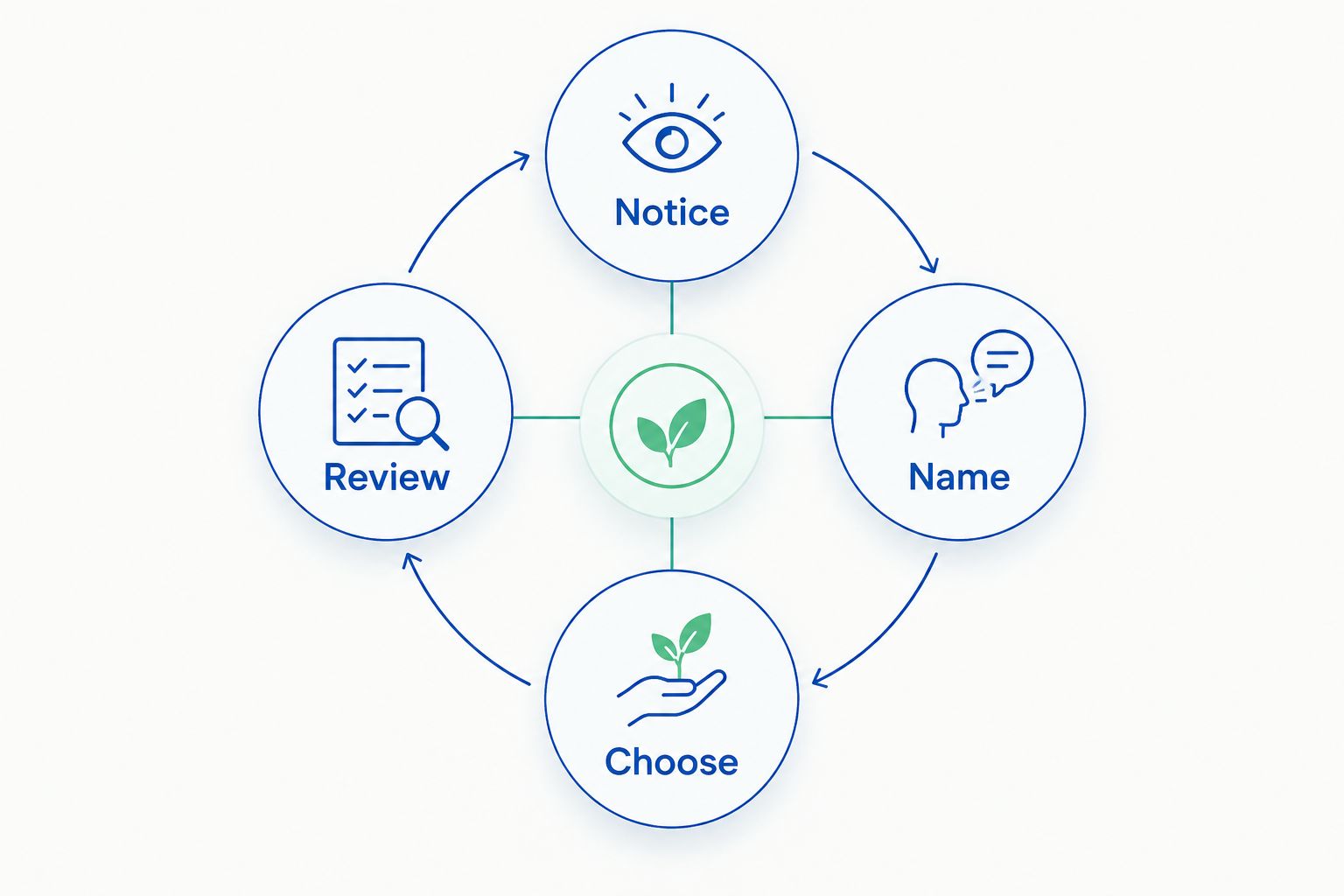
Use the labels Notice, Name, Choose, Review as a simple workshop sequence. This is an exercise structure for the session, not a claim about the model’s official diagram or facets.
- Notice: Describe the familiar situation without judging yourself.
- Name: Put the feeling and need into ordinary words.
- Choose: Write one different sentence or action to try.
- Review: Decide what you will observe afterward.
The sequence keeps attention on a response you can examine. It does not require changing your personality or making every uncomfortable feeling disappear.
Keep witnessing separate from interpreting
If participants choose paired discussion, make listening the task. The listener can repeat the speaker’s own words and ask whether they understood. They should not name the speaker’s shadow, explain their diagram or connect their story to an assumed childhood cause.
Offer a 1-sentence reflection before any question: “I heard that you wanted more space before answering.” The speaker can confirm, correct or decline to continue. Listening does not create permission to advise.
Keep the boundary clear when other approaches enter the conversation. If someone asks about Gestalt therapy for emotional blocks, distinguish that therapeutic topic from spiritual diagram interpretation. This workshop does not establish anyone’s suitability for therapy or equip participants to practise it.
- Ask permission before reflecting back what you heard.
- Use the speaker’s words rather than archetype labels.
- Decline requests to diagnose or explain another participant.
- Stop the exchange when either person wants to pause.
Close with an everyday experiment
Finish with an action rather than a public declaration of transformation. A participant might practise asking for time before agreeing, notice when they interrupt or write down a need before starting a difficult conversation. Each action should come from their own reflection.
Invite people to revisit their diagram as circumstances change. The model includes a cycle of personal development and maturity, but you should not turn that into a ranking of participants. A quieter session does not mean less growth, and a dramatic disclosure does not establish greater maturity.
For your 2026 session notes, record the exercise structure rather than private interpretations. This keeps preparation focused on what you offered, not a file of presumed participant traits.
- Write one action to try in a familiar situation.
- Name the context in which you want to try it.
- Choose whether to keep the reflection entirely private.
- Close with an explicit invitation to stop interpreting for the day.
Compare formats before choosing an exercise
Choose a format according to the permission it requires, not how emotionally intense it appears. These options can complement one another, but none should become a test of willingness to participate. A participant can complete a meaningful reflection without sharing a diagram or speaking publicly.
| Option | Best for | Practical advantage | Key limitation |
|---|---|---|---|
| Private writing | Participants who want control over disclosure | Starts with the person’s own language | Does not provide another perspective |
| Archegram quiz and diagram | Participants who want a structured spiritual framework | Offers a shared visual starting point | Is not a validated diagnostic assessment |
| Paired witnessing | Participants who actively want a listener | Gives space to articulate a reflection | Depends on consent and clear listening boundaries |
| Facilitator-led discussion | Groups clarifying how the model is used | Makes shared questions discussable | Can encourage public labelling if poorly bounded |
Private writing is the best starting format when participants have not yet chosen to share. A diagram adds structure, not authority over their experience. Paired discussion adds another person, not a right to interpret.
In a 2026 facilitator plan, distinguish the activity from its intended purpose. “Participants explore a recurring response” is an appropriate aim; “participants resolve their emotional blocks” promises an outcome this exercise does not establish.
Common mistakes group facilitators make
Treating a diagram as proof
A participant’s diagram does not prove why they avoid conflict, overcommit or seek reassurance. Ask whether an interpretation fits their experience and accept a clear no. Do not treat disagreement as evidence that the interpretation must be especially revealing.
Rewarding the most personal disclosure
Thanking only the most emotionally revealing contributions creates an uneven invitation. Acknowledge careful listening, thoughtful questions and the choice to keep writing private. Never ask someone to disclose more so the group can learn from them.
Turning energies into gender instructions
Do not assign receptivity to women or action to men. In this framework, both are available to anyone. Ask what the situation calls for instead of prescribing how a person should express their gender.
Confusing support with treatment
A spiritual framework does not establish clinical competence. If someone wants to stop, stop the exercise; do not frame their boundary as resistance to growth. Keep the group within its stated educational purpose rather than attempting to process distress publicly.
Using maturity as a status ladder
Do not describe participants as higher, lower, advanced or undeveloped on the basis of a quiz or discussion. Explore changing patterns and developmental needs without ranking people. The useful question is what supports balance now, not who appears most evolved.
FAQ
What are shadow work exercises for group facilitators?
Shadow work exercises for group facilitators are optional reflection activities about overlooked reactions, needs and recurring patterns. In an Archegram-centred session, participants use their own observations and, if they choose, a personal diagram to explore more balanced responses.
Is Archegram a scientifically validated shadow work assessment?
No. Archegram is a spiritual self-regulation and self-understanding framework, not a validated diagnostic assessment. Keep its interpretations distinct from established psychological research and clinical services.
Do participants need to complete the quiz before attending?
No. Participants can begin with private writing about an everyday situation. The free 24-question quiz offers an optional structure for creating a personal visual diagram.
Should everyone share their diagram with the group?
No. Diagram sharing should be optional, with separate permission for any discussion or interpretation. Completing a quiz does not imply consent to disclose its result.
What should I do if someone becomes uncomfortable?
Stop the exercise for that participant and respect their choice to pause or leave. Do not demand an explanation, invite group interpretation or turn the moment into a public lesson.
Can I use these exercises without becoming a therapist?
These exercises are written for educational reflection, not therapy. They do not establish professional competence, replace relevant training or authorise diagnosis or treatment.
How do I keep archetype reflection practical?
Connect the interpretation to one observable response in an ordinary situation. Ask what the participant wants to notice, say or do differently, then leave them free to review whether that experiment was useful.
One last thing
Leave one interpretation unfinished. Ask participants to end their 2026 reflection sheet with: “Something I do not yet understand about this pattern is…” Keeping a question open makes room for observation rather than forcing a neat identity from a complex experience.
Related guides
- Exercises for emotional self-regulation
- Archetype diagrams for life coaches
- Self-discovery questions to ask yourself
