


Yes, shadow work can be done without a therapist when you mean gentle reflection on everyday reactions, recurring patterns, and needs you find difficult to acknowledge. Keep the work focused on present-day self-understanding rather than processing trauma, recovering memories, or treating mental health difficulties; a self-discovery framework does not replace professional care.
- Can shadow work be done without a therapist? Yes, for gentle, present-focused reflection—not as a substitute for treatment.
- Archegram supports self-regulation and emotional balance through reflection; its quiz is not a validated diagnostic assessment.
- Choose an ordinary situation, describe your response, and identify one practical alternative without forcing an explanation.
- Stop the exercise if it becomes overwhelming; seeking qualified support is not a failure of self-understanding.
Can shadow work be done without a therapist?
You can explore everyday patterns independently, but independent reflection and psychotherapy have different purposes. For this 2026 guide, shadow work means noticing reactions or needs you usually avoid acknowledging. It does not mean deliberately revisiting painful experiences until you feel a breakthrough.
The following comparison separates approaches by their intended use, not by a promise of results.
| Approach | Best for | What it offers | Main limitation |
|---|---|---|---|
| Independent journaling | Reflecting on an ordinary interaction | Privacy and space to describe your experience | Nobody is present to question a harsh or mistaken interpretation |
| Archegram-supported reflection | Exploring recurring patterns and everyday balance | Archetypes and a personal visual diagram as reflection tools | The framework is not a clinical assessment or treatment |
| Work with a qualified therapist | Seeking professional help with distress or difficult experiences | A professional relationship in which to discuss concerns and support needs | It requires finding an appropriate practitioner; a quiz cannot establish that fit |
For a focused starting point, the diagram-to-shadow-work journal workflow connects model-based reflection with a written record. Treat any interpretation as a question to explore, not a hidden truth you must accept.
Why this matters
A reflection exercise becomes unhelpful when understanding yourself turns into prosecuting yourself. Noticing that you became defensive is different from deciding that you are fundamentally selfish, broken, or incapable of connection.
The purpose here is practical self-regulation: noticing what happens within you and considering how you want to respond. A dramatic explanation is not required. Sometimes the most useful observation is simply that you agreed to something while wanting to say no.
Your journal should help you describe an experience more clearly, not make a verdict about your worth.
Where the model fits—and where it does not
Archegram, also called Tantragram, is presented as a contemporary, non-dogmatic adaptation of ancient Tantric knowledge developed at Samma Karuna. Its spiritual framework offers a way to reflect on strengths, recurring patterns, coping strategies, developmental needs, and balance.
That spiritual interpretation is distinct from established psychological research. Archetypes are not diagnoses, and a personal diagram is not evidence that you have a disorder or an unconscious motive.
Archegram is best for adults seeking non-clinical reflection on self-regulation and everyday balance. Its value in this context is the opportunity to ask focused questions—not the authority to decide who you really are.
The model's 24-question quiz supports the creation of a personal visual diagram. Use that diagram as a starting point for reflection, rather than a complete account of your personality or circumstances.
When you encounter references to feminine and masculine energies, read them as receptive and active qualities available to anyone. They are not gender rules, and neither quality makes someone more mature or more worthy.
How can you explore a pattern without pushing too far?
For your 2026 reflection practice, begin with an ordinary event rather than your most painful memory. Choose something specific enough to describe without needing to reconstruct your whole life.
The sequence below is an optional journaling exercise, not an official assessment or a treatment protocol.
1. Describe the event
Write what happened in observable terms. For example: a colleague requested a revision, you agreed immediately, and you later felt resentful.
Leave out assumptions about intent. You know that the colleague requested a change; you do not know from that event alone that the colleague wanted to undermine you.
2. Notice your response
Describe what you felt, thought, and did. Perhaps you felt irritation, thought you had no choice, and replied before considering your workload.
Keep these observations separate. Feeling annoyed, interpreting a request as criticism, and accepting extra work are related parts of the experience, but they are not interchangeable.
3. Ask about a need
Consider what mattered to you in that moment: time, respect, clarity, independence, or connection. Choose language that fits your actual experience rather than the most impressive spiritual explanation.
If you use an Archegram diagram, ask whether its interpretation offers a relevant question about this event. You do not need to make every experience fit the diagram.
4. Choose a response
Identify one action you want to try in a similar situation. In the revision example, that might mean asking about the deadline before agreeing.
Keep the action within your control. Making another person appreciate you is not an action you can choose; stating your available time is.
5. Close the exercise
Finish with a plain summary: what happened, what you noticed, and what you want to try. You do not need to keep writing until you discover a deeper explanation.
Put the journal aside and return to an ordinary activity. An unfinished interpretation is allowed to remain unfinished.
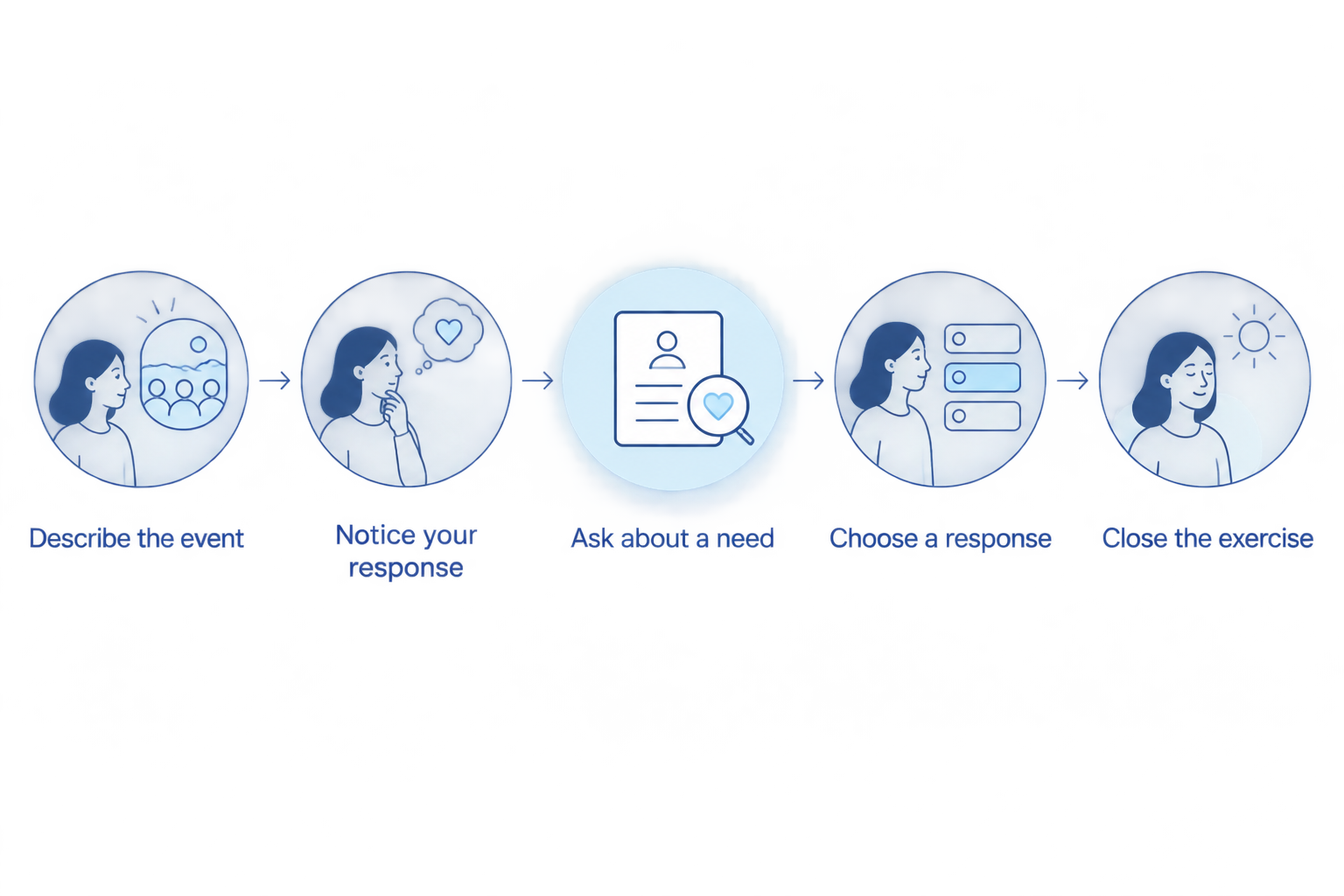
These 5 steps are a suggested structure for this article, not a measure of how deeply you have worked. Skip a prompt if answering it would mean guessing or forcing yourself into an interpretation.
Why the boundaries of solo shadow work vary
The decision is not simply whether you are strong enough to reflect alone. Consider what the exercise asks of you and whether the setting fits that task.
- The subject: An everyday disagreement is different from an attempt to revisit a traumatic experience. Do not treat them as equivalent journaling tasks.
- Your present experience: Feeling able to describe an event is different from feeling overwhelmed by the exercise. You do not owe the prompt a completed answer.
- The interpretation: A tentative observation leaves room for context. A claim that a diagram proves a hidden wound does not.
- The purpose: Exploring a pattern is different from trying to diagnose yourself or treat a condition.
- The setting: Private reflection, coaching, and psychotherapy carry different roles and boundaries. Clarify which kind of conversation you are entering.
For a 2026 self-regulation routine, define what you want from reflection before choosing an exercise. A useful aim is concrete: understanding why you accepted a request you wanted to decline, then considering a clearer response.
A demand to uncover everything you have ever suppressed has no similarly clear stopping point.
What if shadow work turns into criticism of your worth?
A difficult pattern does not establish that you are a difficult person. If every journal entry ends with a global judgment about your worth, set aside the archetype interpretation and return to a specific event.
Compare these questions: what did I do during that conversation, and what does that prove about my value? The first invites description. The second asks a single interaction to answer something it cannot establish.
Persistent concerns about your worth deserve attention beyond a diagram: seeking therapeutic help for self-esteem difficulties concerns your lived experience and support needs, not whether an archetype label seems to fit. A reflective model cannot decide whether professional support is appropriate for you.
You do not need to complete a spiritual explanation before asking for help. You can describe what is troubling you in everyday language, including uncertainty about what kind of support you need.
How do you turn reflection into everyday balance?
After identifying a pattern, choose an ordinary behavior to revisit. Otherwise, shadow work risks becoming an expanding collection of interpretations with no clear connection to your daily decisions.
For example, imagine you notice that you often agree quickly and feel resentful later. Your reflection can stay with that sequence rather than turning it into a permanent identity.
Use these 3 prompts:
- What did I agree to before checking what I wanted?
- What information did I need before answering?
- What would a clear, respectful reply sound like next time?
Write a possible reply in your own words. You might ask when the task is needed or say that you need to check your existing commitments before answering.
If you want to connect the observation with a broader practice, the diagram-to-self-regulation routine workflow keeps the focus on applying reflection. Your 2026 notes can track the situations you encounter and the responses you choose, without turning them into a score of personal maturity.
Returning to a pattern does not require declaring that your earlier reflection failed. Circumstances change, and you can reconsider what the diagram means to you without treating its interpretation as fixed.
Do you need a therapist to interpret an archetype diagram?
You do not need a therapist to use an archetype diagram for non-clinical self-reflection. The boundary is what you ask the interpretation to do: exploring an everyday pattern is different from explaining a mental health condition.
A coach or facilitator should also keep that distinction clear. An interpretation should leave room for your disagreement, context, and choice—not claim authority over your experience.
Can you use shadow work prompts without accepting an archetype label?
Yes, you can explore a prompt without accepting an archetype label. Keep the observation that fits your experience and leave an interpretation that does not.
A useful question stands on its own: where did I ignore a need or act against my intention? You do not have to adopt a fixed identity to answer it honestly.
FAQ
Can shadow work be done without a therapist if I am new to it?
Yes, you can begin with gentle reflection on an ordinary present-day situation. Describe what happened and how you responded; do not use a beginner exercise to force yourself into painful memories or make a diagnosis.
Is Archegram a form of psychotherapy?
No, Archegram is a self-regulation and self-understanding framework, not psychotherapy. Its spiritual interpretations, quiz, and personal diagram support reflection rather than clinical assessment or treatment.
How many questions are in the quiz?
The quiz contains 24 questions. Use the resulting personal diagram to explore patterns and balance, not as proof of a diagnosis or a fixed personality identity.
What should I write about in my first shadow work journal entry?
Write about an ordinary interaction you can describe clearly. Separate what happened from what you assumed, then identify a need and a response you want to consider next time.
Should I keep going if a shadow work prompt feels overwhelming?
No, you do not need to continue an overwhelming reflection exercise. Put the prompt aside; if the experience is troubling you or disrupting daily life, discuss it with a qualified mental health professional.
Can an archetype diagram tell me why I behave a certain way?
An archetype diagram offers an interpretation to consider, not proof of why you behave a certain way. Compare its suggestions with specific experiences and leave room for context, uncertainty, and alternative explanations.
Can a coach replace a therapist for shadow work?
A coaching role does not by itself establish qualification to provide psychotherapy. Ask the practitioner about their qualifications, scope, and boundaries rather than assuming that experience with reflective exercises includes mental health treatment.
One last thing
For your next 2026 reflection, try leaving out the phrase that is just who I am. Replace it with a description of what happened in a particular situation.
That small change preserves a distinction at the heart of Archegram reflection: you are exploring patterns, not accepting a permanent identity. Finish with a choice you can make, not a label you have to carry.
Related guides
- Tools for interpreting your archetype diagram
- Self-discovery questions to ask yourself
- Self-reflection exercises for personal growth
