


Instead of starting a blank page whenever the same emotional pattern returns, turn one observation from your Archegram diagram into a shadow work journal entry: record the situation, question your interpretation and choose a response to practise. This 2026 workflow connects the model with everyday self-regulation, without treating your diagram as a diagnosis or your journal as treatment.
- An Archegram diagram shadow work journal works best when one diagram observation leads to one practical response.
- Use archetypes as flexible reflection tools, not fixed identities or proof of hidden motives.
- Separate observable events from interpretations before exploring a recurring emotional pattern.
- Review your entries for everyday self-regulation, not evidence that a diagram defines you.
Why this matters
A diagram gives you material for reflection; a journal connects that material to something that happened. The useful question is not simply which archetype appears prominent, but what you want to understand about your responses in daily life.
Archegram is best for adults seeking a spiritual self-regulation framework for reflecting on everyday patterns. Also called Tantragram, it is a contemporary, non-dogmatic adaptation of ancient Tantric knowledge developed at Samma Karuna. Its spiritual interpretations are distinct from established psychological research.
Here, shadow work means reflecting on reactions, needs or qualities you find difficult to acknowledge. That is a working definition for this exercise, not a clinical procedure. You do not need to uncover a hidden explanation for everything you feel.
Use the diagram to form questions, not conclusions. An entry is useful when it makes a situation clearer and gives you a response you can actually try.
Before you start
- Have your personal diagram and its accompanying explanations. If you have not created one, the free 24-question quiz is a starting point. The quiz-to-first-diagram workflow covers that earlier stage.
- Choose a private journal and an ordinary situation. Start with a manageable event, such as agreeing to a request you wanted to decline. Set aside 5 minutes as an optional writing boundary, not a performance target.
- Check the interpretation before using it. Do not assume that a larger, smaller or otherwise noticeable part of your diagram means something negative. Use the model's accompanying explanation, and keep anything you do not understand as a question.
The instructions below use headings you create yourself. They are not website buttons, software fields or an automated connection. No separate journaling account or integration is required.
Your diagram reference
Create a working record
- Start a journal page with the heading Diagram reference. Add the date of the diagram you are using; for a diagram created in 2026, record its actual 2026 date rather than guessing when you completed it.
- Write down one archetype or facet that you want to understand. Copy its name accurately from your result rather than creating a new label.
- Under Model explanation, summarise the accompanying description in your own words. Keep this separate from what you think it means about your life.
- Under My question, turn your interest into an open question. For example: When do I keep helping after I want to stop?
Your question should leave room for disagreement with your first impression. Replace Why am I always controlling? with What happened when I wanted to decide how everyone should proceed? The second version names a behaviour without making it your identity.
Expected result: you have a dated reference, one accurately named part of the diagram and one question that an everyday experience can help you explore.
Keep the model and your interpretation separate
A diagram interpretation and a lived observation are different kinds of material. Your journal should make that distinction visible throughout this 2026 practice.
For example, I associate this description with difficulty accepting help is your interpretation. I declined help with the task on Tuesday describes an event. Neither statement proves the other, and a single event does not establish a recurring pattern.
If your interpretation becomes complicated, return to the original explanation. You do not need a complete theory of yourself before writing a useful entry.
Your journal template
Set up an event-to-response sequence
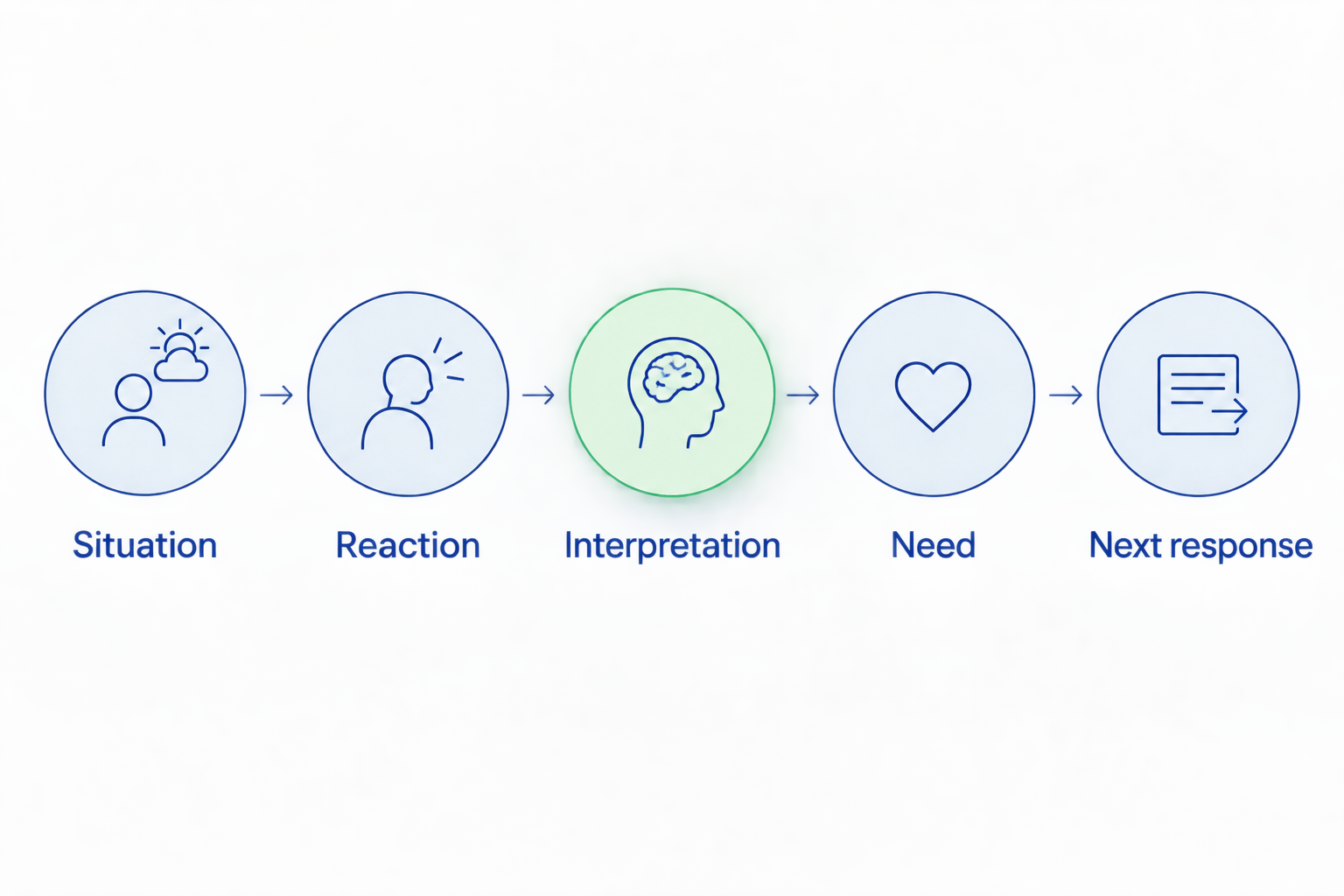
Create these headings beneath your diagram reference. Keep the same sequence when you reuse the template, so reviewing entries does not require reconstructing your thinking.
- Situation: Describe what another person could have observed. Include the request, conversation or action without assigning motives.
- Reaction: Name the feeling and immediate response you noticed. Write I felt annoyed and agreed anyway, rather than I reacted badly.
- Interpretation: Record the meaning you gave the event. Mark assumptions clearly: I assumed declining would disappoint them.
- Need: Ask what mattered to you. Possible answers include rest, clarity, belonging or having a choice; none is a required interpretation of an archetype.
- Next response: Choose something specific you can say or do in a similar situation.
Expected result: the page separates what happened, what you felt, what you assumed and what you want to practise. Your diagram question gives the entry a focus without supplying its answer.
Add a boundary to the entry
Write a closing line: What remains uncertain? This prevents an unfinished question from becoming a confident statement about your character or someone else's intentions.
For example: I do not know whether they would have minded if I had declined. That uncertainty belongs in the record. Shadow work does not require turning every uncomfortable moment into evidence of a concealed flaw.
Your first reflection and review
Complete a manageable example
- Choose one recent event connected to your diagram question. Do not begin with the most painful experience you can remember.
- Fill in Situation and Reaction before consulting the diagram again. This keeps the description anchored in your experience.
- Complete Interpretation and Need using tentative, specific language where the meaning is uncertain.
- Write one Next response you could realistically attempt. Keep it within your control, rather than requiring another person to change.
- Close with What remains uncertain? Stop there instead of searching for a deeper explanation simply because space remains.
A completed example might read:
- Situation: A friend asked me to organise another gathering. I agreed before checking my commitments.
- Reaction: I felt pleased to be included, then resentful about the work.
- Interpretation: I assumed saying no would make me less welcome.
- Need: I wanted connection and a choice about how much responsibility to accept.
- Next response: I will say, Let me check what I can take on before I answer.
- What remains uncertain? I have not asked whether someone else could organise it.
This is an illustrative entry, not an official interpretation of a named archetype. Its purpose is to show how a question becomes a practical response.
Expected result: you finish with something to try, not a verdict about who you are.
Review what happened next
Choose an optional review point, such as 7 days after starting. Review the entry even if no similar situation occurred; no opportunity yet is a complete observation.
Ask whether you remembered the planned response, whether you used it and what actually followed. If you did something different, describe it without grading yourself. A missed attempt is material for a clearer next step, not proof that the diagram predicted your behaviour.
For your 2026 journal, retain the original entry and add a dated review underneath. Do not rewrite the first account to make it match what you understand later.
Expected result: you can distinguish an intention from an attempted response and an observed outcome.
A second workflow: when your diagram changes
An event-led entry begins with a lived situation. A diagram-led review begins when you revisit your result and notice something you want to understand. Both belong in an Archegram self-regulation practice, but they answer different questions.
| Workflow | Best for | Advantage | Limitation |
|---|---|---|---|
| Event-led entry | Understanding a specific everyday reaction | Starts with observable details | One event cannot establish a recurring pattern |
| Diagram-led review | Revisiting questions when circumstances change | Keeps reflection connected to the model | A changed result does not explain why something changed |
To use the second workflow:
- Create a fresh Diagram reference with its actual date.
- Describe what appears different without calling it improvement or decline.
- Note relevant changes in your circumstances, while keeping possible explanations separate from facts.
- Choose one question to explore through future event-led entries.
Keep earlier diagrams rather than replacing them. The useful comparison is between questions and lived examples, not a ranking of your past and present selves.
Expected result: a revised question for reflection, with no assumption that a different diagram proves personal growth or loss of balance.
Troubleshooting your journal practice
Every entry turns into self-criticism
Replace character judgments with actions. I am selfish becomes I declined a request and felt guilty afterwards. Return to the diagram's explanation only after you have described what happened.
When an entry concerns resentment, journal prompts for forgiveness and healing belong alongside questions about responsibility and boundaries, not instead of them. You do not have to forgive someone, resume contact or find a positive meaning to complete this reflection.
You cannot connect an event to an archetype
Leave the connection unresolved. Record the event under your existing question, or set it aside if it does not fit. Forcing every experience into the diagram makes the journal less faithful to your life.
You keep writing but never choose a response
Shorten Interpretation and complete Next response before adding more explanation. Choose a small action: asking for clarification, checking your commitments or stating that you need time to answer.
Understanding and action are separate tasks. A longer explanation is not automatically a more useful one.
Writing becomes overwhelming
Stop the exercise. You do not need to finish an entry, revisit distressing memories or search for an origin story. Set the journal aside and choose whether to return to a simpler, ordinary event another time.
This spiritual reflection practice is not a substitute for professional care. Do not use the diagram to diagnose distress or decide what treatment someone needs.
Customize your workflow
Keep the same observation-to-response structure while changing the question. A question about accepting help, for example, can later become a question about asking clearly for what you need. There is no requirement to work through every part of the diagram.
For a clearer distinction between a diagram description and your personal reading, continue with tools for interpreting your archetype diagram. Bring one specific uncertainty rather than searching for a total explanation of yourself.
If you share an entry with a coach or facilitator, choose what to disclose and what to keep private. Ask the other person to help you examine your interpretation, not assign an identity or reveal a supposedly hidden truth about you.
Keep this 2026 workflow revisable. Your circumstances can change, and the question that matters now does not have to remain your central question indefinitely.
FAQ
How do I turn an Archegram diagram into a shadow work journal?
Choose one diagram observation, turn it into an open question and examine one everyday event. Separate the situation, reaction, interpretation and need before choosing a response to practise.
Is this journal workflow an official interpretation of every archetype?
No. This is a suggested reflection workflow, not a complete interpretation system. Use the explanations accompanying your diagram for the meaning of its named archetypes and facets.
Do I need to understand my whole diagram before starting?
No. Start with one part whose accompanying explanation you understand. Keep unclear elements as questions rather than assigning them meanings.
How often should I write a shadow work journal entry?
Use the journal when you have a manageable event to explore; daily writing is not required by this workflow. Choose a review rhythm that fits your life rather than treating frequency as evidence of progress.
Does a changed diagram mean my emotional balance has improved?
A changed diagram does not by itself establish improved emotional balance. Compare your questions and lived examples without treating a difference as proof of progress or decline.
Can a coach interpret my journal for me?
You can invite a coach to help you explore questions, while retaining authority over what you share and how you describe your experience. The diagram should not be used to diagnose you or impose a fixed identity.
Is shadow work journaling a form of mental health treatment?
This workflow is spiritual self-reflection, not mental health treatment. The quiz is not a validated diagnostic assessment, and neither a diagram nor a journal establishes a diagnosis.
One last thing
Before interpreting an uncomfortable reaction as something you need to change, ask whether your situation needs a practical change instead. Agreeing to more work than you want is not only material for inner reflection; it is also an opportunity to answer a request differently.
The journal does not need to explain your whole self. It needs to help you meet one real situation with more choice.
Related guides
