


Corporate team-building archetype quizzes are reflection activities aimed at helping colleagues understand recurring reactions and choose more balanced responses at work. This guide explains how to use the Archegram self-regulation model for that purpose without turning personal insights into employee labels, compulsory disclosures or performance scores.
- Archegram is best for voluntary team reflection on self-regulation, not employee assessment.
- Use an archetype quiz for team building to explore responses, not assign workplace identities.
- Keep quiz results private; invite colleagues to share practical communication preferences instead.
- Turn personal insight into a working agreement, then review whether colleagues actually use it.
Why this matters for corporate teams
At work, a reflection exercise sits inside a reporting structure. A manager's invitation can feel like an instruction, and a personal disclosure can travel beyond the room. Make participation optional and keep individual results outside performance discussions.
The Archegram self-regulation model offers archetypes, a personal visual diagram and a 24-question quiz as resources for self-understanding. Its purpose here is to support reflection on patterns, strengths and developmental needs—not to measure job suitability or establish a definitive personality type.
For a 2026 team session, define success as a practical agreement colleagues choose to try. A completed quiz is an activity; an agreed way to pause a tense conversation gives the activity a workplace purpose.
Why an archetype quiz matters for corporate team-building
Team members can discuss the same disagreement from very different starting points. One person wants immediate action; another wants time to reflect. A useful session makes room for both without declaring either person the problem.
Archetypes give participants an optional language for exploring those responses. Within this model, they are flexible reflection tools, not permanent identities. The useful question is not which archetype someone is, but which response they recognise in a particular situation and what they want to practise instead.
Corporate teams also need boundaries that a private self-discovery exercise does not:
- Colleagues need a genuine way to decline without explaining why.
- Managers need to separate personal reflection from appraisal.
- Facilitators need to distinguish spiritual interpretation from psychological evidence.
- Everyone needs control over what they share and what gets recorded.
Use the model to open a conversation, not settle an argument about somebody's character. If your objective is selection, promotion or diagnosis, this reflective exercise does not answer that need.
How to run a grounded team reflection session
1. Define a workplace purpose before choosing a quiz
Start with a conversation rather than a questionnaire. Ask the team to name a recurring work situation they want to handle more thoughtfully: rushed handovers, interrupted meetings or disagreements about decisions. Choose a situation people can discuss without disclosing their personal history.
For your 2026 session brief, write an observable aim such as agreeing how to request thinking time during a difficult discussion. Avoid goals such as revealing everyone's true nature. The first gives participants something to practise; the second asks a reflection tool to establish facts it cannot establish.
- Choose a familiar work situation, not a colleague to analyse.
- Write the purpose in everyday language.
- Explain what the session will not assess.
- Offer a discussion-only alternative to taking a quiz.
- Ask participants what would make the activity useful.
2. Agree on consent and privacy before collecting answers
Begin with a spoken agreement and a short written version. Participants should know whether anything will be recorded, who can see it and whether they can withdraw from an activity. Do not promise confidentiality you cannot enforce across a workplace.
You can run this preparation without any tool. Invite each person to consider a workplace example privately, then let them choose whether to share it. Keep participation decisions and individual reflections out of personnel records; record only the working agreements the group explicitly approves.
A manager should accept a refusal without asking for a personal explanation. Offering an alternative activity makes that choice concrete rather than ceremonial.
- State that taking the quiz is optional.
- Allow participants to pass on any question or discussion.
- Do not collect screenshots or individual diagrams.
- Keep personal interpretations out of appraisal notes.
- Agree which shared actions can appear in meeting notes.
3. Introduce the model without turning it into a test of ability
Before using a quiz, offer a simple written prompt: describe what happened, how you responded and what you needed. That gives everyone a way into reflection without adopting a spiritual framework.
For participants who want more structure, the Archegram self-regulation model offers a 24-question quiz and personal visual diagram. These provide a starting point instead of asking someone to invent their own reflection format. They do not replace the participant's judgement about what fits.
Also called Tantragram, the model is a contemporary, non-dogmatic adaptation of ancient Tantric knowledge. Present that spiritual foundation openly. Do not describe the quiz as a validated diagnostic assessment or equate its interpretations with established psychological research.
Explain any unfamiliar term before discussing a diagram. If receptive and active energies arise, describe them as capacities available to anyone—not expectations attached to gender. For further reading, use the guide to interpreting your archetype diagram.
- Explain that archetypes are flexible reflection tools.
- Let participants disagree with an interpretation.
- Keep individual diagrams in participants' own hands.
- Separate spiritual interpretation from evidence claims.
- Avoid assigning archetypes to absent colleagues.
4. Translate a personal pattern into a different response
Work with an ordinary example before inviting personal sharing. Someone receives an unexpected deadline, agrees immediately, then feels frustrated. The exercise is to explore that sequence, not diagnose why the person behaves that way.
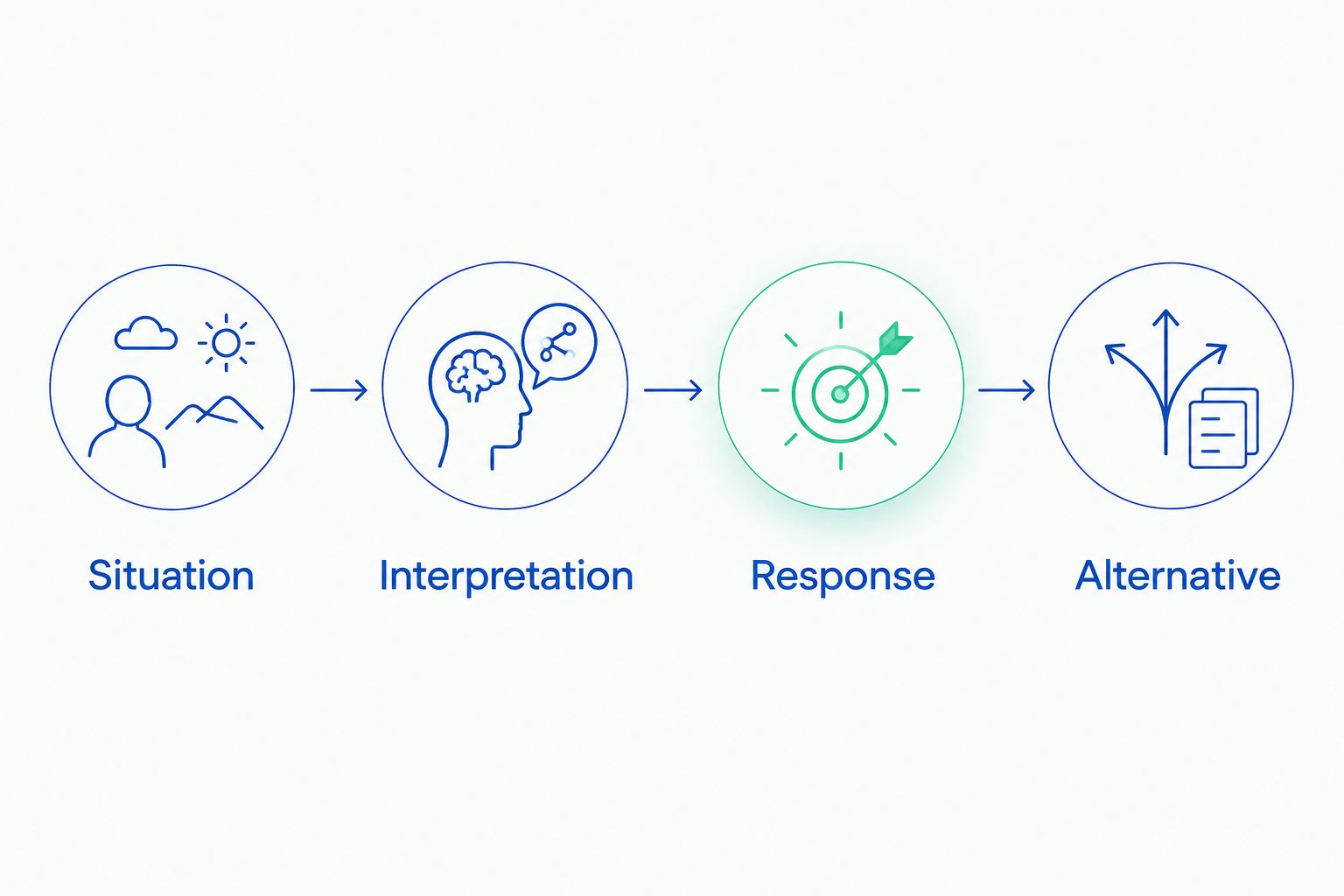
Offer 5 minutes of private writing. Ask participants to distinguish the situation, their interpretation, their response and an alternative they would like to try. This is a suggested workshop exercise, not an official diagram-scoring method.
A useful alternative stays specific: asking which task should move before accepting another deadline. Telling someone to become more balanced gives them no clear next action.
- Situation: Describe the event without judging another person.
- Interpretation: Write the meaning you gave the event.
- Response: Notice what you did or wanted to do.
- Alternative: Choose a response you are willing to practise.
5. Share practical preferences instead of revealing personal profiles
Bring the discussion back to work. Participants can share a useful request without naming an archetype, displaying a diagram or explaining a private experience. That keeps the model connected to self-regulation while respecting personal boundaries.
For example, a participant might ask for the decision question in writing before a meeting. Another might request a clear moment to raise concerns before the group commits. These are proposed working preferences, not evidence that one colleague belongs to a fixed type.
Ask what the team can reasonably accommodate. Reflection should not require colleagues to accept harmful conduct or remove ordinary accountability.
- Invite requests about communication, not personal confessions.
- Ask permission before responding to someone's reflection.
- Describe behaviour rather than assigning a character label.
- Keep feedback tied to a specific workplace situation.
- Allow participants to share a preference without explaining its origin.
6. Turn reflection into a small working agreement
Close the main activity by choosing something the team can actually do. A short agreement about raising concerns is more usable than a wall of archetype descriptions.
For a 30-minute introductory session, reserve time for this decision rather than trying to interpret every diagram together. Individual interpretation deserves space and consent; a group meeting does not need access to everyone's inner life to produce a useful agreement.
In your 2026 working agreement, state the situation, the action and how colleagues can request a change. Keep the wording neutral so people who declined the quiz can still participate fully.
- Choose a behaviour the team controls.
- Write when the agreement applies.
- Specify how someone can request a pause.
- Make space for disagreement without personal analysis.
- Record the shared action, not individual quiz results.
7. Review the agreement without grading personal growth
Arrange a 15-minute follow-up to discuss the agreement. Ask whether people used it, where it was unclear and what needs changing. Do not ask managers to score colleagues' emotional maturity.
Returning to the model can support fresh reflection as circumstances change. A person's earlier diagram is not a permanent workplace identity, and a new interpretation does not require public explanation.
Keep your 2026 review focused on the team's practice. If the activity felt intrusive or unhelpful, change the format rather than treating reluctance as a personal failing.
- Ask whether the agreed behaviour happened.
- Invite feedback on the session's boundaries.
- Revise an agreement that does not fit the work.
- Let people reflect privately without retaking a quiz.
- Stop using labels that colleagues find restrictive.
Compare formats before choosing your session
The best format depends on whether colleagues want a spiritual reflection framework at all. A quiz is optional; a clear purpose and respectful facilitation are not. The table compares session formats, not competing assessments of employee capability.
| Option | Best for | What it offers | Key limitation |
|---|---|---|---|
| Private written reflection | Teams beginning with a sensitive topic | Participants choose their own language and retain their notes | Provides little shared structure unless prompts are clear |
| Archegram quiz and personal diagram | Willing adults seeking structured, spiritually grounded self-reflection | A 24-question starting point for exploring recurring patterns and balance | Not an employee assessment; its spiritual framing will not suit everyone |
| Facilitated workplace discussion | Teams that want to focus directly on communication | Connects a real work situation to a shared agreement | Requires careful boundaries to prevent blame or unwanted disclosure |
| Individual reflection followed by an optional conversation | Groups with different comfort levels about sharing | Separates personal exploration from workplace participation | Leaves less material for group discussion, which the facilitator must accept |
You can combine private reflection with a workplace conversation without asking everyone to complete the same exercise. The shared outcome is the agreement, not matching participation or identical beliefs.
Common mistakes corporate teams make
Treating a diagram as a hiring or promotion signal
A personal reflection diagram does not establish job suitability. Keep this exercise separate from selection, promotion and performance decisions; otherwise colleagues are being asked to disclose personal material under evaluative pressure.
Letting the manager interpret everybody else
A manager's interpretation carries workplace authority even when presented casually. Let participants describe what resonates for them, and stop discussion that turns a colleague's diagram into a group verdict.
Replacing a work problem with an archetype explanation
An unclear brief remains an unclear brief. Before exploring anyone's patterns, check the practical issue: responsibilities, conflicting instructions or an unresolved decision. Self-regulation is not a reason to ignore working conditions.
Assigning gender roles to receptive and active energies
Within the model, receptive and active energies are available to anyone. Do not use these terms to decide who should lead, support, listen or take responsibility in a team.
Asking colleagues to predict relationship compatibility
Use relationship reflection to discuss possible dynamics and conflicts, not to predict who will work well together. Assigning projects by supposed archetype compatibility turns an exploratory framework into an unsupported staffing rule.
FAQ
What’s the best way to use an archetype quiz for team building?
Use an archetype quiz for team building as an optional starting point for discussing responses and communication preferences. Keep results private and finish with a practical agreement rather than a set of employee labels.
Is Archegram a scientifically validated workplace assessment?
Archegram should not be presented as a scientifically validated workplace assessment. It is a spiritually grounded self-regulation and self-understanding model, not a tool for diagnosis or employee evaluation.
Can employees join the session without taking the quiz?
Yes, employees can join through private reflection or a discussion of workplace preferences. Offer these alternatives from the start so declining the quiz does not exclude anyone from the team’s working agreement.
Should a manager collect everyone’s archetype diagram?
No, this team-building format does not require managers to collect individual diagrams. Participants can keep their results private and share only the requests or observations they choose.
How long should an introductory team session last?
A suggested starting format is a 30-minute discussion focused on a familiar work situation and a shared agreement. This is a planning suggestion, not an official course duration or a promise that every group will finish within it.
Can archetypes explain why two colleagues keep disagreeing?
Archetypes can provide a reflection language, but they do not establish the cause of a workplace disagreement. Discuss the actual behaviour, expectations and working conditions before considering personal interpretations.
What should a team do after the workshop?
Review the behaviour the team agreed to practise, not anyone’s personal growth score. Ask whether the agreement was used and revise it with the people expected to follow it.
One last thing
The most useful outcome does not require anyone to reveal an archetype. A colleague can keep a diagram entirely private and still ask for a clearer deadline, a pause before responding or a different way to raise concerns.
That is the boundary to carry into an Archegram session: personal insight belongs to the person; shared agreements belong to the team. Keep both connected without confusing them.
Related guides
- Exercises for emotional self-regulation
- Archetype diagrams for life coaches
- Self-discovery questions to ask yourself
