


Instead of trying to remember what your diagram means whenever you feel stretched, turn it into a daily check-in: notice one recurring pattern, choose one balancing action, and record what happened. This 2026 workflow connects your Archegram diagram to everyday self-regulation without treating its spiritual interpretations as a diagnosis.
- An Archegram diagram energy balance practice turns reflection into one concrete action, not a daily personality verdict.
- Use receptive and active energies as reflection prompts available to anyone, never as gender rules.
- Keep your diagram as context; use today’s circumstances to choose your response.
- Review everyday examples rather than treating quiz results as evidence of psychological change.
Why this matters
A personal diagram offers a starting point for reflection. The practical question is what you do differently when you notice yourself repeating a familiar response: agreeing before checking your capacity, postponing an uncomfortable conversation, or continuing a task when you need to stop.
Archegram is best for adults seeking a spiritual self-regulation model for reflection, not clinical assessment. Its archetypes are flexible ways to explore patterns, strengths and developmental needs—not identities you must live up to. You can explore the free 24-question quiz through Archegram.
In this guide, energy balance means reflecting on how you direct your attention and effort, including receptive and active responses. It does not mean measuring a physical energy field. The model, also called Tantragram, is a contemporary, non-dogmatic adaptation of ancient Tantric knowledge; keep that spiritual context distinct from established psychological research.
Before you start
- Have your personal diagram and its accompanying explanations available. Use the descriptions supplied with your results rather than guessing what a shape, position or relative prominence means.
- Prepare a private notebook or document. The headings below are suggested journal labels, not buttons or settings on the website. Start with a suggested 2-minute check-in; no additional tracking account is needed.
- Keep interpretation separate from observation. A prominent feature is not automatically a strength, and a less prominent feature is not automatically a deficiency. Do not turn visual differences into a goal of making every part equal.
The workflow below is an optional reflection exercise, not an official scoring method. You do not need to settle the meaning of your whole diagram before beginning.
Your diagram reference
- Keep the original. Retain a private copy of your diagram and the explanations you received with it. Date your reference so you can distinguish it from later reflections.
- Select one pattern. Choose an archetype description or feature that connects with a specific recent situation. Start with something familiar and manageable rather than your most painful experience.
- Separate description from interpretation. Under Diagram description, copy the relevant wording accurately. Under My interpretation, write what you think it means in your life.
- Add an everyday example. Under What happened, describe an action someone could have observed: you accepted another task, delayed replying, or interrupted before hearing the whole request.
Expected result: you have a short reference connecting one model description to one real event, with your interpretation clearly marked as your own.
For example, a practice note dated 6 May 2026 might say: I agreed to help before checking what I had already committed to. That observation is more useful than a fixed label such as I am always the accommodating person. It gives you something specific to revisit.
If the diagram itself remains unclear, begin with tools for interpreting your archetype diagram. Do not invent a meaning just to complete this exercise.
Your daily check-in
- Choose a familiar cue. Attach the reflection to an ordinary transition, such as finishing breakfast or beginning your working day. Choose a cue you can recognize without adding a complicated routine.
- Describe the present situation. Under Situation, record what is happening now. Keep facts separate from predictions about what someone else thinks.
- Name your experience. Under Feeling and impulse, describe the emotion you notice and what you want to do next. Plain language is enough: frustrated, uncertain, eager to explain, or ready to withdraw.
- Connect carefully. Under Possible pattern, note whether this resembles the diagram description you selected. If it does not, leave the connection open rather than forcing a match.
Expected result: you can distinguish the event, your experience of it, and a possible interpretation through the model.
A check-in is not a requirement to feel peaceful. You can feel irritated and still choose a considered response. Equally, you can feel enthusiastic and decide that accepting another commitment would stretch you too far.
On 7 May 2026, for instance, your note might describe a different response to the same kind of request. Record the difference without deciding that either day reveals your permanent character. The purpose is to notice context, not establish a personality verdict.
Your balancing action
- Ask what the situation needs. Consider whether you need more receptivity, more action, or simply more information. Receptivity here means making room to listen and notice; action means making a choice or taking a clear step.
- Choose one observable action. Write something you can actually do, such as asking for time to consider a request, stating a limit, or listening without immediately offering a solution.
- Check the action against reality. Consider your responsibilities, safety and the other person's boundaries. A symbolic interpretation is not a reason to ignore practical consequences.
- Set a review point. Return to the note after the relevant conversation or task. A suggested 1-minute review is enough to record what you tried and what followed.
Expected result: your reflection produces a specific next step rather than another label about yourself.
Choose the response the situation calls for—not the opposite of your usual response simply for the sake of balance. Listening is not always better than speaking, and taking action is not always better than waiting.
These are illustrative choices, not prescribed meanings for particular archetypes:
| Practice choice | Best for | Practical advantage | Limitation |
|---|---|---|---|
| Receptive pause | Understanding a request before responding | Creates room to hear details and notice your reaction | Becomes avoidance if you never return to the decision |
| Active step | Following through after reflection | Turns an intention into a visible action | Becomes rushed if you skip relevant information |
| Combined response | Situations needing listening and a boundary | Allows you to acknowledge someone and state your capacity | Requires clarity about what you can genuinely offer |
For a combined response, you might acknowledge a request, ask a clarifying question, then explain what you can take on. No gender determines which response is available to you.
Your review record
- Record the outcome. Under What I tried, write the action you took. Under What happened, describe the response or result without claiming to know another person's motives.
- Include the limitation. Note anything the action did not resolve. A clear boundary does not guarantee agreement, and a thoughtful pause does not remove every uncomfortable feeling.
- Choose what to retain. Under Next adjustment, decide whether to repeat, simplify or change the action. Keep the adjustment small enough to recognize in daily life.
- Review several entries together. Try a suggested 7-day review interval, then adapt it to your circumstances. Look for repeated situations rather than calculating a score from your notes.
Expected result: you have a record of choices and consequences, not a daily judgment of whether your diagram is good or bad.
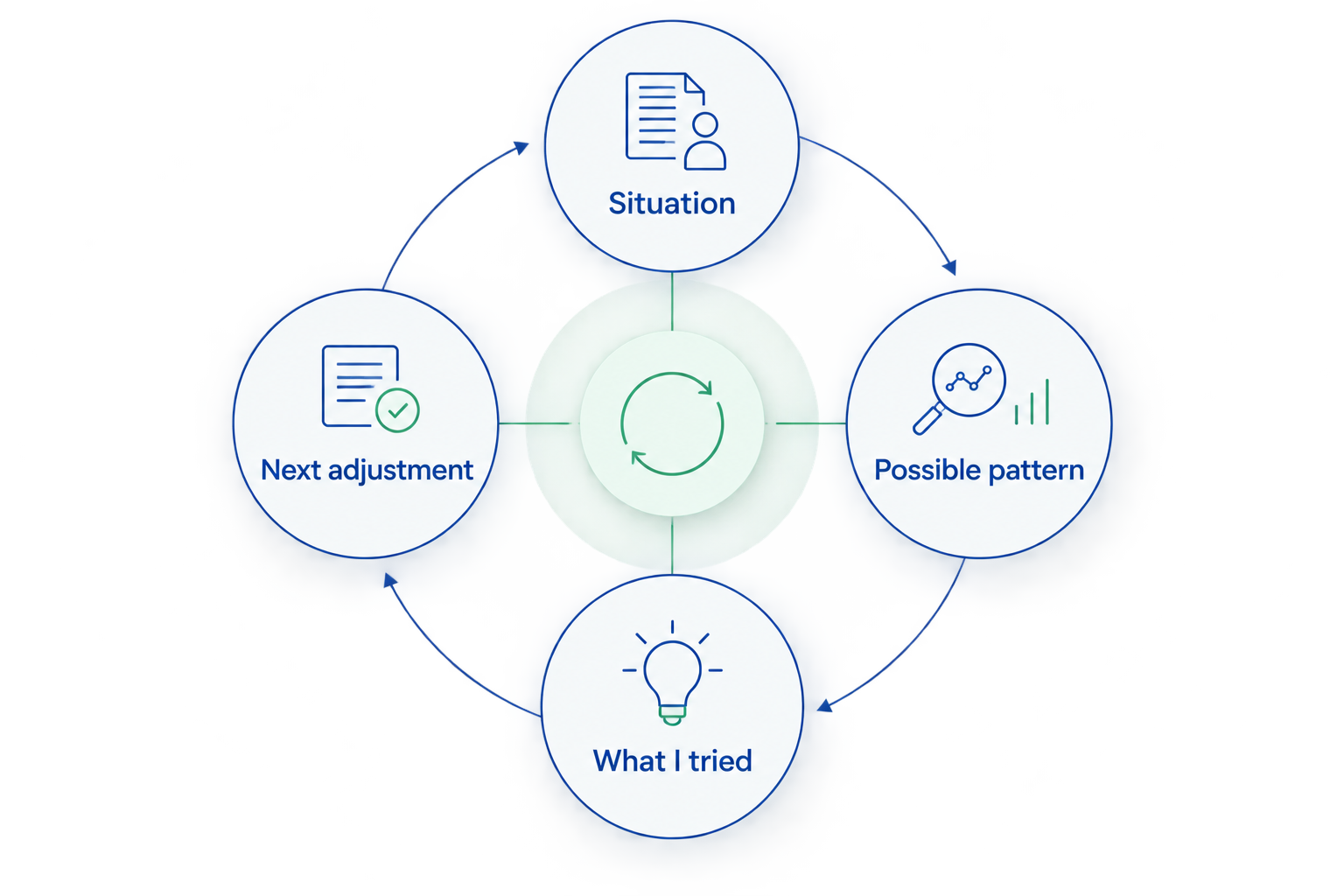
At a review dated 13 May 2026, compare the situations you recorded rather than assuming that a week of practice changed your underlying profile. Ask where the action fitted, where it did not, and what you still do not understand. Your notes describe experience; they do not validate the framework.
Another version: use a check-in after a difficult moment
Best for: moments when a planned daily reflection did not address the situation you actually faced. Use this version after an ordinary disagreement, an overcommitment or a decision you want to understand—not as an instruction to analyse yourself during overwhelming distress.
Begin with the event rather than opening your diagram immediately. Write what happened, what you felt and what you did. Only then ask whether a familiar archetype description offers a relevant perspective.
This order keeps the lived experience ahead of the symbolic explanation. Whether you move from a diagram to a reflection or from a life-path number to an interpretation, the distinction remains: an interpretation is not independent evidence about a person.
Use a short sequence:
- Describe the event. Leave out explanations of hidden motives.
- Name the choice. Identify where you responded automatically or deliberately.
- Consider another response. Choose an alternative that respects both your needs and the situation.
- Return to the diagram. Notice whether its language clarifies the pattern or adds an unnecessary story.
The advantage is immediacy: you are working with a concrete example. The limitation is that a recent disagreement can dominate your interpretation. Revisit the entry later before turning a strong first impression into a broader conclusion.
Troubleshooting your practice
Every situation seems to confirm the diagram
Write an alternative explanation beside the archetype interpretation. A delayed reply, for example, does not establish a recurring inner pattern on its own. Ask what evidence would make you reconsider your reading, and leave uncertainty visible in your notes.
Balance has become a demand to feel calm
Replace Was I balanced? with What did I notice, and what did I choose? Emotional balance in this exercise is not constant comfort. Keep difficult feelings in the record without treating their presence as failure.
The daily practice becomes another obligation
Reduce the entry to Situation, What I tried and Next adjustment. Skip elaborate tracking. If a scheduled check-in encourages repetitive analysis rather than a clear next step, use the event-based version instead.
Your interpretation turns into a fixed identity
Replace I am this archetype with This description connects with how I responded here. Look for an example that does not fit, too. Archetypes support reflection more honestly when they leave room for different circumstances and choices.
Reflection brings up more than you want to explore
Stop the exercise rather than pushing toward a breakthrough. You do not need to complete a journal entry or interpret every reaction. The quiz and diagram are not substitutes for qualified mental health support when that is what you need.
Customize your workflow
Keep the same basic record while changing the setting. For work, focus on commitments and decisions; for relationships, focus on your own responses rather than assigning the other person an archetype. Your diagram does not establish what someone else feels or needs.
If you guide reflective conversations, invite the person to supply their own examples and meanings. Ask permission before discussing their diagram, and do not present your interpretation as authority over their experience. A facilitator can support inquiry without making diagnostic claims.
Keep the model's strength and limitation together: Archegram offers a spiritual language for exploring recurring patterns, but that language does not establish a scientifically validated explanation for those patterns. Use the framework where it helps you describe experience clearly; set it aside where it obscures the situation.
FAQ
How do I start an Archegram diagram energy balance practice?
Choose one diagram description, connect it to a recent situation, and select one observable response to try. Record what happened before deciding whether the interpretation fits.
Does energy balance mean making every part of my diagram equal?
No. This practice does not set equal diagram sections as a goal. Use the diagram to explore your responses and needs, not to pursue visual symmetry.
Do I need to retake the quiz every day?
No. This workflow uses your existing diagram as a reference and daily notes to explore changing situations. Repeated quiz-taking is not a measure of daily self-regulation.
What if I do not relate to an archetype description?
Leave that interpretation open rather than forcing a connection. Start with a concrete situation and use only the model language that helps you describe it honestly.
Are receptive and active energies tied to gender?
No. In this reflection practice, receptive and active energies are available to anyone. They are not instructions about how a particular gender should behave.
Is the quiz a validated psychological assessment in 2026?
The quiz is presented as a spiritual self-discovery resource, not a validated diagnostic assessment. Do not use its results to diagnose conditions or make treatment decisions.
Can I use the diagram to understand a disagreement with my partner?
You can use your diagram to reflect on your own response to a disagreement. It cannot establish your partner’s motives, predict compatibility or replace asking about their experience directly.
One last thing
Keep one entry where the diagram did not explain your experience. That is not a failed reflection. It preserves the difference between a person and a model—and gives you permission to respond to today's circumstances instead of defending yesterday's interpretation.
Related guides
- Archegram diagram to a self-regulation routine
- Archegram diagram to a shadow-work journal
- Two archetype diagrams to a relationship talk
