


Instead of repeatedly taking a quiz and leaving the result unread, connect your personal diagram to a spiritual awakening journal: record one everyday situation, explore a possible pattern, and choose a response to practise. This manual workflow uses Archegram as a self-regulation framework, with spiritual reflection supporting greater balance rather than becoming another label to live up to.
- Archegram is best for adults seeking spiritual reflection within a non-clinical self-regulation framework.
- Use this archetype quiz spiritual awakening journal workflow to connect your diagram with everyday choices.
- Treat archetypes as flexible reflection tools, not fixed identities or proof of spiritual progress.
- Keep observations separate from interpretations, then choose one practical response to explore.
Why this matters
A quiz result gives you something to consider; a journal gives you somewhere to examine whether it fits your actual experience. The useful outcome is a more deliberate everyday choice, not a more impressive spiritual interpretation.
Archegram offers a free 24-question quiz and personal visual diagram for exploring recurring patterns, strengths and developmental needs. The model, also called Tantragram, is a contemporary, non-dogmatic adaptation of ancient Tantric knowledge developed at Samma Karuna. Its spiritual interpretations are not established psychological findings, and the quiz is not a validated diagnostic assessment.
For this 2026 workflow, use spiritual awakening to describe your own inquiry into awareness, meaning and how you live. The journal does not certify awakening, measure maturity or establish that an interpretation is true.
Before you start
- Gather your materials. Have access to the quiz, your personal diagram and a private notebook or editable document. This workflow involves manual writing, not an automated connection between services.
- Set a small practice window. Try a 10-minute writing session followed by a 5-minute review on another day. These are suggested limits for the exercise, not tested requirements or promises of results.
- Keep the original result separate. Preserve the diagram and the explanations provided with it before adding your own interpretations. A journal entry should never silently become an official explanation of the model.
Choose a place where you can write without having to perform insight for anyone else. If you use a shared device or document, check who can access it before recording personal details.
The journal headings below are labels you create yourself. They are not website buttons, quiz fields or official diagram categories.
Your diagram reference
Save the source before interpreting it
- Complete the quiz and keep your personal diagram in a form you can revisit. Answer from your experience rather than from the qualities you wish to demonstrate.
- Create a journal page titled Diagram reference. Add the date and record the model's wording separately from your own notes.
- Add Initial questions beneath it. Write what you want to understand, such as why you agree quickly and later feel resentful.
- Choose one recurring situation to explore. Avoid trying to explain your whole personality in the first entry.
Expected result: you have a reference page that distinguishes the original material from your personal interpretation.
If you are still working out how to approach the result, use the quiz-to-first-diagram workflow before building a detailed journal around it. Do not fill unfamiliar parts of the diagram with meanings borrowed from another framework.
Choose an observation, not an identity
Start with something you can describe: interrupting during disagreement, postponing a decision or offering help before checking your capacity. These are starting points for reflection, not evidence of a particular archetype.
Write the question in flexible language: What happens when I feel responsible for keeping everyone comfortable? Avoid conclusions such as This is who I am, so this is what I always do.
Archegram self-regulation practice is best suited to adults who want a spiritual reflection framework, not a clinical assessment. Its value here is the structure for inquiry; its limit is that an interpretation cannot establish the cause of your behaviour.
Your journal template
Create the entry fields
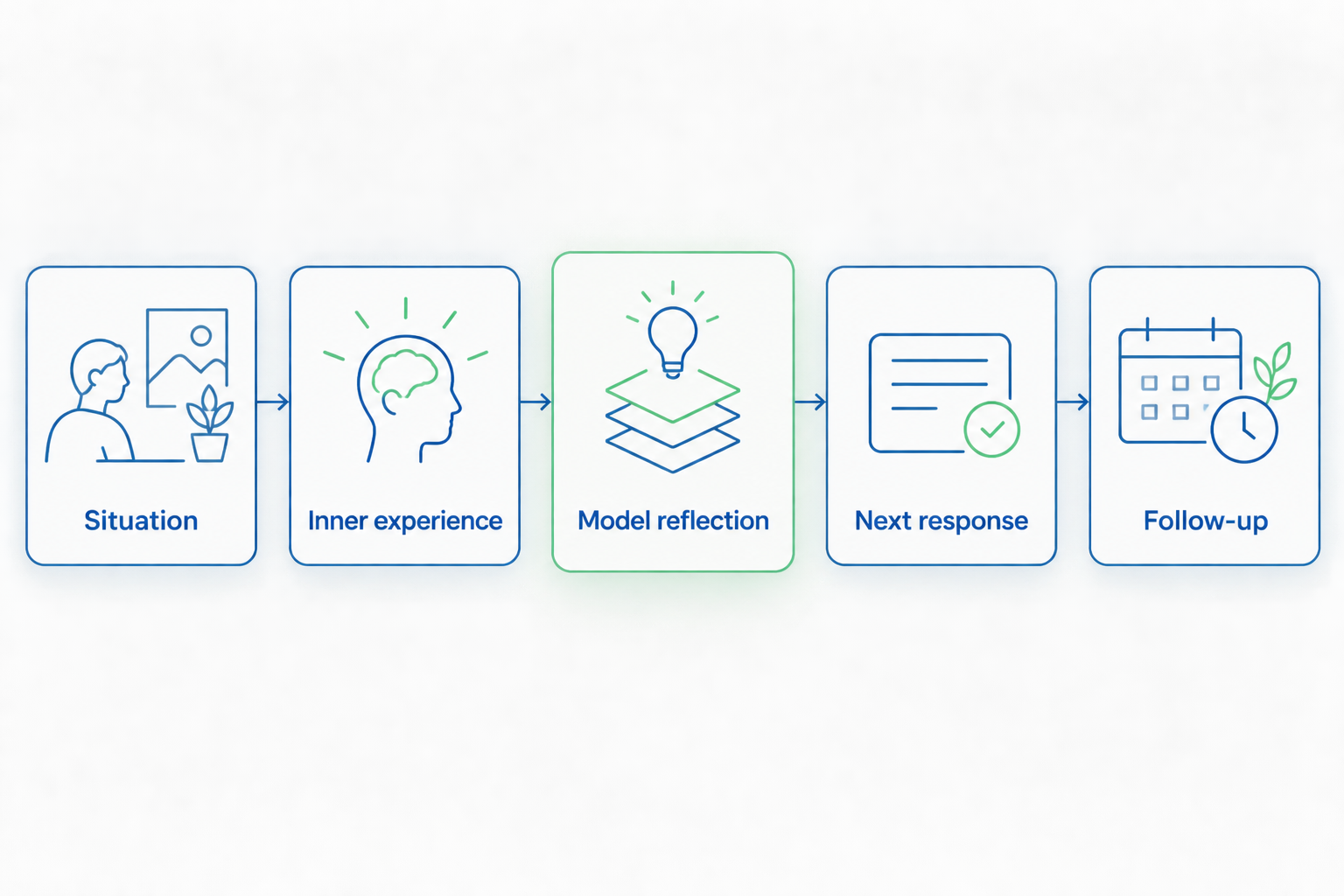
- Open a blank page and title it Reflection entry. Add the date; for a journal begun in 2026, include the year so later reviews retain their context.
- Add Situation and describe what happened without explaining anyone's motives.
- Add Inner experience and note the feelings, thoughts or physical sensations you noticed.
- Add Model reflection and connect the experience to one relevant idea from your diagram, using the accompanying explanation rather than guessing.
- Add Next response and choose an action within your control. Finish with Follow-up, leaving space to record what happened.
Expected result: you have a reusable entry that separates an event, your experience, a tentative interpretation and a practical choice.
The order matters for this exercise. Describe the situation before introducing archetypes so that the model remains a lens on your experience rather than a script for rewriting it.
Keep meaning and evidence separate
Under Model reflection, use language such as This interpretation invites me to consider… or This seems connected to… Then add a question that could challenge your first reading.
For example, if you interpret a difficult conversation as avoidance, ask whether you also needed more information or time. The purpose is not to replace one harsh label with a spiritual one.
If your source material discusses feminine and masculine energies, understand them as receptive and active qualities available to anyone. Do not assign them by gender or use them to prescribe a person's role in a relationship.
Your first reflection session
Complete an entry around an ordinary moment
- Pick a recent situation that feels manageable to revisit. Begin with an everyday frustration rather than the most painful experience you can remember.
- Fill in Situation using observable details. Then describe your own experience without claiming to know what another person intended.
- Consult your diagram and write one possible connection under Model reflection. Include something that does not fit the interpretation.
- Choose a modest Next response. Make it specific enough to recognise later, such as asking for time before accepting a request.
- Close the journal when the session ends. Leave Follow-up open until you have something concrete to record.
Expected result: you finish with a small experiment in everyday self-regulation, not an assignment to transform your entire life.
Here is an invented example of the writing format, not a quiz result or an official archetype interpretation:
| Journal field | Example entry |
|---|---|
| Situation | I accepted an extra task although my evening was already committed. |
| Inner experience | I wanted to seem helpful and felt tense after agreeing. |
| Model reflection | Does my diagram offer a useful question about this pattern? I also need to consider the immediate circumstances. |
| Next response | Before accepting another task, I will check what I have already committed to. |
| Follow-up | Record whether I paused and what I chose, without grading myself. |
Notice what the example leaves out: no claim about destiny, no diagnosis and no assumption that helpfulness is a problem. The reflection concerns whether a response fits the situation and your current capacity.
Your review routine
Review the response rather than scoring yourself
- Set a review date and return to the entry after an opportunity to try your chosen response.
- Complete Follow-up with what you actually did. If the relevant situation did not arise, record that rather than inventing a lesson.
- Compare the observation with your interpretation. Keep, revise or set aside the interpretation according to how useful and accurate it seems.
- Choose whether to repeat the response, adjust it or explore a different question. Preserve the earlier entry instead of rewriting it to match your latest view.
Expected result: your journal contains a visible record of questions and choices, including interpretations you changed your mind about.
Create a page called 2026 review if you want a place to gather recurring themes. Record examples alongside each theme so that a confident-sounding summary does not replace the events behind it.
A useful review question is: What did I notice earlier this time? Another is: What remained difficult? Neither requires you to declare progress, and both leave room for changing circumstances.
A second workflow: return when circumstances change
You can also revisit the journal after a change in responsibilities, relationships or daily demands. Start from the new situation rather than assuming an earlier interpretation still explains everything.
Compare your existing diagram notes with recent entries before deciding whether to revisit the quiz. If you do take it again, date the new result and keep it beside the earlier one; a changed result does not by itself establish spiritual development or decline.
| Workflow | Best for | Advantage | Limitation |
|---|---|---|---|
| One-situation practice | Exploring a recurring everyday response | Keeps reflection connected to a specific choice | Does not represent your whole life |
| Change-of-circumstances review | Reconsidering patterns during a transition | Makes room for context and changing needs | Different circumstances make direct comparisons difficult |
Choose one-situation practice when you want a clear next action. Choose a change-of-circumstances review when your earlier questions no longer match the life you are living.
For a transition review in 2026, write down what changed outside you as well as what feels different inside. That distinction keeps the journal from attributing every change to an archetype or spiritual process.
Troubleshooting
Your interpretation feels like a fixed identity
Replace I am this archetype with This description raises a question about this situation. Return to an example that does not fit the label, and keep that exception in the entry.
Your entry becomes a story about someone else's motives
Separate what the person said or did from what you imagined it meant. Use the model to explore your own response, not to classify someone who has not chosen to participate.
You keep retaking the quiz instead of trying anything
Return to your latest entry and choose an observable next response before taking another quiz. More results are not required to investigate whether pausing before a commitment changes your choice.
The writing becomes overwhelming
Stop the exercise rather than forcing an interpretation. Leave the entry unfinished, return to an ordinary activity and seek appropriate support if distress persists; this journal is not a substitute for professional care.
You cannot connect the diagram to the situation
Leave Model reflection blank and describe the experience plainly. Review the supplied explanation later; a forced connection adds certainty without adding understanding.
Customize your workflow
Keep the Archegram journal centred on self-regulation even when your interests include spiritual meaning, relationships or guiding others. Ask how an interpretation helps you meet a real situation, and retain permission to decide that it does not fit.
For private reflection, choose one repeated setting, such as requests from others or decisions you postpone. Narrowing the scope gives you comparable situations without requiring daily writing.
For a reflective conversation with a coach or facilitator, decide what you want to share before the meeting. Share an entry or question rather than granting access to the whole journal, and ask that interpretations remain invitations rather than verdicts.
Do not turn the journal into a maturity ranking. The model includes personal development and maturity, but this exercise does not create a validated score for either. Your 2026 entries can remain a record of unfinished questions and practical choices.
FAQ
How do I turn an archetype quiz into a spiritual awakening journal?
Keep your diagram as a reference, then record a situation, your inner experience, a possible model connection and a next response. Return later to document what happened rather than treating the initial interpretation as a conclusion.
Is the Archegram quiz a psychological assessment?
No. Archegram is a spiritual self-understanding and self-regulation framework, and its quiz is not a validated diagnostic assessment. Its interpretations should not be presented as established psychological findings.
Do I need a journaling app for this workflow?
No, a private notebook or editable document is enough. This is a manual reflection workflow, so no software integration is required.
How long should I spend writing each entry?
Try a 10-minute session as an optional starting limit. Shorten or stop the exercise if it becomes unhelpful; that duration is a practical suggestion, not a tested requirement.
Does a changed quiz result mean I am spiritually awakening?
A changed quiz result does not establish spiritual awakening or personal maturity. Keep the dates and circumstances alongside each result, and explore what feels relevant without assigning a spiritual rank.
Can I use the journal with a coach or facilitator?
Yes, you can choose an entry or question to bring into a reflective conversation. Agree on what you want to share, and keep interpretations open to discussion rather than accepting them as diagnoses.
What should I do if an archetype description does not fit?
Set aside the interpretation rather than forcing your experience to match it. Keep the original description separate from your notes and record the parts that do not fit.
One last thing
An entry that challenges your favourite interpretation deserves to stay in the journal. Keep one example that does not fit beside every recurring theme you record.
That small practice leaves room for complexity. Your diagram can support reflection without becoming a rulebook for who you are allowed to be.
Related guides
- Archegram diagram to a self-regulation routine
- Best journaling prompts for spiritual awakening
- Archetype quiz to a journaling habit
