
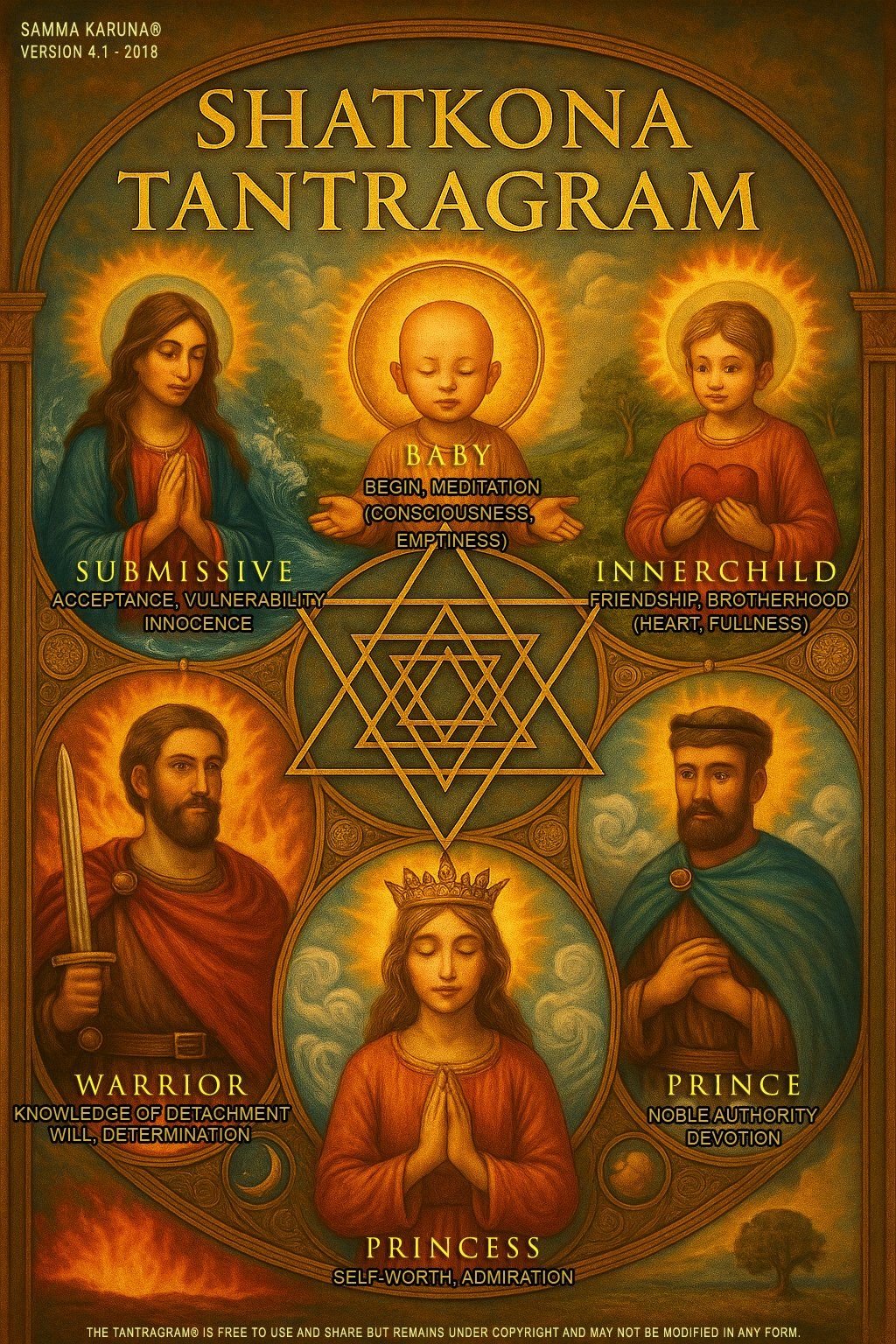

In the Archegram, the archetypes support and influence one another rather than working as separate personality types. Ishi describes Inner Strength as supporting Connection, Connection as supporting Wisdom, and Wisdom as helping you meet life with greater balance. Also called Tantragram, the model uses these relationships to explore why developing one quality in isolation can leave another need unattended.
- Archegram archetype interdependence connects Warrior–Submissive, Prince–Princess and Baby–InnerChild within one model.
- Inner Strength, Connection and Wisdom are complementary fields, not competing measures of importance.
- A quality becomes limiting when its expression excludes responsibilities or capacities elsewhere in the model.
- The model’s developmental language is spiritual interpretation, not a validated ranking of people.
How do the Archegram archetypes support one another?
Ishi’s account gives the Archegram framework three fields and six facets. Warrior–Submissive concerns Inner Strength, Prince–Princess concerns Connection, and Baby–InnerChild concerns Wisdom. Interdependence means that you examine the relationships among these fields, not only the quality that is most visible.
| Archetypal pair | Field in the model | Contribution to the whole | Question when isolated |
|---|---|---|---|
| Warrior–Submissive | Inner Strength | Will, determination and acceptance | Can I care beyond immediate preferences? |
| Prince–Princess | Connection | Care for others and self-worth | Can I allow life beyond my ideas of how it should be? |
| Baby–InnerChild | Wisdom | Awareness, connection and appreciation | Am I still meeting practical responsibilities? |
The table summarises relationships within Ishi’s teaching. It does not establish that someone who struggles in one field lacks human value or belongs permanently to a particular developmental category.
Why interdependence changes how you use the diagram
A diagram can encourage attention to a single point. Interdependence asks you to include the rest of the system before deciding what to explore.
If you are determined but unable to adapt, more effort is not necessarily the relevant question. If you are devoted to helping but unable to rest, more service might not address what is missing. If acceptance becomes a reason to ignore a commitment, another field needs attention.
The Archegram self-discovery framework is best used to explore how Inner Strength, Connection and Wisdom work together, not to choose a winning archetype. The practical value lies in a more complete question, not a flattering label.
Inner Strength can support Connection
Warrior–Submissive gives the model a language for acting when change is possible and accepting what is present when it cannot be changed. In Ishi’s explanation, this capacity can support more authentic care for others.
Imagine that a friend needs help. If you cannot acknowledge your own limits, you might agree to more than you can offer and later resent them. If you cannot act on a reasonable commitment, good intentions alone might not produce the support you meant to give.
Within the model, both capacities matter:
- Warrior language asks whether you can follow through on an appropriate action.
- Submissive language asks whether you can recognise limits and adapt.
- Prince–Princess language asks whether care includes yourself and the other person.
These are different questions about the same experience. You do not need to become perfectly strong before being capable of love, nor does needing support mean you cannot care for anyone else.
Acceptance is not the opposite of contribution
Acknowledging that you cannot solve every problem can make your actual commitment clearer. You can offer what you can sustain rather than promising everything.
This illustrates the relation between Inner Strength and Connection. Acceptance does not erase dedication; it helps place dedication within the circumstances you actually face.
Connection can support Wisdom
Prince–Princess explores how you relate to yourself and others. The manuscript connects this field with the possibility of moving beyond comparison and recognising a wider sense of belonging.
Ishi summarises the pair’s balanced mindset with the statement: “I can never be more or less than anyone else.” Within his teaching, this concerns worth rather than identical skills, decisions or consequences.
If giving becomes proof that you are better than someone else, the outward action might look generous while the relationship remains competitive. If a mistake means you see yourself as beneath everyone else, that comparison can also dominate your experience.
The model invites a different reflection:
- Can I recognise another person without ranking our worth?
- Can I acknowledge a mistake without reducing myself to it?
- Can I contribute without needing the contribution to make me special?
These questions connect care and self-worth with the wisdom field. They do not require agreeing with harmful behaviour or abandoning accountability.
Wisdom does not make consequences disappear
Seeing yourself as connected with another person is compatible with saying that their action caused harm. You can recognise their humanity while setting a boundary.
Interdependence is not a reason to blame yourself for mistreatment. It is a perspective within the model, not a replacement for practical safety or another person’s responsibility.
Wisdom can bring you back to practical action
Baby–InnerChild includes the model’s spiritual language of observing awareness, connection, appreciation and contentment. Ishi also describes a limit: acceptance can become unbalanced when it is used to neglect your own needs or the people who depend on you.
That is where Warrior–Submissive becomes relevant again. Recognising what is present does not remove the need to act within it.
You might feel grateful for a quiet day and still need to answer an important message. You might accept that a problem exists and still need to address it. The teaching does not require choosing between appreciation and responsibility.
Questions for this relationship include:
- Am I appreciating the present or avoiding an obligation?
- What practical need requires my attention?
- Can I act without insisting that everything should already be different?
This return to action is central to the model’s interdependence. No archetype permanently replaces the others.
Distinguish balance from becoming stuck in a mindset
The manuscript describes what happens when the energy of a field becomes stuck. Read that as Ishi’s way of discussing an inflexible expression, not a clinical label.
| Expression being explored | What it can overlook | Complementary question |
|---|---|---|
| Immediate preferences dominate decisions | Meaningful care and longer commitments | What matters beyond what is easiest now? |
| Rigid ideals dominate giving | Playfulness, openness and appreciation | Can I care without forcing everything to fit my ideal? |
| Acceptance becomes disengagement | Basic needs and responsibilities | What action belongs to me here? |
The contrast is not between good and bad people. It is between expressions of qualities that remain responsive to circumstances and expressions that exclude relevant parts of life.
An isolated example cannot establish a pattern. You might need rest after a demanding period, and rest does not automatically mean avoidance. Use the table to ask questions, not to accuse yourself.
A worked example: organising a shared project
Suppose you are arranging an activity with friends. You want it to go well, become frustrated when others do things differently and start taking over their tasks.
Through Warrior–Submissive, you can explore whether your determination includes acceptance of other people’s choices. The practical question is not whether effort is wrong, but whether your response remains flexible.
Through Prince–Princess, you can explore what the project means for connection and self-worth. Are you trying to offer something meaningful, seeking approval, or treating disagreement as a verdict about you?
Through Baby–InnerChild, you can explore the wider perspective. Can you appreciate the gathering without making it satisfy a perfect image? Can you remain curious about what is actually happening rather than only what you expected?
Then the model returns you to action. You might clarify responsibilities, stop taking over or explain a real concern. That response is grounded in the whole situation rather than the command to develop one facet as much as possible.
This is an invented illustration of the model’s relationships, not a student case study. It does not assign scores or claim that the same interpretation fits your experience.
Do the archetypes form a hierarchy?
Ishi uses developmental language when describing the model, but he also states that no archetype is more important or more powerful than another. The principle of mutual influence prevents a simple ranking from capturing the whole teaching.
The model includes three archetypal pairs and six named facets. Its questionnaire contains 24 questions. Neither those categories nor the resulting scores establish a scientific ranking of maturity, wisdom or spiritual achievement.
For practical reflection, replace the question of which archetype is highest with a question about what is missing from the current expression. You can recognise the need for action, care or acceptance without deciding that another person is below you.
How does interdependence differ from the rooted-in-each-other principle?
Interdependence concerns relationships across the model’s fields. The rooted-in-each-other principle describes how complementary facets can support an expression from within a pair.
For example, Ishi explains that effective action can require inner acceptance of changing circumstances. Receptivity can also require determination to remain present rather than simply withdrawing.
The two ideas are related, but they are not interchangeable:
- Across archetypes, ask how strength, connection and wisdom influence each other.
- Within a pair, ask how action and receptivity support the expression you observe.
- In both cases, return to your actual example rather than assuming the diagram explains it fully.
Neither principle assigns a fixed role based on gender. Masculine and feminine are the model’s terms for qualities available to anyone.
Use interdependence in a reflective conversation
You can discuss an ordinary situation without deciding in advance which archetype caused it. Begin with what happened and what you did, then use the three fields as prompts.
A facilitator can help keep the discussion connected, but should not claim that they know your motives from a diagram. You remain the person who decides what to share and whether an interpretation fits.
Keep the exercise bounded:
- Choose a manageable example rather than your most distressing experience.
- Include practical circumstances as well as inner interpretations.
- Ask about the contribution of each field.
- Choose a realistic next step, or leave the question open.
Spiritual reflection does not replace professional care, and you do not need to persist when the exercise is overwhelming.
FAQ
What does interdependence mean in the Archegram?
It means that Inner Strength, Connection and Wisdom influence and support one another. The three archetypal pairs are explored as parts of one model rather than separate identities.
Which Archegram archetype is most important?
Ishi’s interdependence principle does not make one archetype more important than the others. Their relationship matters more than selecting a winner.
Can acceptance become unbalanced in the model?
Yes. Ishi describes acceptance becoming limiting when it leads to neglect of needs or responsibilities, which brings the focus back to appropriate action.
Does focusing on others always mean balanced Prince–Princess?
No. The manuscript distinguishes freely offered care from losing yourself in giving or relying on it for validation.
Are the model’s developmental descriptions scientifically validated?
They are presented here as Ishi’s spiritual interpretations, not validated developmental rankings or clinical findings.
Does the same principle apply to the Tantragram?
Yes. Tantragram and Archegram are two names for the same model, including its principle of archetypal interdependence.
One last thing
In this model, returning to action after acceptance is not going backwards. It can be the moment when a spiritual perspective becomes connected to the life you are actually responsible for living.
Related guides
An original educational explanation based on Ishi’s author-supplied account of the Tantragram’s interdependence and complementary facets. The manuscript remains source material, not a text reproduced or serialised here.

Self-discovery journal: easiest formats ranked 2026 - November 11, 2026
[…] Archetype interdependence […]
Archetype Diagram Interpretation: Best Tools 2026 - November 13, 2026
[…] a broader model-focused perspective, explore Archegram archetype interdependence rather than treating an individual archetype as your entire […]