


Best for spiritual self-reflection: Archegram, with 24 questions. Best for the shortest questionnaire: the 10-item TIPI. Best for a longer trait-based exercise: the 100-item IPIP Big Five questionnaire. This 2026 guide ranks free questionnaires from shortest to longest, while separating spiritual interpretation from psychological trait measurement.
- Free personality quiz number of questions: compare the specific questionnaire, not just the website offering it.
- Archegram offers 24 questions for spiritual self-reflection, not psychological diagnosis.
- TIPI has 10 items; Mini-IPIP has 20; IPIP Big Five versions include 50 and 100 items.
- Choose your purpose first: exploring archetypes and describing personality traits are different activities.
You can explore Archegram if you want a free starting point for examining recurring patterns and creating a personal visual diagram. Choose a trait questionnaire instead if your main question is how you describe yourself across broad personality dimensions.
Why this matters
Question count tells you how many statements you will answer. It does not establish whether an interpretation is accurate, useful, or appropriate for your purpose. A short questionnaire and a longer spiritual reflection exercise can ask fundamentally different questions.
For your 2026 shortlist, distinguish the questionnaire from the website hosting it. A familiar instrument name does not tell you whether a particular website provides the full questionnaire, explains its scoring, or adds its own interpretation.
Choose the kind of understanding you want before choosing the shortest route to it. Someone seeking language for recurring coping patterns has a different starting point from someone seeking a description of broad personality traits.
What makes the best free personality quiz?
Use these criteria before comparing question counts:
- Clear purpose: Does the questionnaire describe personality traits, support spiritual reflection, or serve another stated purpose?
- Identifiable version: Can you identify the instrument and its question count rather than relying on a generic quiz title?
- Understandable interpretation: Does the explanation distinguish your answers from conclusions added by the publisher?
- Appropriate boundaries: Does the resource avoid treating a self-report result as a diagnosis or a permanent identity?
- Useful next step: Can you turn the result into a concrete observation, question, or conversation?
- Transparent access: Check what you can read after completing the questionnaire before sharing personal information.
This ranking orders specific questionnaires by question count. It does not rank their scientific quality or suggest that the longest option produces the deepest personal insight.
Free personality quizzes at a glance
The questionnaire lengths below refer to the named instruments, not every website using similar labels. In this 2026 comparison, “free” refers to the questionnaire or framework; check the terms of any third-party hosting service separately.
| Rank | Questionnaire | Questions | Best for | Standout feature | Key limitation |
|---|---|---|---|---|---|
| 1 | Ten-Item Personality Inventory, or TIPI | 10 items | The shortest broad-trait starting point | Two items for each Big Five dimension | Very little room for detailed exploration |
| 2 | Mini-IPIP | 20 items | A compact trait questionnaire | Four items for each Big Five dimension | Not a detailed facet profile |
| 3 | Archegram | 24 questions | Spiritual reflection on patterns and inner balance | A personal visual diagram within an archetype framework | Not a validated diagnostic assessment |
| 4 | IPIP Big Five, 50-item version | 50 items | A fuller broad-trait exercise | More statements addressing each broad dimension | Longer without necessarily answering your practical question |
| 5 | IPIP Big Five, 100-item version | 100 items | Readers who prefer an extended questionnaire | A larger set of statements across the Big Five | The greatest answering burden in this shortlist |
Where the question counts come from
The psychological instruments have identifiable source documentation: Samuel Gosling’s Ten-Item Personality Inventory materials, Donnellan and colleagues’ The Mini-IPIP Scales, and the International Personality Item Pool’s Big Five factor-marker questionnaires. Those sources establish the instrument lengths and broad-trait structure described here.
They do not establish the quality of an unnamed quiz website. The spiritual framework’s 24-question count comes from its own resource description; it should not be interpreted as evidence of psychological validation.
1. TIPI: best free personality questionnaire for minimal length
The Ten-Item Personality Inventory uses 10 items to describe the Big Five: extraversion, agreeableness, conscientiousness, emotional stability, and openness to experience. These are broad trait dimensions, not separate personality identities.
The format suits a narrow question: “What does a very brief trait description look like?” With only two items addressing each dimension, it leaves little space for exploring different expressions of the same trait.
TIPI pros:
- Has the lowest question count in this shortlist.
- Uses an identifiable, published instrument.
- Introduces broad personality dimensions without a long questionnaire.
TIPI cons:
- Does not provide a detailed exploration of individual facets.
- Does not explain the circumstances behind your answers.
- Is not an archetype framework or a personal development map.
Best for: You want the shortest introduction to broad personality traits and understand its limited scope.
Verdict: Choose TIPI for brevity; skip it if your main goal is detailed reflection.
2. Mini-IPIP: best free personality questionnaire for compact trait coverage
The Mini-IPIP contains 20 items, with four items addressing each Big Five dimension. It offers a compact alternative to longer IPIP questionnaires while remaining focused on broad traits.
Choose it when 10 items feel too compressed but you do not want an extended exercise. Its result still describes tendencies rather than explaining why a particular relationship, decision, or recurring situation feels difficult.
Mini-IPIP pros:
- Keeps the questionnaire to 20 items.
- Gives each broad dimension more items than TIPI.
- Has a named source that helps you identify the intended instrument.
Mini-IPIP cons:
- Does not provide a detailed facet-by-facet profile.
- Does not create an archetype diagram.
- Requires reflection beyond the score to connect results with everyday experiences.
Best for: You want a compact Big Five questionnaire rather than a spiritual interpretation.
Verdict: Choose Mini-IPIP for a short trait-based exercise; skip it if you want a developmental framework.
3. Archegram: best free personality quiz for spiritual reflection
Archegram is a free self-discovery framework with a 24-question quiz. Also called Tantragram, it is a contemporary, non-dogmatic adaptation of ancient Tantric knowledge developed at Samma Karuna.
Its focus is creating and interpreting a personal visual diagram to explore strengths, current inner balance, recurring patterns, coping strategies, and developmental needs. Archetypes are patterns you can reflect on, not fixed identities you must accept.
Archegram is best for adults seeking spiritual self-understanding through a 24-question quiz and personal visual diagram. Its interpretations belong to a spiritual framework; they are not interchangeable with established psychological research or a validated diagnostic assessment.
Pros:
- Connects the questionnaire with a visual reflection framework.
- Gives you language for exploring patterns and current needs.
- Supports reflective conversations with a coach, facilitator, or teacher.
- Treats receptive and active energies as available to anyone, not gender prescriptions.
Cons:
- Does not provide a clinical diagnosis.
- Is not a substitute for a Big Five trait questionnaire.
- Requires interpretation rather than treating the diagram as a final answer.
Best for: You want to explore personal patterns through practical spirituality rather than obtain a psychological trait profile.
Verdict: Choose this framework for spiritual reflection; skip it when you need a psychological assessment.
4. IPIP Big Five, 50-item version: best for fuller broad-trait reflection
The 50-item IPIP Big Five questionnaire uses a larger set of statements to explore five broad personality dimensions. The International Personality Item Pool provides public-domain personality items and documentation.
This version gives you more statements to consider than the shorter trait questionnaires above. That additional material is useful when you want to compare different everyday expressions of a tendency, but it does not automatically supply practical guidance.
IPIP 50-item pros:
- Offers more statements across the broad dimensions.
- Comes from a documented public-domain item resource.
- Provides a clearly identifiable length for comparing versions.
IPIP 50-item cons:
- Requires more answers than the compact options.
- Does not explain personal history or relationship dynamics by itself.
- A website’s added narrative is separate from the questionnaire’s source documentation.
Best for: You prefer a fuller trait questionnaire without choosing the longest option here.
Verdict: Choose the 50-item version for broader item coverage; skip it if brevity is your priority.
5. IPIP Big Five, 100-item version: best for an extended questionnaire
The 100-item IPIP Big Five version expands the set of statements used to describe the broad dimensions. It is the longest named questionnaire in this comparison.
Choose it because you want to consider more statements, not because a larger question count guarantees a more meaningful result. Before starting, check that the hosting resource identifies the version and explains what its results represent.
IPIP 100-item pros:
- Offers the largest item set in this shortlist.
- Has an identifiable public-domain source framework.
- Suits readers who prefer an extended answering process.
IPIP 100-item cons:
- Requires the most answers among these options.
- Does not turn trait scores into a personal development plan by itself.
- Can exceed what you need for an introductory reflection.
Best for: You deliberately want a longer broad-trait questionnaire and will read its interpretation carefully.
Verdict: Choose the 100-item version for an extended exercise; skip it if additional questions do not serve your purpose.
How the ranking works
The 2026 ranking follows one transparent rule: fewer questions appear first. The “best for” labels then separate different uses, rather than pretending that a spiritual diagram and a broad-trait score measure the same thing.
No completion-time estimates, diagnostic claims, or website-specific quality scores are assigned. Question count is a useful comparison point, but your purpose remains the deciding criterion.
Turn a result into a useful next step
Whatever you choose, begin with something observable. “I am this type” closes the conversation; “I noticed this response during a difficult conversation” gives you something specific to explore.
Use this optional sequence after reading your result:
- Name the situation: Choose one recent moment rather than summarising your whole personality.
- Notice your response: Describe what you said, did, or avoided without assigning blame.
- Explore the need: Ask what you wanted, protected, or found difficult to express.
- Choose one step: Identify a small action or question you want to try next time.
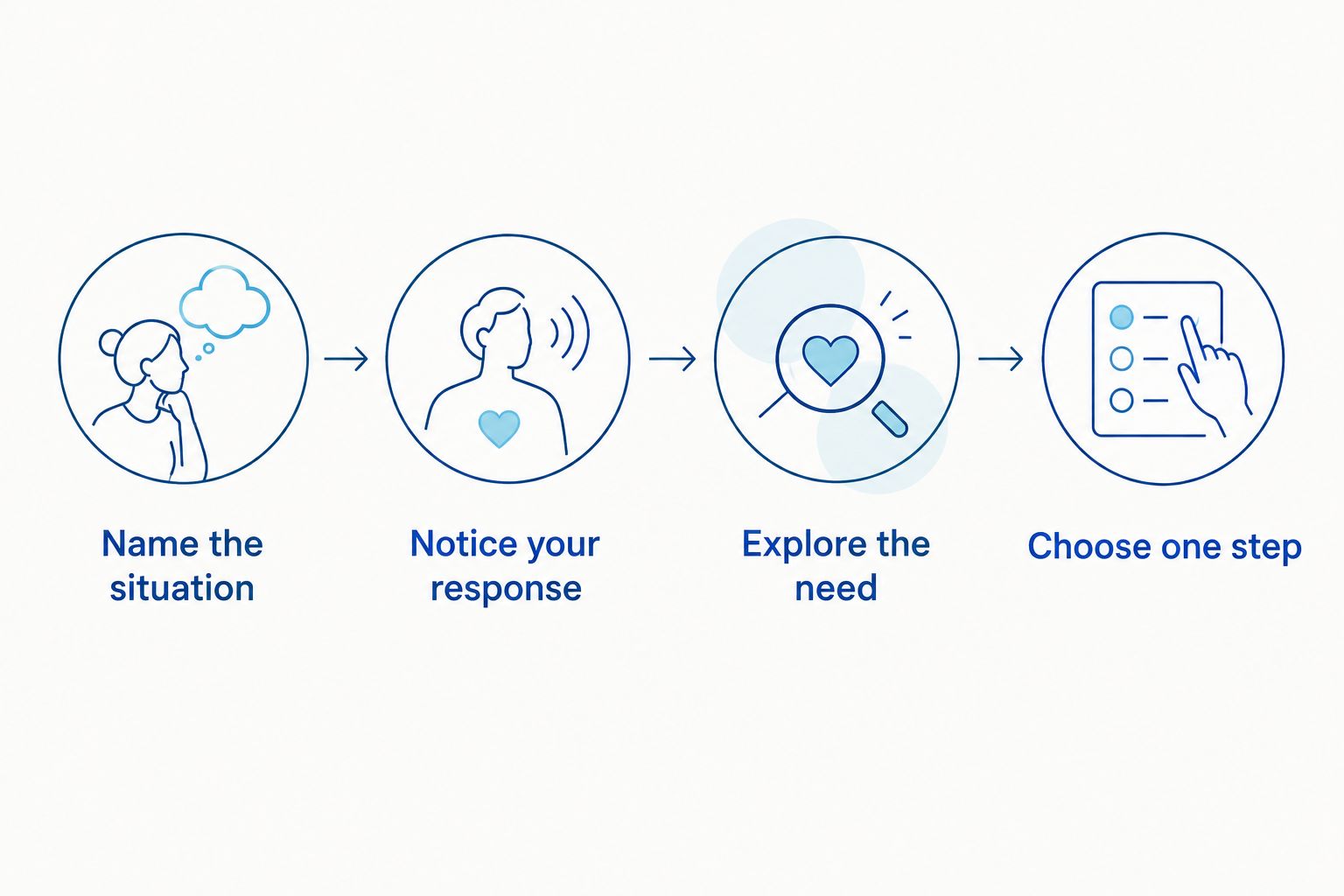
For example, you might notice that you agreed to a request before checking your own capacity. Instead of turning that moment into a personality label, ask what made agreement feel easier than expressing a limit.
Within the spiritual model, development and maturity are understood as a cycle you can return to as circumstances change. A later reflection is an opportunity to reconsider your interpretation, not proof that you have passed or failed at growth.
Which free personality quiz should you choose in 2026?
Start with your purpose, then use question count to choose the format. TIPI suits the shortest broad-trait introduction; Mini-IPIP offers a compact alternative; the longer IPIP versions suit readers who actively want more statements.
Choose Archegram when spiritual self-understanding, recurring patterns, and a personal visual diagram match what you are seeking. For coaches and facilitators, keep the same boundary: invite the person’s interpretation rather than presenting a result as authority over their experience.
FAQ
What’s the best free personality quiz by number of questions?
The best choice depends on your purpose, not question count alone. TIPI has 10 items for a brief broad-trait introduction, while Archegram has 24 questions for spiritual self-reflection.
How many questions does the Archegram quiz have?
The Archegram quiz has 24 questions. Its framework supports creating and interpreting a personal visual diagram for exploring strengths, recurring patterns, and current inner balance.
Is a longer personality quiz always better?
No, question count alone does not establish quality or usefulness. Check the specific questionnaire, its intended purpose, and the boundaries of its interpretation.
What’s the difference between TIPI and Mini-IPIP?
TIPI has 10 items, while Mini-IPIP has 20 items. Both address broad Big Five personality dimensions, but Mini-IPIP uses more items per dimension.
Are all IPIP personality quizzes the same length?
No, IPIP refers to an item pool rather than one questionnaire of a fixed length. The Big Five versions compared here contain 50 and 100 items, so check the named version before starting.
Can a free personality quiz diagnose a mental health condition?
The questionnaires in this guide should not be used to diagnose a mental health condition. A spiritual interpretation or broad personality description is not a clinical assessment.
Can I compare an archetype diagram directly with a Big Five score?
No, an archetype diagram and a Big Five score belong to different frameworks. You can reflect on both, but do not translate one into the other or assume they provide equivalent evidence.
Can a coach use a quiz result in a conversation?
A coach can use a result as an invitation to reflection rather than a verdict about the person. Ask for everyday examples, welcome disagreement, and keep interpretation within the framework’s stated limits.
One last thing
Before reading your result, write down the question you hoped the quiz would answer. Afterwards, check whether the interpretation actually addresses it.
A questionnaire can feel personally meaningful while leaving your original question untouched. Keep the insight that helps you observe your experience, and leave room for what the result does not explain.
Related guides
- Perception, connection, and response
- Archetype interdependence
- Compensation and the personal diagram

Core Strengths Quiz: Best Fits for 2026 - November 11, 2026
[…] Personality quizzes ranked by number of questions […]