


Instead of repeatedly rereading your quiz result and wondering what to do with it, build an archetype quiz journaling habit that connects your personal diagram to everyday situations, responses and choices. Use the free 24-question quiz at Archegram, then follow the workflow below to turn reflection into a small, repeatable practice for greater balance.
- Archegram suits adults seeking a spiritual self-regulation model, not a diagnostic assessment.
- Build your archetype quiz journaling habit around one recurring situation and one practical response.
- Use your personal diagram as a reflection prompt, not a fixed identity.
- Keep entries brief, protect your privacy and review patterns without scoring your worth.
Why this matters
A quiz result gives you material to consider. A journal gives you somewhere to examine whether that material actually describes your experience. The useful connection is between a pattern you notice and a response you can choose, not between an archetype label and a permanent definition of yourself.
Archegram is a contemporary, non-dogmatic adaptation of ancient Tantric knowledge, also called Tantragram. Its spiritual interpretations are distinct from established psychological research; this workflow is a reflective practice, not a validated intervention or treatment.
For your 2026 journal, give the practice a modest purpose: understand one recurring reaction more clearly. You do not need to interpret your entire diagram before you begin.
Before you start
- Gather your materials: access to the free quiz, your personal diagram or result, and a private notebook or digital document. Use the result you actually receive; do not add meanings from unrelated personality systems.
- Choose a repeatable cue: attach writing to something already in your day, such as finishing breakfast. Begin with a suggested 3-minute session, not a demanding writing target.
- Watch for the hidden obstacle: an archetype description is not evidence that every part applies to you. Keep the original wording separate from your observations so your journal does not become a record of assumptions.
No connected apps or automated transfer are required. The workflow uses a manual journal template, so the instructions below name headings you create yourself, not buttons or fields on the quiz website.
Your journal setup
Choose one writing space
- Pick a notebook or an existing digital document. Choose the place you are willing to reopen, rather than adding a new system to maintain.
- Give it a plain title, such as Balance journal — 2026.
- Write a purpose statement at the top: I am exploring patterns and practicing choices, not deciding what kind of person I must be.
- Keep the journal private. If you use a digital tool, review its sharing settings before recording sensitive experiences.
Both formats support this workflow. Their practical differences matter more than extra features.
| Format | Best for | Advantage | Limitation |
|---|---|---|---|
| Paper notebook | People who prefer writing away from screens | Keeps the practice separate from digital tasks | Finding older entries requires manual browsing |
| Digital document | People who want searchable reflections | Lets you search for recurring words and situations | Requires attention to access and sharing settings |
Expected result: you have one writing space and a clear reason to use it. Neither format makes your interpretations more accurate; honest examples do that work.
Save a reference note
- Record the date you completed the quiz.
- Copy a short phrase from your result that you want to explore, keeping its wording intact. Label it Result wording.
- Under My interpretation, explain what that phrase means to you in ordinary language.
- Under Questions, record anything you do not understand instead of filling the gap with a guess.
For example, your interpretation might be: I want to explore how I respond when someone needs an answer before I feel ready. This is a question about behavior, not a claim that the diagram has identified a hidden truth.
If the visual itself is unclear, use the guide to interpreting your archetype diagram before assigning meaning to unfamiliar elements.
Expected result: the model's wording, your interpretation and your uncertainty remain visibly separate.
Your daily reflection template
Create a short entry
- Add these headings: Situation, Response, Possible pattern, Next choice.
- Under Situation, describe one observable event. Write what happened before explaining why you think it happened.
- Under Response, name the emotion you noticed and what you did. Include uncertainty when you cannot identify the feeling clearly.
- Under Possible pattern, connect the event to your reference note only if the connection fits.
- Under Next choice, write one action within your control.
Here is a fictional example of the template in use:
- Situation: A friend asked for help while I was finishing something important.
- Response: I felt pulled in different directions and agreed before checking my time.
- Possible pattern: I want to explore whether keeping connection sometimes takes priority over noticing my limits.
- Next choice: Before agreeing, I will check what I can realistically offer.
The example does not assign an archetype. Use your own result to explore the pattern rather than borrowing a label that sounds convincing.
Expected result: each entry ends with a practical option, not just an explanation of your personality.
Make the diagram connection optional
- Ask whether the situation genuinely relates to the part of your diagram you selected.
- If it does, describe the connection as a possibility you can examine.
- If it does not, write No clear connection and keep the entry.
- Record examples that challenge your interpretation as well as examples that support it.
A useful reflection loop is Notice, Reflect, Choose, Review. Notice the event, reflect on the possible pattern, choose a response and review what happened later. These are journaling instructions, not official names for parts of the model.
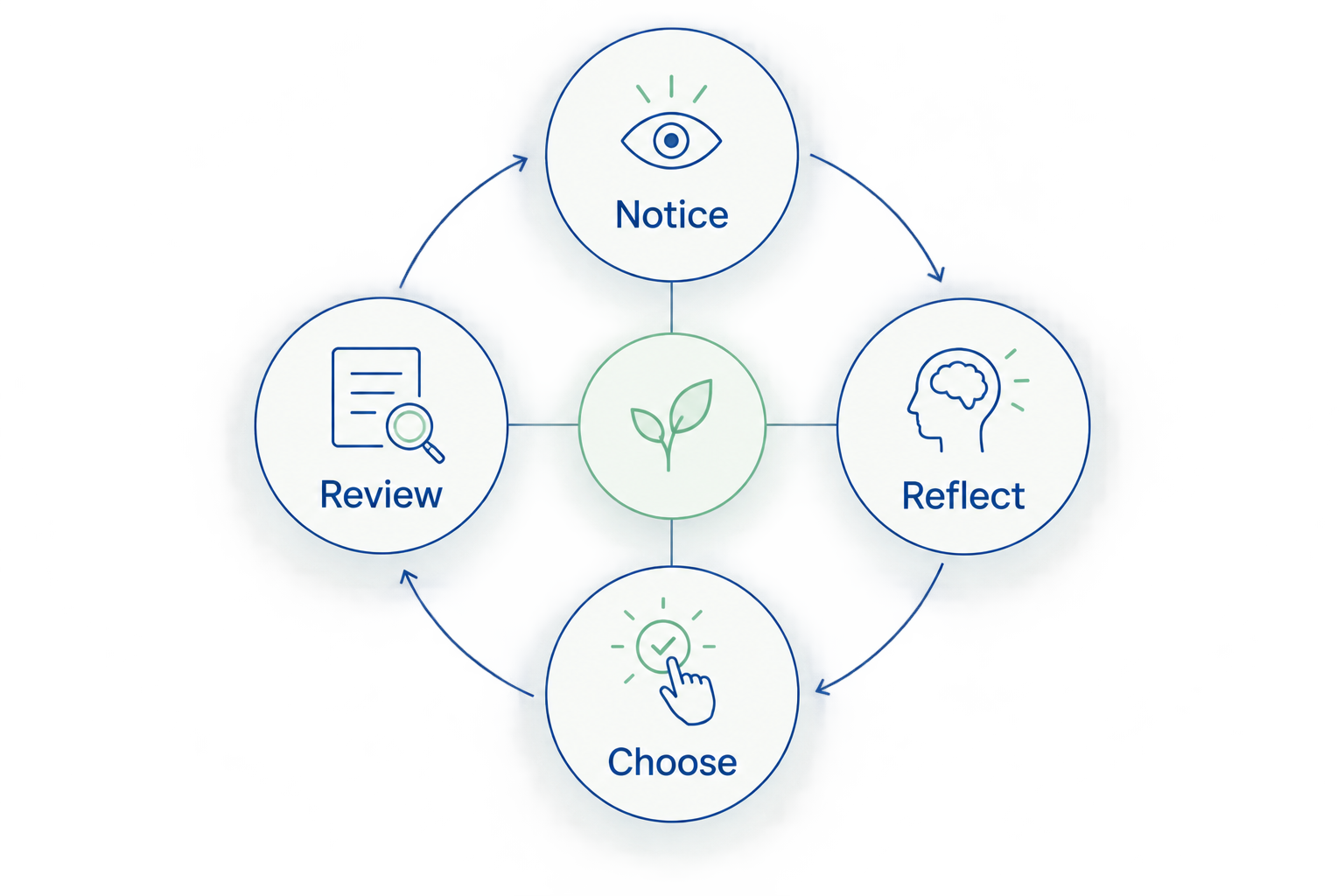
Expected result: your diagram supports curiosity without becoming an explanation for everything. An entry that contradicts your first interpretation is useful material, not a failed exercise.
Your reminder and review rhythm
Set a gentle writing cue
- Choose one existing daily activity as your cue.
- Keep the notebook nearby, or place the digital document somewhere easy to reopen.
- If you already use reminders, add one titled Notice one moment. A reminder prompts writing; it does not automatically transfer quiz results.
- Try the suggested 3-minute session. Stop after one entry, even if the reflection feels unfinished.
Expected result: starting the practice requires one clear action. You are not depending on a burst of motivation or a long period of quiet.
For a 2026 start, use your actual starting date rather than waiting for a new month. The date provides context; it is not a deadline for becoming more balanced.
Review without giving yourself a score
- After a suggested 7-day trial, read your entries together.
- Identify one repeated situation, one strength you used and one need you overlooked.
- Check whether your chosen response was something you could actually do.
- Keep, simplify or replace that response for the next review period.
A strength might be willingness to listen. A developmental need might be expressing a preference before agreeing. These are examples of reflection topics, not conclusions that a particular diagram necessarily produces.
Expected result: you leave the review with one specific adjustment. Do not turn the journal into a daily rating of how spiritually mature or emotionally balanced you are.
A second workflow: write after a recurring situation
A daily cue is not the only way to use the model. Event-based reflection is best for exploring a specific recurring interaction, such as agreeing too quickly or withdrawing from a difficult conversation.
| Workflow | Best for | Advantage | Limitation |
|---|---|---|---|
| Daily cue | Building a regular place for reflection | Does not depend on remembering a particular event later | Some days offer little relevant material |
| Event-based reflection | Examining a recognizable recurring situation | Keeps the entry close to the experience being explored | The practice depends on noticing that situation |
- Define the event in observable language: When I agree before checking my capacity is clearer than When my difficult archetype appears.
- Write only when you have enough space to reflect. You do not need to journal during a disagreement.
- Use the same entry headings rather than creating a second system.
- During review, look for differences in context instead of assuming every occurrence has the same explanation.
If your diagram or interpretation changes during 2026, date the new reference note and preserve the earlier one. Compare the questions you were asking and the circumstances you were living through; do not describe changed results as proof of improvement or decline.
Troubleshooting
Every entry becomes the same archetype story
Return to observable events. Add an example that does not fit your current explanation, and ask what other interpretation deserves consideration. A flexible reflection tool must leave room for disagreement.
You keep missing the writing session
Shorten the entry before adding reminders. Write one situation and one next choice, then reconnect the practice to an activity you already do. Resume with today's experience rather than creating a backlog.
You cannot interpret part of the diagram
Keep the unfamiliar wording in your questions list. Do not import definitions from the Enneagram, Human Design or archetypal psychology; these are distinct frameworks. Continue with the parts you understand while seeking clarification.
Writing turns into repeated self-criticism
Replace judgments such as I always fail at boundaries with a description of one event. If reflection increases distress, stop the exercise; a spiritual journaling practice is not a substitute for appropriate professional support.
Someone else wants to interpret your entries
Decide what, if anything, you want to share. A coach or facilitator can invite reflection without declaring your identity, diagnosing you or treating private writing as proof about your relationships.
Customize your workflow
Keep Archegram self-regulation practice centered on everyday choices. Once the basic routine feels manageable, add one question about a strength, a coping strategy or a developmental need—not all three at once.
If you explore receptive and active energies, treat them as capacities available to anyone. Ask whether a situation calls for listening, initiative, rest or expression; avoid turning those possibilities into fixed gender roles.
For a shared reflection with a coach or facilitator, choose an entry yourself and agree on its purpose before discussing it. The journal belongs to you. A useful conversation explores possible meanings rather than asking another person to decide what your diagram says you must become.
For the remainder of 2026, adjust the practice when circumstances change. A routine that fits a quiet week need not remain unchanged during a move, a demanding project or a relationship transition.
FAQ
How do I start an archetype quiz journaling habit?
Complete the quiz, keep your result as a reference and write about one everyday situation. Separate what happened from your interpretation, then finish with one response you want to practice.
Is Archegram a scientifically validated assessment?
Archegram is a spiritual self-regulation and self-understanding model, not a validated diagnostic assessment. Use its quiz and personal diagram for reflection, not for diagnosis or treatment decisions.
Do I need to understand every part of my diagram before journaling?
No, you can begin with one part you understand. Keep unfamiliar terms in a questions list rather than assigning them meanings from another framework.
How long should each journaling session take?
Start with a suggested 3-minute session and adjust it to your needs. This is a practical starting point, not a tested requirement or a promise of results.
Should I retake the quiz every week?
You do not need weekly retesting for this workflow. Explore your current result through everyday examples, and date any later result without treating changes as a progress score.
Can I use this journal to understand relationship compatibility?
Use the journal to reflect on interactions and possible conflicts, not to predict compatibility. Record your own responses and questions without assigning another person an identity or motive.
What should I do if my result does not fit my experience?
Record the mismatch rather than forcing your experience into the result. Archetypes are flexible reflection tools, and disagreement is a valid subject for further questions.
One last thing
Keep a space for What did not fit? beside your reference note. The entry that challenges your interpretation can be more useful than another entry that repeats it: it keeps the model in service of self-understanding, rather than making your life serve the model.
Related guides
- From the quiz to your first diagram
- Exercises for emotional self-regulation
- Self-discovery questions to ask yourself
