


Instead of repeatedly trying to explain your reactions from memory, follow the Archegram quiz to diagram workflow: complete the 24-question quiz, read your personal diagram alongside its explanations, and connect one pattern to an everyday situation. Use that reflection to choose a practical response—not to assign yourself a permanent personality label.
- The Archegram quiz to diagram workflow supports self-regulation through reflection, not diagnosis or fixed personality labels.
- Answer the 24 questions from lived experience, then read your personal diagram alongside its accompanying explanations.
- Connect one recurring pattern to a recent situation before choosing a small change to practise.
- Keep dated notes so later reflection includes real situations, not just impressions of your diagram.
Why this matters
A diagram becomes useful when you can connect it to something you actually do: agreeing before checking your capacity, withdrawing during disagreement, or continuing a task when you need a pause. These are examples to explore, not meanings automatically assigned to any particular archetype.
Archegram is best for adults seeking a spiritual self-regulation model for everyday reflection, not a clinical assessment. Start with Archegram and keep that distinction in view throughout the process.
The model, also called Tantragram, is a contemporary, non-dogmatic adaptation of ancient Tantric knowledge. Its spiritual interpretations are not equivalent to established psychological research. Your diagram is a starting point for understanding recurring patterns, strengths and developmental needs—not evidence of a disorder or a prediction of your future.
This 2026 guide focuses on the practical sequence: prepare, complete the quiz, interpret carefully, and bring one observation into daily life.
Before you start
- Have the quiz and somewhere to write. Use a browser to access the website and a notebook or document for your reflections. Keep the accompanying diagram explanations available while you interpret your result.
- Choose a concrete reference point. Bring a recent, ordinary situation to mind, such as receiving feedback or deciding whether to accept another responsibility. Set aside an optional 10-minute reflection period after completing the questions.
- Separate your experience from your ideal self. The non-obvious trap is answering as the person you wish to be—or treating one difficult day as your whole identity. If a question feels context-dependent, answer as honestly as you can and record the context separately.
You do not need to resolve every uncertainty before beginning. You do need to leave room for a result that feels partly familiar and partly open to question.
Quiz preparation and completion
- Write your purpose. Finish this sentence: “I want to understand what happens when…” Choose an everyday situation rather than a broad goal such as becoming a completely different person. For example, explore what happens when someone asks for more than you feel able to give.
- Establish your reference context. Note the circumstances shaping your answers: a busy period, a relationship change, or an unusually quiet stretch. This note belongs in your journal; it is not an additional quiz score or an instruction to reinterpret the scoring.
- Complete the 24 questions. Follow the instructions presented in the quiz. Choose answers that reflect your experience rather than trying to produce a desirable diagram, and do not assume an answer is better because it sounds more spiritual.
- Keep your initial observations separate. Before drawing conclusions, write what felt straightforward and what felt difficult to answer. If you are keeping a 2026 journal, date this entry so you can later distinguish the circumstances of this reflection from another.
Expected result: you have completed the questions and recorded the context behind your answers. You also have a clear purpose to return to when you examine your personal diagram.
Avoid adjusting answers simply because an emerging impression feels uncomfortable. An uncomfortable response is something to examine thoughtfully, not proof that you answered incorrectly—or that the interpretation must be true.
Diagram reading and interpretation
- Start with the accompanying explanation. Read the guidance provided with your diagram before interpreting its visual features. Do not assume that position, size, colour or prominence means the same thing as it does in another framework.
- Learn unfamiliar terms in context. An archetype is a reflection lens for exploring patterns, not a fixed identity. Where the model discusses feminine and masculine energies, understand these as receptive and active qualities available to anyone, not gender prescriptions.
- Separate description from interpretation. First note what the diagram and its explanation actually state. Then add your own response: what feels familiar, what feels unclear, and what does not fit your experience. Keep those observations distinct.
- Add lived examples. For each pattern you want to explore, record a situation that appears to fit and a situation that does not. A useful interpretation leaves space for both rather than forcing every experience into the same explanation.
Expected result: you can describe one part of your diagram in plain language and connect it to experience without presenting that connection as a diagnosis or certainty.
For further reading, explore tools for interpreting your archetype diagram. Keep your own examples beside any interpretation so the diagram remains connected to your life.
A journal heading such as “2026 diagram reflection” provides a simple boundary: this is your reading at this point in your life, not a final statement about who you are. Revisit the interpretation when your circumstances change, without assuming every change requires another quiz.
Everyday practice and review
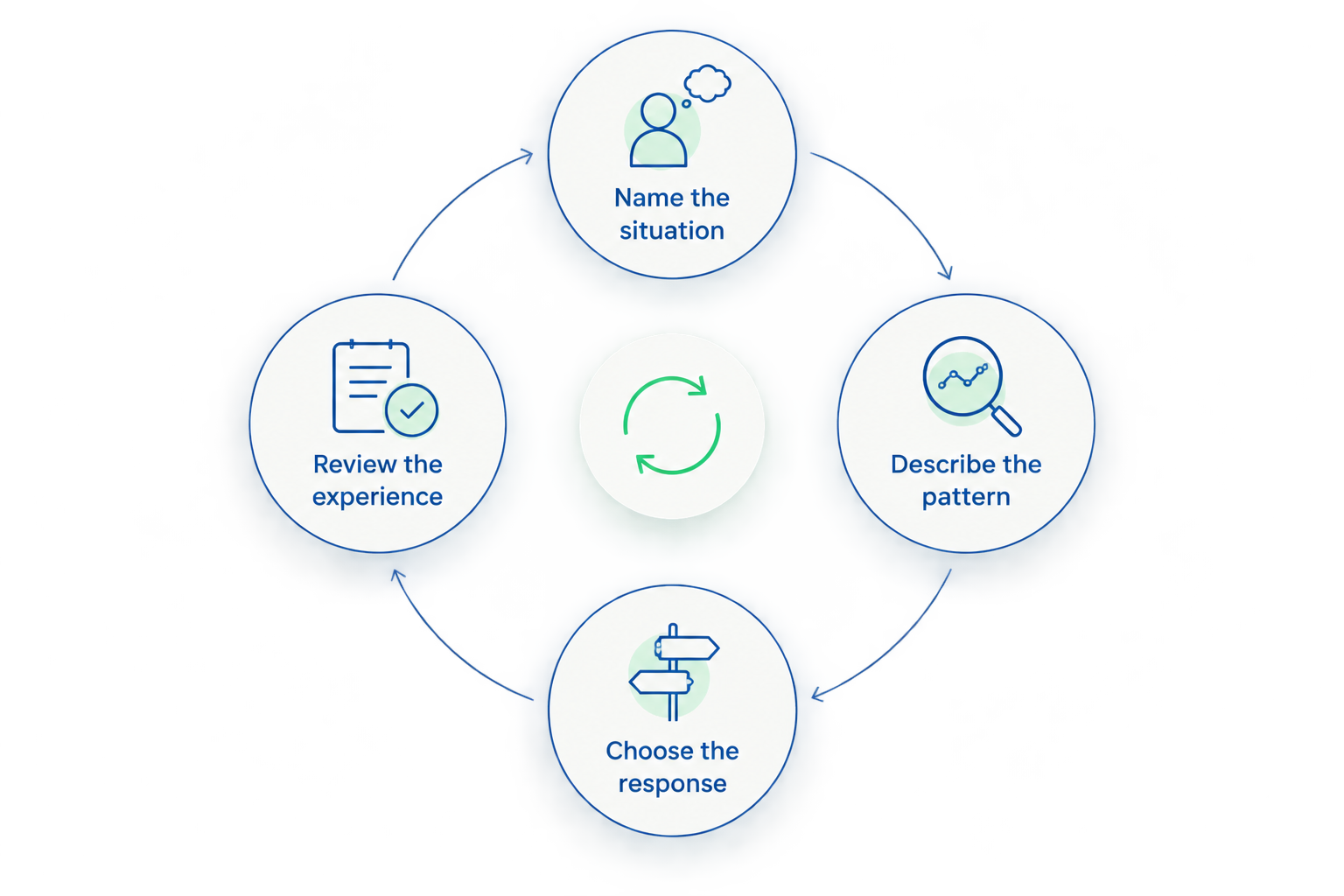
The next sequence turns reflection into a small experiment. Choose one situation and one response to practise, rather than trying to change every pattern your diagram brings to mind.
- Name the situation. Choose something recognisable: receiving an unexpected request, hearing criticism, or noticing tension during a conversation. Describe what happened without assigning motives to another person.
- Describe the pattern. Write what you noticed in your thoughts, feelings and actions. Then explain how the pattern relates to your reading of the diagram. Keep that connection provisional: it is your interpretation, not an objective measurement.
- Choose the response. Select a manageable action, such as asking for time before answering, naming a preference, or checking what someone meant. Make the action specific enough that you can recognise whether you tried it.
- Review the experience. After a relevant situation, record what you did, what followed and what you want to adjust. Review the action itself rather than judging whether you were a “good” or “bad” version of an archetype.
Expected result: you have a practical reflection loop, not just an interesting description of yourself.
For example, imagine you agree to help before checking your commitments and later feel resentful. Your experiment might be to say that you need to check your plans before answering. Do not assign this behaviour to a named archetype unless the model's explanation supports that interpretation.
For your next 2026 reflection entry, use three prompts: “What happened?”, “What did I choose?” and “What will I try next?” These are optional journaling prompts, not official quiz questions or a scoring method.
A second workflow: revisit your diagram with a guide
You can also use the Archegram self-regulation model as the focus of a reflective conversation with a coach, facilitator or teacher familiar with it. This changes the setting, not the status of the result: the diagram remains a self-understanding resource rather than a clinical assessment.
| Workflow | Best for | Strength | Limitation |
|---|---|---|---|
| Personal reflection | Adults wanting private space to explore a pattern | You choose the pace and what to record | Your own assumptions can go unchallenged |
| Guided reflection | Adults wanting help putting observations into words | Another person can ask clarifying questions | The guide's interpretation can influence yours; boundaries matter |
To prepare for guided reflection, bring your diagram, your original purpose and one concrete example. Decide in advance what you want to discuss and what you prefer to keep private.
Ask the guide to distinguish the model's explanation from their personal interpretation. You remain free to disagree, pause the conversation or leave a question unresolved. A diagram does not give anyone authority to define your identity.
When circumstances change during 2026, revisit your notes before deciding whether another quiz would serve a clear purpose. Compare examples and choices rather than treating a different-looking result as proof of progress or decline.
Troubleshooting
“I cannot find or understand my diagram”
Return to the instructions accompanying the quiz and check what the page asks you to do next. If the result or its explanation remains inaccessible, ask the site for help rather than reconstructing a diagram from memory or borrowing another framework's scoring rules.
“My result does not sound like me”
Write down exactly what does not fit and add a counterexample. Check whether you answered from your usual experience, an idealised self-image or a particular recent event; none of these possibilities makes an interpretation automatically correct.
“I keep changing my answers”
Pause and return to the question's wording. Answer as honestly as you can, then record any context that made the choice difficult; repeating the quiz until you obtain a preferred result does not resolve that ambiguity.
“I am reading one feature as a personal flaw”
Return to the model's explanation and remove judgemental language from your notes. Replace “This proves something is wrong with me” with a concrete observation about a situation, a response and a possible next choice.
“The reflection feels overwhelming”
Stop the exercise rather than pushing through. You do not need to finish an interpretation in one sitting, and a spiritual self-reflection model is not a substitute for professional support when you need it.
Customize your workflow
Give your diagram a clear role. For personal reflection, use it to frame a question about your own behaviour; for a guided conversation, agree on the topic and boundaries before interpreting anything.
If you explore relationship dynamics, describe interactions rather than predicting compatibility. A diagram cannot guarantee whether a relationship will work. Keep another person's experiences and explanations separate from your interpretation of them.
Measure your practice by what you notice and choose, not by trying to produce an ideal diagram. Keep notes short enough that you will actually return to them. One specific example gives you more to examine than a page of abstract labels.
FAQ
How do I go from the Archegram quiz to a personal diagram?
Complete the 24-question quiz, follow its accompanying instructions, and read your personal diagram alongside the model’s explanations. Then connect one observation to an everyday situation rather than treating the result as a fixed identity.
Do I need to know about archetypes before taking the quiz?
You can begin with your everyday experiences rather than an archetype label. Read unfamiliar terms alongside the diagram explanations, and keep questions open when a meaning is unclear.
Is the quiz a scientifically validated personality assessment?
The quiz is a spiritual self-reflection resource, not a validated diagnostic assessment. Do not use its results to identify a mental health condition, establish clinical needs or claim scientific certainty about your personality.
What should I do if my diagram does not feel accurate?
Record what does not fit and add specific examples from your life. Revisit the instructions and your answering context without forcing yourself to accept the interpretation.
Should I take the quiz again whenever I feel different?
You do not need to repeat the quiz whenever your mood changes. Revisit your existing diagram and dated examples first, then decide whether another completion answers a clear reflection question.
Can I use my diagram with a coach or facilitator?
You can bring your diagram into a reflective conversation with someone familiar with the model. Agree on boundaries, distinguish model explanations from personal interpretations, and retain the right to disagree.
What is the most useful next step after reading my diagram?
Choose one everyday situation and one response you want to practise. Record what happens when you try it, then adjust your next step without treating the outcome as a score.
One last thing
The part of your diagram you disagree with can become a useful question—not because the diagram must be right, but because disagreement asks you to name your experience more precisely. Write one example that fits and one that does not; leave both on the page.
Your first diagram does not need a final interpretation. It needs a thoughtful next question and enough space for your answer to change.
Related guides
- Self-discovery questions to ask yourself
- Exercises for emotional self-regulation
- Archetype diagrams for life coaches

Archegram diagram shadow work journal: Start small, 2026 - November 20, 2026
[…] explanations. If you have not created one, the free 24-question quiz is a starting point. The quiz-to-first-diagram workflow covers that earlier […]
Archegram certification first session: Plan | 2026 - November 23, 2026
[…] Quiz to your first diagram: a complete workflow […]
Archegram diagram coaching session: practical workflow 2026 - November 23, 2026
[…] notes. The model’s free online quiz contains 24 questions. If a diagram is not ready, use the quiz-to-first-diagram workflow before planning […]