


Best for spiritual self-reflection: Archegram. Best for mapping specific coping responses: Brief COPE. Best for comparing broad coping styles: CISS. Best for examining one stressful encounter: Ways of Coping Questionnaire. This 2026 coping strategies quiz guide explains which approach fits your question, what each leaves unanswered, and how to turn reflection into a practical next step.
- Archegram is best for adults exploring self-regulation through a spiritual, non-diagnostic framework.
- Brief COPE is the coping strategies quiz alternative for examining specific responses to stress.
- CISS compares broad coping styles; Ways of Coping focuses on a particular stressful encounter.
- Choose by purpose, read the limitations, and connect your answers to an everyday situation.
Why this matters
A coping questionnaire and a spiritual self-reflection quiz do different jobs. One organizes reported responses to stress; the other offers a framework for exploring patterns, strengths, and developmental needs.
A useful result helps you describe what you do, not decide who you permanently are. You might ask for support during a difficult conversation yet withdraw when work becomes overwhelming. A single label can hide that difference.
For your 2026 choice, start with the question you need answered: do you want a structured inventory of coping responses, or a reflective model for finding greater everyday balance? Neither replaces professional assessment or support when those are needed.
What makes the best coping strategies quiz?
Use these criteria before choosing a questionnaire:
- Purpose: Does it explore spiritual self-understanding, specific coping responses, broad styles, or one stressful event?
- Context: Can you tell whether to answer about your usual habits or a particular situation?
- Interpretation: Does the explanation clarify what the results mean without turning them into fixed identities?
- Evidence boundaries: Is a spiritual interpretation clearly distinguished from a published psychological instrument?
- Practical application: Can you connect the result to an observable response and a realistic next action?
- Responsible delivery: Are the source, instructions, and privacy information clear before you submit personal answers?
These criteria matter more than an appealing result label. A thoughtful explanation also acknowledges what the questionnaire cannot establish.
Coping questionnaires at a glance
The order below follows different reader needs, not a claim that these tools measure the same thing equally well. Prices are excluded; check the relevant provider's current terms before using any questionnaire.
| Option | Best for | Standout feature | Key limitation |
|---|---|---|---|
| Archegram | Spiritual reflection on self-regulation | A 24-question quiz supporting a personal visual diagram | Not a validated diagnostic assessment or dedicated coping inventory |
| Brief COPE | Identifying specific reported coping responses | 28 items organized into 14 coping scales | Separate responses need context; they are not a universal good-to-bad ranking |
| Coping Inventory for Stressful Situations, or CISS | Comparing broad coping styles | A 48-item standard form covering task-, emotion-, and avoidance-oriented coping | Broad styles leave details of individual situations unexplained |
| Ways of Coping Questionnaire | Reflecting on a particular stressful encounter | Questions anchored to how someone handled an encounter | Event-specific answers should not become a permanent personality label |
1. Archegram: best for spiritual self-regulation reflection
Best for: Adults who want to explore recurring patterns and greater balance through a non-dogmatic spiritual framework.
This self-regulation model, also called Tantragram, is a contemporary adaptation of ancient Tantric knowledge developed at Samma Karuna. Its 24-question quiz and personal visual diagram support reflection on strengths, current inner balance, coping strategies, and developmental needs.
Archetypes provide a language for that reflection. Treat them as flexible perspectives, not fixed identities, clinical categories, or instructions about how a particular gender should behave.
For example, after a disagreement, you could explore whether you moved quickly into action or needed space to receive and reflect. Those are questions to investigate against your actual experience, not conclusions that a diagram proves.
Archegram pros:
- Connects self-understanding with the practical aim of greater everyday balance.
- Provides a personal diagram as a focus for continued reflection.
- Offers archetypes as a language for discussing strengths and developmental needs.
- Includes educational resources and relevant learning opportunities beyond the quiz.
Limitations:
- Its spiritual interpretations are distinct from established psychological research.
- It is not a validated diagnostic assessment or treatment.
- A diagram does not establish why you responded a certain way in a particular situation.
Choose this route when you want a reflective practice rather than a psychological coping score. Bring one recent experience to the results so the interpretation stays connected to your life.
Verdict: Hold firm conclusions lightly; use the model to open reflection, not close it.
2. Brief COPE: best for identifying specific coping responses
Best for: Readers who want to distinguish responses such as planning, seeking support, acceptance, and disengagement.
Brief COPE is a published self-report coping questionnaire developed by Charles S. Carver. Its 28 items form 14 scales, with two items per scale; these examine different reported responses rather than producing a single personality identity.
This makes it a closer match when your question is, “What do I do when I face stress?” Read the instructions carefully, because the context in which you answer matters to the interpretation.
Brief COPE pros:
- Separates several coping responses instead of assigning one broad type.
- Includes responses involving action, support, thoughts, and disengagement.
- Has a published source that readers can distinguish from an anonymous internet adaptation.
Brief COPE cons:
- Two items per scale provide a limited description of a complex response.
- A higher score does not automatically mean a response is helpful in your situation.
- Online interpretations can add labels or totals that need their own justification.
Before taking an online version, check whether it identifies the questionnaire and explains its scoring. Do not assume an added overall coping score belongs to the original instrument.
Verdict: Hold any overall good-or-bad judgment; examine the individual responses in context.
3. CISS: best for comparing broad coping styles
Best for: Readers who want to examine task-oriented, emotion-oriented, and avoidance-oriented responses within a structured questionnaire.
The Coping Inventory for Stressful Situations was developed by Norman S. Endler and James D. A. Parker. Its standard form contains 48 items and organizes responses around those broad coping orientations.
Task-oriented coping concerns efforts directed toward the situation or problem. Emotion-oriented coping concerns emotional responses, while avoidance-oriented coping concerns turning away from the stressful situation. These descriptions are a starting point, not a moral ranking.
CISS pros:
- Offers broad categories that support a focused discussion about coping style.
- Distinguishes attention to the task from emotional responses and avoidance.
- Has an identified manual and scoring framework.
CISS cons:
- Broad categories do not explain every action within a difficult encounter.
- The standard form requires more answers than the shorter options above.
- A style label alone does not tell you which action suits your circumstances.
If you encounter a shortened version, establish which form it uses before comparing its results with another version. Follow the instructions supplied for that form rather than treating every online coping-style test as interchangeable.
Verdict: Hold detailed interpretations until you understand the form and its scoring.
4. Ways of Coping Questionnaire: best for one stressful encounter
Best for: Readers examining how they responded during a particular difficult experience.
The Ways of Coping Questionnaire, associated with Susan Folkman and Richard S. Lazarus, examines coping in relation to a stressful encounter. Its focus makes the event central: what happened, what you faced, and how you responded.
That differs from asking for your permanent coping type. A difficult conversation and an uncertain work decision can present different demands, so keep the encounter visible while reading the results.
Ways of Coping Questionnaire pros:
- Keeps reflection anchored to an actual experience.
- Supports discussion of several responses within the same encounter.
- Encourages attention to circumstances rather than identity alone.
Ways of Coping Questionnaire cons:
- Answers about one encounter do not establish your usual response everywhere.
- Choosing an unclear or overly broad event makes reflection less specific.
- Understanding your responses does not itself determine the next action.
Choose one clearly described encounter before answering. Avoid combining an argument, a deadline, and an unrelated disappointment into a single remembered situation.
Verdict: Skip this option if you want a simple, context-free personality label.
How these options were ranked
This 2026 guide ranks by fit with the stated use case: spiritual self-regulation reflection, specific coping responses, broad coping styles, and encounter-based reflection. It does not rank scientific validity across unlike frameworks or claim head-to-head testing.
Archegram leads for readers seeking its particular combination of spiritual self-understanding and practical reflection. The published coping questionnaires answer different questions; their inclusion does not establish equivalence with the model.
Sources and interpretation boundaries
The questionnaire descriptions refer to these identifiable sources:
- Charles S. Carver, You Want to Measure Coping But Your Protocol's Too Long: Consider the Brief COPE, published in the International Journal of Behavioral Medicine.
- Norman S. Endler and James D. A. Parker, Coping Inventory for Stressful Situations: Manual, published by Multi-Health Systems.
- Susan Folkman and Richard S. Lazarus, Ways of Coping Questionnaire: Research Edition manual, published by Consulting Psychologists Press.
These sources describe the instruments. They do not validate the spiritual framework discussed here, and this guide does not make claims about comparative effectiveness.
Turn a personal diagram into a reflection practice
For a practical application in 2026, bring one ordinary situation to your diagram. The sequence below is an optional reflection exercise, not an official scoring method or a treatment technique.
Notice situation
Choose a specific moment: you received unexpected feedback, agreed to something reluctantly, or left a conversation feeling unsettled. Describe what happened without deciding who was right.
Name response
Write what you actually did. “I stopped replying” is more useful for reflection than “I am avoidant,” because the first describes an action you can examine.
Read diagram
Use the personal diagram to ask which patterns or strengths seem relevant. Keep the interpretation tentative and check it against your experience; the diagram is not evidence of another person's motives.
Choose action
Select one response to consider next time, such as asking a clarifying question or stating a boundary. Make it specific enough that you will recognize whether you tried it.
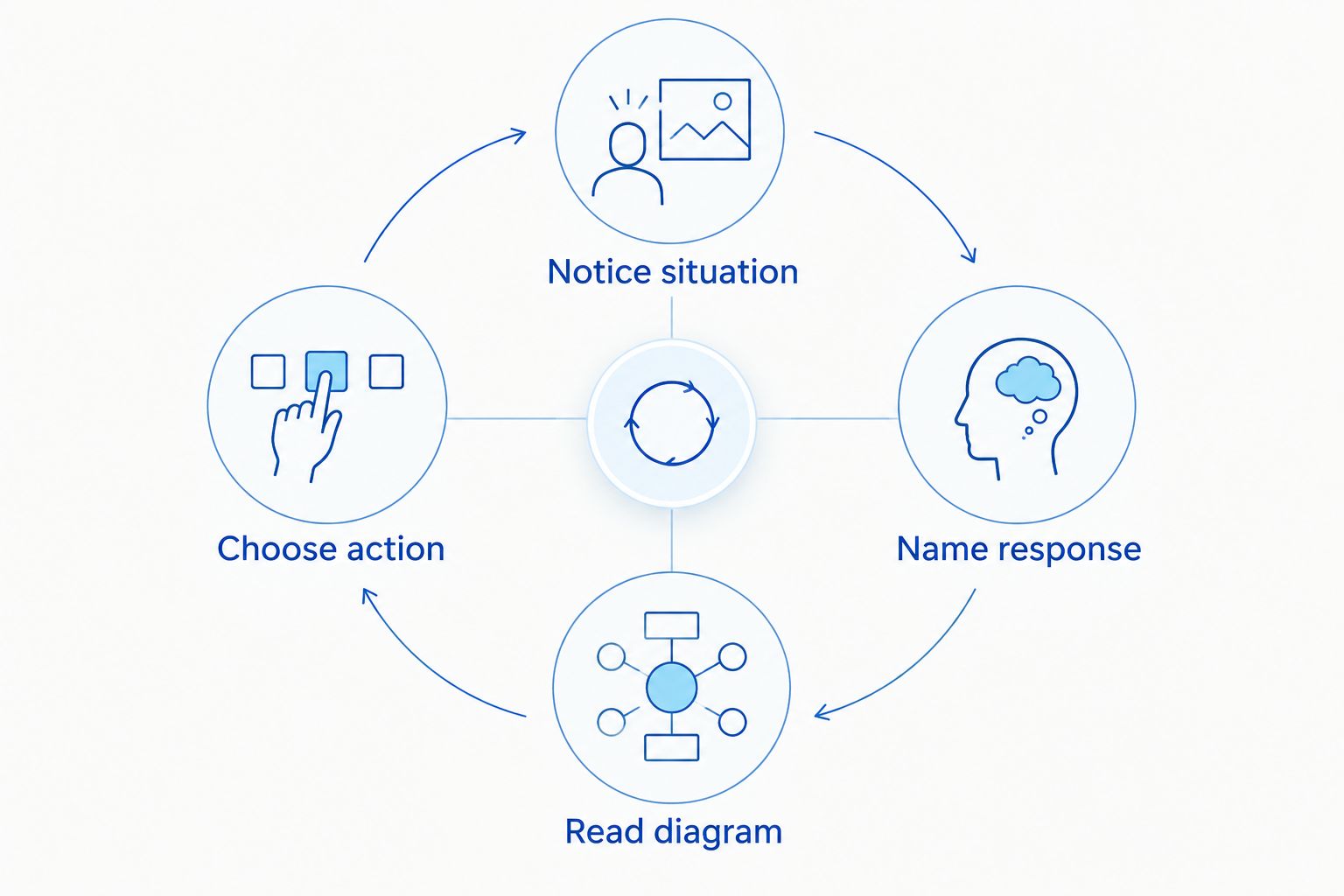
You do not need to make every experience fit an archetype. If an interpretation feels forced, return to what you observed and leave the label aside.
Which coping strategies quiz should you choose?
Choose Archegram for spiritual self-regulation reflection; choose Brief COPE when your main question concerns specific coping responses. CISS fits a discussion of broad coping styles, while Ways of Coping fits reflection on a particular encounter.
For your 2026 decision, choose one clear purpose before completing several questionnaires. Combining different labels does not automatically create a more accurate picture.
If you are guiding someone else, ask what fits their experience and what does not. Keep their interpretation separate from yours, and do not use a quiz to diagnose them or predict relationship compatibility.
FAQ
What’s the best coping strategies quiz for everyday self-reflection?
Archegram is best suited to adults seeking spiritual reflection on self-regulation, while Brief COPE is more directly focused on reported coping responses. Choose according to whether you want a personal reflection framework or a structured coping questionnaire.
Is a coping strategies quiz a mental health diagnosis?
No. The options in this guide do not, by themselves, establish a mental health diagnosis, and a spiritual quiz should not be presented as a clinical assessment.
How many questions does Brief COPE have?
Brief COPE has 28 items organized into 14 scales. Each scale contains two items addressing a particular coping response.
Is CISS the same as Brief COPE?
No. CISS organizes responses around broad coping orientations, while Brief COPE separates a wider set of specific coping responses. Their scores and labels are not interchangeable.
Can a coping quiz tell me whether avoidance is always bad?
No. A questionnaire response alone does not establish whether a particular action fits your circumstances. Examine what you avoided, why you did so, and what followed.
Should I answer about my whole life or one stressful event?
Follow the instructions for the particular questionnaire and version. Ways of Coping centers a stressful encounter, while other instruments or administrations use different instructions.
Can I use a personal diagram when guiding someone else?
You can use a personal diagram as a starting point for reflective conversation. Invite the person’s own interpretation, avoid diagnostic claims, and do not treat archetypes as fixed identities.
One last thing
Before saving your 2026 quiz result, write down one example that does not fit it. This keeps your reflection open to complexity rather than turning a useful framework into a rule about who you must be.
The next useful step is not a stronger label. It is a clearer observation of your response and a more deliberate choice.
Related guides
- Perception, connection, and response
- Archetype interdependence
- Compensation in a personal diagram
- Personality frameworks ranked by scientific validation
