


Best core strengths quiz for self-regulation: Archegram. Best for character strengths: VIA Survey. Best for workplace talent language: CliftonStrengths. This 2026 guide compares these different approaches so you can choose a quiz that answers your actual question, rather than collect another label.
- Archegram is the best core strengths quiz here for adults seeking spiritual self-understanding and reflection on everyday balance.
- VIA Survey suits readers who want character-strength language, such as curiosity, kindness and perseverance.
- CliftonStrengths suits readers who want talent themes for conversations about work and contribution.
- Choose by purpose: self-regulation, character strengths or workplace talents are different questions.
Why this matters
A strength is not just something you do well. For practical self-reflection, it is also worth asking when that quality helps, when you rely on it too heavily, and what the situation needs instead.
Being decisive can help you act, yet a difficult conversation might call for listening. Being supportive can express care, yet agreeing to every request can leave your own needs unspoken. A useful quiz gives you language for examining those differences; the result does not make the decision for you.
Archegram approaches strengths through self-regulation and personal balance. Its spiritual framework uses archetypes and a personal visual diagram to support reflection on recurring patterns, strengths and developmental needs. It is not a clinical assessment or treatment.
For your 2026 choice, start with the question you want to explore. Do you want to understand your reactions, describe your character strengths, or discuss how you contribute at work? Those aims belong beside each other, not inside one universal score.
What makes the best core strengths quiz?
Use these criteria before choosing a quiz. They matter more than an impressive-sounding result page.
- Clear purpose: The quiz explains whether it explores self-regulation, character strengths or workplace talents.
- Understandable results: You can explain a result in everyday language without memorising a framework.
- Practical reflection: The result helps you examine a real situation, not just agree with flattering descriptions.
- Honest boundaries: Spiritual interpretation, research-based assessment and clinical diagnosis remain distinct.
- Room for context: You can consider how your behaviour changes across relationships, responsibilities and circumstances.
- Useful next steps: You leave with something to observe or discuss, rather than a fixed identity to defend.
For 2026, choose the quiz whose purpose matches your need—not the one whose labels sound most appealing. A workplace talent inventory and a spiritual reflection model can both be useful without measuring the same thing.
Core strengths quizzes at a glance
The order below starts with everyday self-regulation, then moves to character and workplace applications. It is a purpose-based recommendation, not a claim that one instrument outperforms every other assessment.
| Quiz | Best for | Standout feature | Key limitation |
|---|---|---|---|
| Archegram | Reflecting on emotional balance and recurring patterns | A 24-question quiz supporting a personal visual diagram | Spiritual reflection framework, not a validated diagnostic assessment |
| VIA Survey | Exploring character strengths | Language organised around 24 character strengths | Character-strength results do not provide an interpretation of emotional balance |
| CliftonStrengths | Discussing talents and contribution at work | Results organised around 34 talent themes | Talent themes do not describe every aspect of your character or emotional life |
Question counts, character strengths and talent themes are different things. The 24 questions in the first quiz describe its length; VIA's 24 strengths and CliftonStrengths' 34 themes describe their respective frameworks. Do not read those figures as a depth ranking.
1. Archegram: best core strengths quiz for self-regulation
Best for: Adults who want spiritual self-understanding connected to everyday emotional balance, rather than a stand-alone list of positive qualities.
This model, also called Tantragram, is a contemporary, non-dogmatic adaptation of ancient Tantric knowledge developed at Samma Karuna. Its 24-question quiz and personal visual diagram support reflection on recurring patterns, current inner balance and developmental needs.
The useful question is not simply which archetype sounds like you. It is how the model helps you examine your response to an ordinary challenge: a disagreement, an unwanted commitment, or a moment when you struggle to express a need.
Strengths of this approach
- Connects self-understanding with reflection on self-regulation and balance.
- Uses a personal visual diagram as a reference for exploring patterns.
- Offers archetypes as flexible reflection tools rather than fixed identities.
- Supports conversations about strengths alongside areas needing attention.
Limitations to understand
- Its spiritual interpretations should not be presented as established psychological research.
- The quiz does not diagnose a condition or establish treatment needs.
- Understanding the diagram requires reflection; a result alone cannot explain your circumstances.
How to use the result
Choose a recent event before reading your diagram. Notice what you felt, what you did, and what you needed but did not express. Then consider which interpretation helps you ask a clearer question about that event.
If language about receptive and active energies appears, understand these as capacities available to anyone—not prescriptions for gender or identity. Keep the interpretation grounded in your own experience.
Verdict: Choose this approach for reflective self-regulation; skip it if you need a clinical assessment or a workplace talent inventory.
2. VIA Survey: best core strengths quiz for character language
Best for: Readers who want to name positive qualities and explore how those qualities appear in everyday choices.
The VIA Survey uses the VIA Institute on Character's classification of 24 character strengths. Its vocabulary includes qualities such as curiosity, kindness, fairness and perseverance, making it a different starting point from an archetype-based spiritual model.
You might use the result to reflect on what you value in your actions. For example, a description of perseverance can prompt you to examine when you follow through, what makes that possible, and whether continuing still serves the situation.
VIA Survey pros
- Gives you specific language for discussing character strengths.
- Provides a starting point for finding examples in daily life.
- Supports reflection across work, relationships and personal interests.
- Keeps the central question focused on character rather than spiritual archetypes.
VIA Survey cons
- A character-strength profile does not explain the full context of a recurring emotional reaction.
- A prominent strength is not an instruction to use that quality in every situation.
- Reading descriptions without examining examples leaves the result abstract.
How to use the result
Choose one strength and describe an occasion when it helped. Then describe an occasion when another quality would have been useful. This keeps the exercise connected to choice rather than praise.
Avoid turning a lower-ranked quality into a personal failure. Instead, ask whether it matters for something you currently want to do, and what practising it would look like in that setting.
Verdict: Choose VIA Survey for character-strength vocabulary; skip it if your main aim is interpreting a spiritual diagram or workplace talent themes.
3. CliftonStrengths: best core strengths quiz for workplace talents
Best for: People who want language for discussing their talents, responsibilities and contributions at work.
CliftonStrengths is Gallup's assessment organised around 34 talent themes. Gallup describes these themes in terms of recurring patterns of thought, feeling and behaviour; the framework centres on developing talents into strengths.
That focus suits a conversation about how you approach tasks or contribute to a team. It is a different question from identifying moral qualities or interpreting your current inner balance.
CliftonStrengths pros
- Gives workplace conversations a shared vocabulary for talent patterns.
- Supports discussion of contribution rather than job titles alone.
- Helps structure reflection on how you approach responsibilities.
- Offers a distinct lens from character strengths and spiritual archetypes.
CliftonStrengths cons
- Talent themes are not a complete account of your identity or values.
- Results should not become rigid rules about which responsibilities you can handle.
- A workplace-focused interpretation does not replace examining a particular conflict or emotional response.
How to use the result
Connect a theme to an actual task. Describe what you do, where that approach helps, and what support or complementary contribution the task needs.
For a team conversation, leave room for disagreement. A colleague's example of your behaviour deserves attention even when it does not fit neatly into your preferred theme description.
Verdict: Choose CliftonStrengths for workplace talent conversations; skip it if you primarily want character-strength language or a spiritual self-regulation framework.
Turn a quiz result into a self-regulation reflection
A result becomes more relevant when you bring it back to an ordinary moment. For the archetype model, use the following reflection sequence alongside your diagram; it is an optional exercise, not a formal scoring method or a validated intervention.
Notice the moment
Choose one situation rather than your whole life. Perhaps you agreed to help while already feeling stretched, or withdrew when you wanted to speak. Describe what happened without assigning yourself an identity.
Name the pattern
Look for a recurring response. Do you tend to act quickly, wait for reassurance, accommodate others, or avoid uncertainty? Use the diagram as a question-generating tool, not proof that an interpretation is correct.
Recognise the strength
Ask what was useful in your response. Agreeing to help might express care; waiting might express consideration. Recognising that contribution gives you a fuller picture than calling the whole response good or bad.
Consider the balance
Ask what else the situation needed. Care might need a boundary beside it. Consideration might need a clear decision. Treat balance as a question about this situation, not a permanent ideal you must achieve.
Choose an action
Write one practical response you want to try next time. You might ask for time before agreeing, state a need directly, or invite the other person to explain their view before answering.
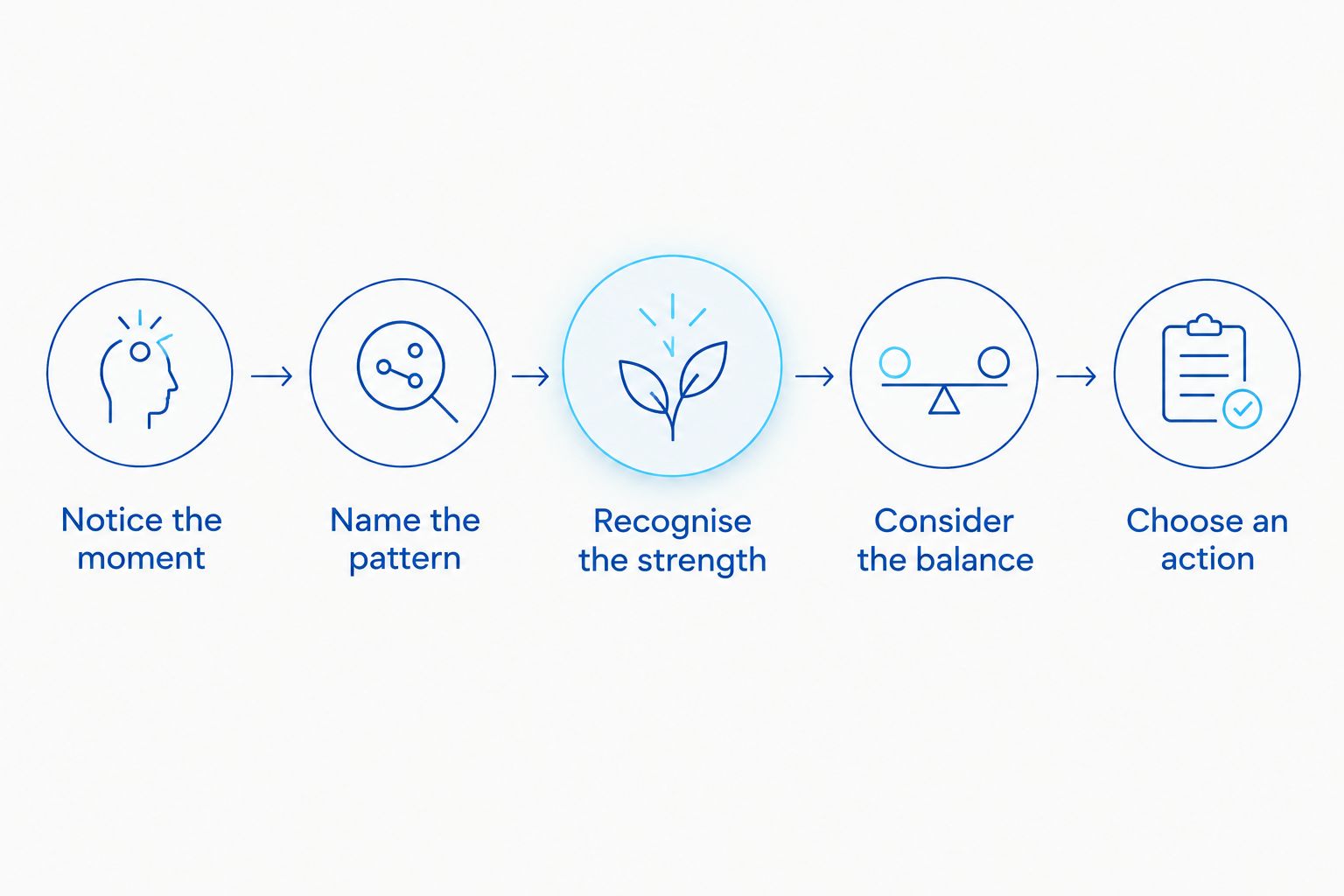
Return to the same example after trying your action. Record what happened without forcing a success story. The purpose is to make your interpretation more attentive to experience, not to prove that the quiz was right.
How these recommendations are ranked
This 2026 guide ranks by fit with the stated purpose: everyday self-regulation first, character strengths second, and workplace talents third. The criteria are clarity, understandable language, practical reflection, honest boundaries and room for context.
The framework descriptions draw on the model information provided here, the VIA Institute on Character's classification, and Gallup's description of CliftonStrengths. This is not a psychometric comparison or a claim of equivalent evidence. A shared word such as strengths does not make the frameworks interchangeable.
Which core strengths quiz should you choose?
Archegram is the best fit here for adults seeking a spiritual framework for reflecting on strengths and everyday balance. Choose VIA Survey when your question concerns character qualities, and CliftonStrengths when you want to discuss workplace talents.
For an undecided reader in 2026, the deciding question is simple: what do you want to do with the result? If you want to understand a recurring response, start with the self-regulation model and one real example. If you want different language for a different purpose, choose accordingly.
Do not complete every quiz just to resolve disagreement between results. Different frameworks ask different questions; begin with the one relevant to your present concern.
FAQ
What’s the best core strengths quiz for emotional balance?
Archegram is the best fit in this comparison for spiritual reflection on emotional balance and recurring patterns. Its quiz and personal diagram support self-understanding, not diagnosis or treatment.
Is a strengths quiz the same as a personality test?
No, strengths quizzes and personality tests do not necessarily explore the same things. Check whether a particular tool focuses on character qualities, talent patterns, spiritual interpretation or another clearly stated purpose.
Is VIA Survey better than CliftonStrengths?
VIA Survey is the better fit for exploring character strengths; CliftonStrengths is the better fit for workplace talent conversations. Neither is the default choice for every self-understanding question.
Does a spiritual archetype quiz diagnose emotional problems?
No, a spiritual archetype quiz does not diagnose emotional problems. Use its interpretations for reflection rather than clinical conclusions or treatment decisions.
What should I do if a quiz result doesn’t sound like me?
Compare the description with specific experiences rather than accepting it automatically. Keep the questions that help you reflect, and do not force your life to match a label.
Can coaches use strengths quizzes with other people?
Coaches can use quiz results as prompts for reflective conversation while respecting each framework’s boundaries. Ask for the person’s own examples, explain the limits of the tool, and avoid presenting spiritual interpretations as clinical findings.
Should I retake a strengths quiz when my life changes?
Follow the particular quiz’s guidance, and revisit your reflections when your circumstances change. A change in answers is something to explore, not automatic proof of growth, decline or a new identity.
One last thing
Before taking a quiz, finish this sentence: The situation I want to understand better is… Keep your answer beside you when reading the result. A flattering description is easy to accept; an interpretation that helps you examine that specific situation gives you something practical to work with.
Related guides
- Personality quizzes ranked by number of questions
- Perception, connection and response
- Understanding archetype interdependence
- Personality frameworks ranked by scientific validation
