


Best overall: Archegram and its personal diagram. Best for understanding everyday triggers: a situation log. Best for a simple starting point: a reflection journal. This 2026 guide compares five tools for archetype diagram interpretation, with one purpose: turning self-understanding into practical choices that support greater emotional balance.
- Archegram is the best starting point for archetype diagram interpretation within its own self-regulation framework.
- Use a situation log to connect diagram interpretations with everyday experiences, rather than treating labels as facts.
- Use receptive and active reflection to consider whether you need more listening, clearer action, or both.
- Choose guided reflection when you want another perspective, while keeping authority over your own experience.
Why this matters
A diagram gives you something to look at. Interpretation asks what it means in your life. The useful question is not simply which archetype appears strongest, but whether an interpretation helps you notice a recurring response and choose what to do next.
Archegram, also called Tantragram, is a contemporary, non-dogmatic adaptation of ancient Tantric knowledge developed at Samma Karuna. Its spiritual framework supports reflection on strengths, coping strategies and developmental needs. It is not a clinical assessment, and its interpretations are not established psychological findings.
For your 2026 reading, keep that distinction close: a meaningful description is an invitation to explore, not proof about your personality. You remain free to disagree with a label, revisit an interpretation or leave a question unanswered.
What makes the best diagram interpretation tool?
The strongest tool helps you move between a diagram and lived experience without confusing either with a diagnosis. Use these criteria before choosing:
- Model fit: Does the tool respect the framework behind your diagram instead of importing meanings from another system?
- Everyday relevance: Can you connect an interpretation to an actual conversation, decision or recurring difficulty?
- Flexibility: Can you revise your reading when circumstances change or an example contradicts it?
- Practical direction: Does reflection lead to a manageable choice rather than another label?
- Clear boundaries: Does the tool keep spiritual interpretation separate from clinical assessment and treatment?
A useful interpretation stays open to correction. If every possible experience supposedly confirms the same label, pause before building decisions around it.
Interpretation tools at a glance
These are complementary tools, not competing personality systems. Start with the model-specific resource, then choose the supporting approach that answers your current question.
| Tool | Best for | Standout feature | Key limitation |
|---|---|---|---|
| Archegram quiz and personal diagram | Establishing a model-specific starting point | Connects self-reflection with a personal visual diagram | Does not provide a validated diagnosis |
| Situation log | Exploring triggers and responses | Keeps interpretation tied to particular events | Describes situations without resolving their meaning |
| Reflection journal | Exploring personal meaning | Gives room for questions, contradictions and changing needs | Can become repetitive without concrete examples |
| Receptive and active reflection | Considering your next response | Turns an abstract distinction into a practical question | Does not explain the whole diagram |
| Guided reflective conversation | Exploring alternative perspectives | Adds questions you would not ask yourself | Depends on the guide's boundaries and approach |
1. Archegram: best for a model-specific starting point
The free 24-question quiz and personal visual diagram provide a starting point for exploring the model. Use them to consider recurring patterns, strengths and developmental needs, rather than to obtain a fixed identity.
Archegram is best for adults seeking a spiritual self-regulation framework, not a clinical assessment. Begin with what you recognise in your experience, then stay curious about what does not fit.
Quiz and diagram pros:
- Gives your reflection a shared visual reference.
- Keeps your starting point within the model you are studying.
- Provides material for personal reflection or a guided conversation.
Quiz and diagram cons:
- Quiz answers are not a substitute for examples from everyday life.
- A diagram does not establish a diagnosis or scientifically validated personality profile.
- An appealing label can distract from an uncomfortable but relevant experience.
Best for: Readers who want an introduction before adding other reflection tools.
Choose one feature that catches your attention. Ask: When have I experienced something like this, and when have I acted differently? Write down both answers rather than searching only for confirmation.
Verdict: Start here when your diagram comes from this model; keep the interpretation provisional.
2. Situation log: best for exploring everyday triggers
A situation log records what happened before you explain what it means. Its role is to give archetype diagram interpretation concrete material: the conversation you avoided, the request you accepted reluctantly or the boundary you expressed clearly.
Keep observation separate from interpretation. Someone interrupting you is an event; deciding that the interruption proves you are unimportant is an interpretation.
Situation log pros:
- Grounds reflection in specific experiences.
- Separates an event from the meaning you give it.
- Makes contrasting examples easier to compare.
Situation log cons:
- Your account still represents your perspective, not everyone's experience.
- Detailed recording can become a distraction from making a needed decision.
Best for: Readers who recognise diagram descriptions but struggle to connect them with everyday behaviour.
Try recording 3 situations before deciding that a pattern describes you. For each situation, note what happened, what you felt, what you did and what you needed. This is a suggested exercise, not a scoring rule or a validated threshold.
Include an ordinary moment as well as a difficult one. Otherwise, your notes tell only the story of how you respond under strain.
Verdict: Choose a situation log when your interpretation needs examples, not more terminology.
3. Reflection journal: best for exploring personal meaning
A reflection journal gives you space to explore what an interpretation brings up. Unlike a situation log, which prioritises events, a journal prioritises the questions, values and needs those events reveal.
Set aside 5 minutes as an optional starting point. You do not need a polished account; a few honest sentences are enough to begin examining an assumption.
Reflection journal pros:
- Gives uncertainty and mixed feelings room to exist.
- Lets you revisit an interpretation without committing to it.
- Keeps your own words alongside the model's language.
Reflection journal cons:
- Writing can circle around the same explanation without challenging it.
- Private reflection does not provide another person's perspective.
Best for: Readers who want to understand why a diagram description feels meaningful, uncomfortable or incomplete.
Try these prompts:
- Which part of this interpretation feels familiar?
- What experience does not fit this description?
- What need am I finding difficult to acknowledge?
- What would a more balanced response look like in an ordinary situation?
Treat these as optional reflection questions, not official quiz items. If an answer becomes a harsh judgement about yourself, rewrite it as a description of something you did in a particular context.
Verdict: Choose a reflection journal for meaning and nuance; add real examples when writing becomes abstract.
4. Receptive and active reflection: best for choosing a response
Within the model's spiritual language, feminine and masculine refer to receptive and active energies available to anyone. They are not instructions about gender, appearance, relationships or the roles you should occupy.
For practical reflection, ask whether the situation calls for more receptivity, clearer action or a combination. These questions apply one distinction from the framework; they do not replace a full diagram interpretation.
Receptive and active reflection pros:
- Connects an abstract idea with an immediate choice.
- Makes space for listening as well as taking action.
- Avoids treating one mode as the correct response everywhere.
Receptive and active reflection cons:
- Reduces a complex situation if used as the only explanation.
- Becomes restrictive when confused with fixed gender roles.
Best for: Readers who understand a recurring pattern but want a practical question to carry into daily life.
For example, after a tense conversation, receptive reflection asks what you have not yet heard or acknowledged. Active reflection asks what you need to communicate or do. You do not have to choose one permanently.
For a broader model-focused perspective, explore Archegram archetype interdependence rather than treating an individual archetype as your entire identity.
Verdict: Choose this check when you need a next response, not another personality label.
5. Guided reflective conversation: best for another perspective
A guided conversation gives you room to speak about your diagram while someone asks questions. The guide's role is to support exploration, not announce hidden truths about you or decide what your life should look like.
This approach also matters for coaches, facilitators and teachers. Keep the person's examples at the centre, and distinguish the model's interpretations from psychological research or clinical conclusions.
Guided conversation pros:
- Introduces questions you have not considered.
- Gives you space to explain apparent contradictions aloud.
- Allows discussion of strengths alongside difficulties.
Guided conversation cons:
- A confident interpretation can sound more certain than it deserves.
- Poor boundaries turn reflection into labelling or unwanted advice.
Best for: Readers who want dialogue and guides supporting reflective conversations.
Before beginning, ask how the guide handles disagreement. A useful boundary is that you can reject an interpretation without being told that your disagreement proves it correct.
Agree on the conversation's purpose. Exploring a recurring response is different from seeking diagnosis, treatment or a prediction about relationship compatibility; this framework does not provide those guarantees.
Verdict: Choose guided reflection when another perspective helps, while keeping authority over your own experience.
Turn an interpretation into a practical choice
You do not need to use every tool at once. Follow this simple sequence with one diagram feature and one everyday situation:
- Notice: Choose something in the diagram that catches your attention without deciding it defines you.
- Describe: Record a specific situation, separating what happened from what you assumed.
- Question: Look for both a matching example and an exception.
- Choose: Identify 1 small action you want to try, such as asking for clarification before agreeing.
- Review: Return to the experience and consider what your interpretation missed.
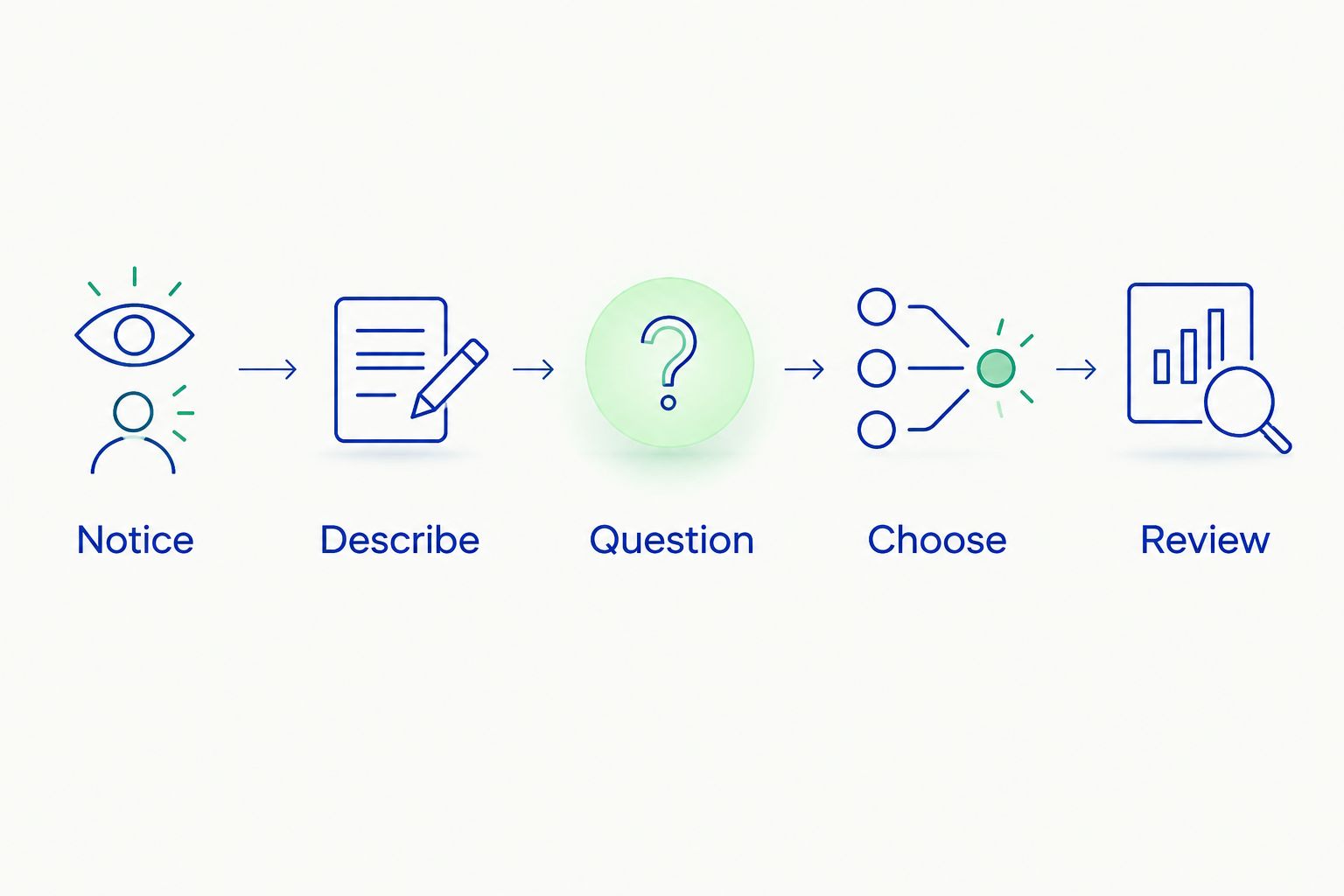
For example, you might notice that you often agree to requests before checking your own needs. Rather than naming that your permanent nature, describe one recent request and consider what a more deliberate response would sound like.
The sequence above is a suggested reflection exercise, not an official scoring or interpretation protocol. Use the model's own explanations when you need the meaning of a particular diagram feature.
How these tools are ranked
This 2026 ranking prioritises model fit, everyday relevance, flexibility, practical direction and clear boundaries. The model-specific starting point comes first because a diagram needs its own framework's explanations; supporting tools follow according to the different questions they help you explore.
This is a practical recommendation, not a claim that one approach has demonstrated better psychological outcomes. No effectiveness scores or clinical comparisons are implied.
Which interpretation tool should you choose?
Start with the diagram's own framework, then add a situation log. That pairing gives you both a proposed interpretation and everyday experiences against which to question it.
Choose a journal when meaning remains unclear. Choose receptive and active reflection when you want to consider a response. Choose a guided conversation when you want another perspective without handing over your judgement.
FAQ
What’s the best tool for archetype diagram interpretation in 2026?
For a diagram created through Archegram, start with that model’s quiz, diagram and educational resources. Add a situation log to connect interpretations with specific everyday experiences rather than treating labels as facts.
Can I interpret my diagram without a coach?
You can begin with personal reflection and the model’s educational resources. A guided conversation adds another perspective, but it should not replace your judgement or require agreement with every interpretation.
Does an archetype diagram tell me my fixed personality?
No, treat archetypes as flexible reflection tools rather than fixed identities. Consider your circumstances, contrasting experiences and changing developmental needs when reading a diagram.
Is a situation log better than a reflection journal?
A situation log is better for recording events, while a reflection journal is better for exploring their personal meaning. Choose according to whether you need clearer examples or more space to question an interpretation.
Are masculine and feminine energies tied to gender?
Within this model, masculine and feminine describe active and receptive energies available to anyone. They are not fixed gender roles or prescriptions for how you should behave.
Can an archetype quiz diagnose an emotional problem?
No, this quiz is not a clinical assessment or treatment tool. Use it for spiritual self-understanding and reflection, not diagnosis or decisions about medical care.
Can a diagram predict relationship compatibility?
A diagram does not guarantee or predict relationship compatibility. Use it to reflect on dynamics and possible conflicts while staying attentive to what people actually communicate and do.
One last thing
For your 2026 reflection, keep an exception beside every strong interpretation. If you write that you always withdraw during conflict, look for a situation in which you stayed present or spoke clearly.
That exception deserves attention. The purpose is not to make your life fit the diagram; it is to use the diagram to ask better questions about your life.
Related guides
- Archegram perception, connection and response
- Compensation in an Archegram diagram
- Best quizzes for identifying your coping strategies
