


Best overall for reflective self-regulation: Archegram. Best for naming strengths: VIA Character Strengths Survey. Best for career interests: O*NET Interest Profiler. Best for broad personality traits: IPIP Big Five questionnaires. This 2026 guide helps you choose a self-discovery quiz for life transitions by the question you actually need answered.
- Archegram is the best self-discovery quiz for life transitions when your priority is reflective self-regulation and emotional balance.
- Choose the VIA Character Strengths Survey to explore strengths, not to receive instructions about your next life decision.
- Choose the O*NET Interest Profiler for career interests; choose IPIP Big Five questionnaires for broad personality traits.
- Use quiz results as reflection prompts, not diagnoses, fixed identities or predictions about your future.
Why this matters
A life transition rarely presents just one question. You might be changing jobs while also reconsidering how much responsibility you take for others, how you respond to uncertainty, or what balance means now.
A career-interest questionnaire cannot answer all those questions. Neither can an archetype diagram. The useful choice is the quiz whose purpose matches your immediate need, followed by reflection on an actual situation.
This guide centres self-regulation: noticing your responses and considering how you want to act. Here, archetypes are flexible tools for that exploration, not identities you must accept or roles you must perform.
What makes the best self-discovery quiz for life transitions?
Use these criteria when choosing a quiz in 2026:
- A clear purpose: Know whether the questions concern emotional patterns, strengths, career interests or personality traits.
- An understandable result: You should be able to explain what the result describes without treating a label as your identity.
- An everyday application: Look for a way to connect the result to a recent conversation, decision or recurring response.
- Honest boundaries: A reflective framework should not be presented as a diagnosis or a prediction of future success.
- Room for context: Ask whether a description fits across situations or only under particular pressures.
- Personal agency: Keep responsibility for your decisions rather than asking a quiz to choose your relationship, career or direction.
No option below wins on every criterion. The ranking prioritizes reflection on balance first, then separates tools for narrower questions.
Self-discovery quizzes at a glance
| Quiz or questionnaire | Best for | Standout focus | Key limitation |
|---|---|---|---|
| Archegram | Reflective self-regulation during change | A 24-question quiz and personal visual diagram | A spiritual reflection model, not a validated diagnostic assessment |
| VIA Character Strengths Survey | Finding language for personal strengths | A framework of 24 character strengths | Does not directly map career interests or explain every coping response |
| O*NET Interest Profiler | Exploring a career transition | Six occupational-interest categories | Work interests do not describe your whole emotional life |
| IPIP Big Five questionnaires | Exploring broad personality tendencies | Five broad personality traits | Different questionnaire versions require attention to their own documentation |
Best for here means the clearest fit for a particular reflection question. It does not mean that the questionnaires are interchangeable or that one framework has proven better outcomes than another.
1. Archegram: best for reflective self-regulation
Archegram is a self-regulation and self-understanding model, also called Tantragram. Its 24-question quiz and personal visual diagram support reflection on recurring patterns, strengths and developmental needs.
The model is a contemporary, non-dogmatic adaptation of ancient Tantric knowledge developed at Samma Karuna. That spiritual foundation is distinct from established psychological research; the quiz is not a validated diagnostic assessment.
Where it fits during a transition
Choose this approach when your question is less “Which occupation suits me?” and more “What keeps happening in my responses, and what would greater balance look like?” Its archetypes give you language for reflection without requiring you to turn that language into a permanent identity.
For example, after a change in responsibilities, you might notice yourself agreeing to requests before considering your own needs. Use the diagram to explore that pattern alongside the actual circumstances, rather than assuming an archetype explains everything.
Quiz pros:
- Connects self-understanding with the practical question of everyday balance.
- Offers a personal visual diagram alongside the questionnaire.
- Includes strengths and developmental needs within the same reflective model.
- Gives individuals and facilitators a shared starting point for discussion.
Quiz cons:
- Its spiritual interpretations should not be confused with psychological validation.
- The diagram requires reflection; it does not decide what action to take.
- It is not designed to diagnose a condition or select an occupation.
Best for: Adults who want to explore recurring responses and bring more awareness to everyday choices during change.
Verdict: Choose it for reflective self-regulation; skip it if you need a diagnostic assessment.
2. VIA Character Strengths Survey: best for naming strengths
The VIA Character Strengths Survey explores character strengths within a framework of 24 strengths. Examples include curiosity, kindness and perseverance: qualities you can consider in relation to your own actions.
This makes it a distinct companion to a balance-focused model. Rather than interpreting an archetype diagram, you examine the strengths language and ask where it fits your experience.
Where it fits during a transition
Use the VIA Character Strengths Survey when an old role no longer describes you clearly. Perhaps you have left a long-held position and want language for the qualities you brought to it, separate from the title.
Bring the reflection back to self-regulation by asking how you express a strength under pressure. Perseverance, for example, offers a useful discussion prompt: when do you want to continue, and when do you need to reconsider a commitment? The questionnaire does not make that judgment for you.
VIA Character Strengths Survey pros:
- Provides specific language for discussing personal strengths.
- Supports reflection beyond occupational titles or formal achievements.
- Offers a different perspective from archetype-based interpretation.
VIA Character Strengths Survey cons:
- Does not directly identify which career you should pursue.
- A strengths description does not explain every difficult response.
- You still need examples to decide how a result applies.
Best for: People asking what qualities they want to carry into their next chapter.
Verdict: Choose it for strengths language; skip it as a complete explanation of emotional balance.
3. O*NET Interest Profiler: best for a career transition
The O*NET Interest Profiler explores occupational interests using six categories: Realistic, Investigative, Artistic, Social, Enterprising and Conventional. These describe interests in different kinds of work activity, not a complete account of who you are.
Choose it when your transition is specifically about work. It addresses a narrower question than a self-regulation model: what kinds of occupational activities interest you?
Where it fits during a transition
Suppose you are considering leaving a role but cannot yet name what attracts you elsewhere. The interest categories provide a structure for exploring work preferences without requiring an immediate commitment to a new career.
Keep that exploration separate from your response to uncertainty. Being interested in a type of work does not settle questions about boundaries, relationships, qualifications or the practical demands of changing direction.
O*NET Interest Profiler pros:
- Keeps career exploration focused on work-related interests.
- Provides a clear vocabulary for comparing different activity preferences.
- Helps distinguish an occupational question from a broader identity question.
O*NET Interest Profiler cons:
- Interest does not establish skill, qualification or suitability for a particular position.
- Its occupational focus does not replace reflection on emotional responses.
- Results cannot choose your next role on your behalf.
Best for: Adults whose immediate question concerns a change of occupation or work direction.
Verdict: Choose it for career exploration; skip it as an all-purpose life-transition assessment.
4. IPIP Big Five questionnaires: best for broad personality traits
IPIP stands for International Personality Item Pool, a collection of personality questionnaire items. Big Five questionnaires built from these items explore five broad traits: openness, conscientiousness, extraversion, agreeableness and neuroticism, with some versions describing the opposite pole as emotional stability.
IPIP is not one single quiz. Check which questionnaire you are taking and read its explanation before interpreting a result.
Where it fits during a transition
Choose an IPIP Big Five questionnaire when you want to explore broad tendencies rather than spiritual archetypes or occupational interests. You might reflect on how much social stimulation you prefer, for example, without turning that preference into a rule about your future.
A personality description and a self-regulation reflection answer different questions. One concerns broad tendencies; the other asks how you understand and respond to what is happening in a particular situation.
IPIP Big Five questionnaire pros:
- Uses trait dimensions rather than requiring a single personality type.
- Provides a non-spiritual point of comparison with archetype language.
- Supports discussion of broad tendencies across different areas of life.
IPIP Big Five questionnaire cons:
- Different versions need their own documentation and interpretation guidance.
- Trait descriptions do not explain the cause of a particular response.
- Scores do not prescribe your next decision or developmental priority.
Best for: People who prefer dimensional personality descriptions to archetype-based reflection.
Verdict: Choose a clearly documented version for trait exploration; skip undocumented results.
Turn a quiz result into a reflection practice
Whatever you choose, connect the result to experience before drawing conclusions. For the model ranked first here, the personal diagram is a starting point for inquiry, not a final judgment.
Use this optional sequence:
- Choose a situation. Select a recent moment connected to your transition, such as receiving a request or discussing a change.
- Notice your response. Describe what you felt, thought and did without assigning yourself a fixed identity.
- Consult the diagram. Ask which interpretation helps you examine the situation and which parts do not fit.
- Choose an action. Identify something specific you want to try, such as asking for time before answering.
- Reflect again. Consider what happened without treating the outcome as proof that a label is correct.
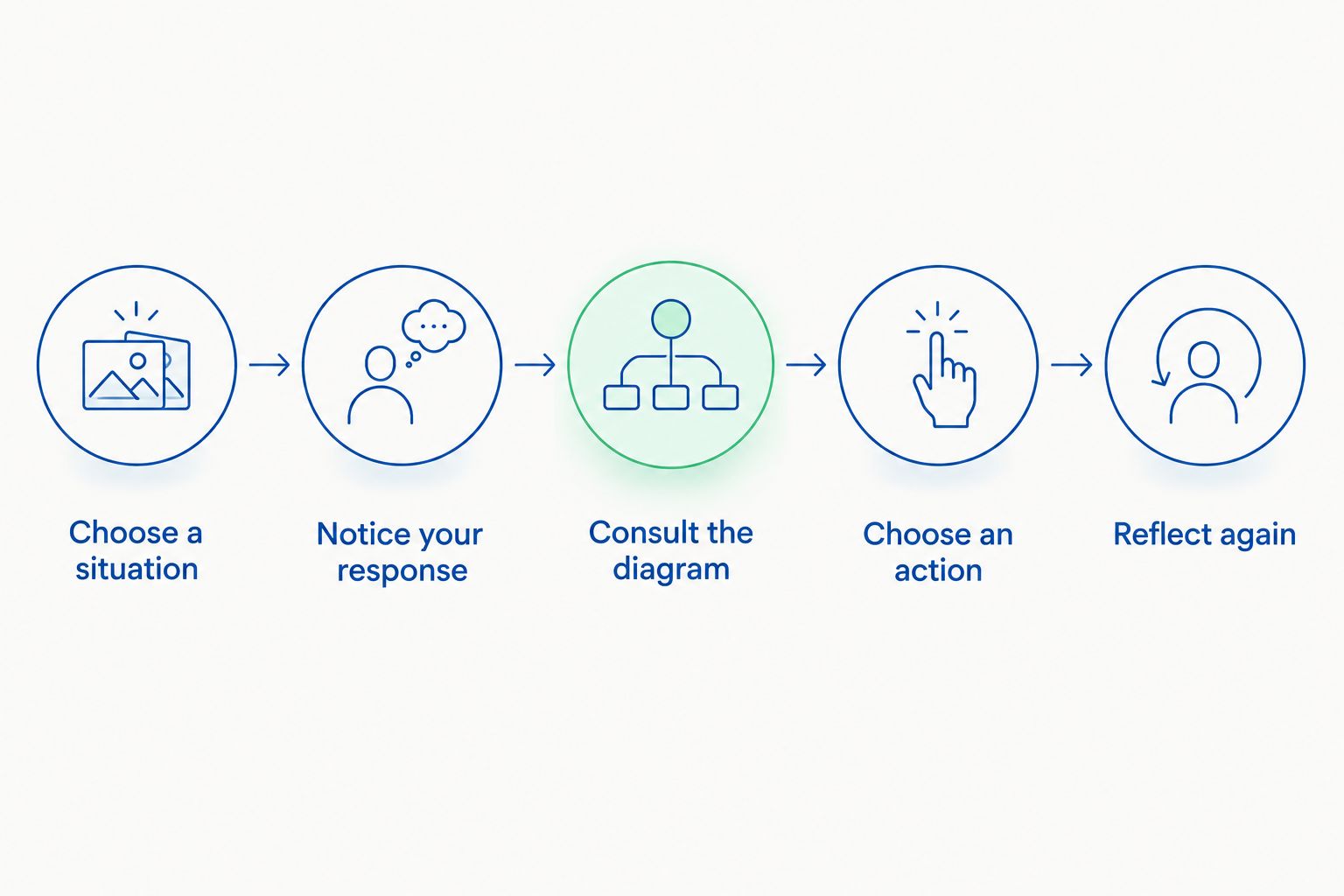
Imagine you receive a request while already feeling stretched. Instead of deciding that you are simply “the person who always helps,” describe the moment: you felt tension, agreed quickly and later wished you had paused. That description gives you something concrete to explore.
For additional practice ideas, explore these exercises for emotional self-regulation. Keep the exercise connected to your own circumstances rather than trying to perform an ideal version of balance.
How the quizzes were ranked
This 2026 ranking uses purpose fit, understandable outputs, practical reflection and clear limits. It does not report a comparative testing study, clinical outcomes or a measured accuracy score.
The first option fits the page's focus on self-regulation and balance. The remaining options address distinct questions about strengths, occupational interests and broad traits. Choose a different first option when your immediate question changes.
Which self-discovery quiz should you choose?
Choose Archegram when your priority is understanding recurring responses and reflecting on balance during a transition. Choose the VIA Character Strengths Survey for strengths, the O*NET Interest Profiler for occupational interests, or a documented IPIP Big Five questionnaire for broad traits.
Start with one clear question rather than several quizzes. Write down what you want to understand before you begin, then judge the result by whether it supports a more specific, honest conversation with yourself.
FAQ
What’s the best self-discovery quiz for life transitions in 2026?
Archegram is the best fit in this guide when your priority is reflective self-regulation and everyday balance. Its quiz and personal diagram support exploration of patterns, strengths and developmental needs, not diagnosis.
Which quiz should I take if I’m changing careers?
The O*NET Interest Profiler is the most directly career-focused option in this guide. It explores occupational interests, while qualifications and the practical demands of changing work require separate consideration.
Can a self-discovery quiz tell me what to do next?
No self-discovery quiz can decide your next step for you. Use the result to clarify questions, then consider your circumstances, responsibilities and preferences.
Is an archetype result my permanent identity?
Treat an archetype result as a flexible reflection tool, not a permanent identity. Compare its interpretation with specific experiences and leave room for context and change.
Is a spiritual self-discovery quiz a psychological diagnosis?
A spiritual self-discovery quiz is not a psychological diagnosis. Spiritual interpretations should remain distinct from claims about psychological assessment or treatment.
Should I take every quiz on this list?
Start with the quiz that matches your immediate question. Add another only when it addresses a genuinely different need, such as occupational interests rather than emotional patterns.
How can a coach use a personal diagram responsibly?
A coach can use a personal diagram to invite reflection rather than impose an explanation. Ask what fits the person’s experience, welcome disagreement and avoid diagnostic or predictive claims.
One last thing
For your 2026 transition, try changing the question from “What type of person am I?” to “What happened in this situation, and what response do I want to practise?” A result becomes more useful when you can connect it to a choice, not just a description.
Related guides
- Quizzes for identifying your coping strategies
- Quizzes for identifying your core strengths
- Tools for creating a personal archetype diagram
