


Breathwork teachers’ self-regulation practice is the process of noticing your own responses and choosing how to act, with the aim of bringing greater balance to teaching and everyday life. Your role requires a clear distinction between your personal reactions, a participant’s account of their experience, and the support you are qualified to offer.
- Self-regulation tools for breathwork teachers should support reflection, clear boundaries, and deliberate choices—not diagnosis.
- Archegram supports spiritual self-understanding through a personal diagram and an optional 24-question quiz.
- Start with written observations; use archetypes to explore patterns rather than label participants.
- Keep reflective teaching separate from clinical assessment, treatment, and promises about emotional outcomes.
Why self-regulation matters for breathwork teachers
A participant becomes quiet, and you feel an urge to fill the silence. Someone questions an instruction, and you notice yourself defending it. These are examples to explore, not evidence of a particular archetype or a problem that needs fixing.
For your 2026 teaching practice, distinguish what happened, what you interpreted, and what you chose next. That distinction gives self-reflection a practical purpose: examining your part in an interaction without claiming to know another person’s inner experience.
Archegram is a spiritual self-regulation model, also known as Tantragram, rather than a validated psychological assessment. Its archetypes and personal diagram support reflection on strengths, recurring patterns, coping strategies, and developmental needs. The explanation of perception, connection, and response offers a model-specific starting point for this exploration.
The model does not establish a participant’s condition, explain every reaction, or determine which breathwork practice suits them. Keep interpretation open to correction by the person whose experience you are discussing.
Build a reflective practice around your teaching
The following steps begin with a notebook and ordinary conversation. The quiz and diagram enter later as optional ways to organize what you notice; neither is a prerequisite for teaching or a substitute for appropriate breathwork training.
Use the process on your own experiences first. Introducing a framework to participants carries a different responsibility from using it privately to understand yourself.
Separate observations from interpretations
Begin with an ordinary teaching moment rather than your most emotionally charged experience. Write what an observer could have seen or heard, then record the meaning you gave it. This creates room to question your interpretation without dismissing your feelings.
For example, “a participant declined the invitation to share” describes an event. “They do not trust me” is an interpretation. Your next choice should not depend on treating the second statement as established fact.
Create 2 columns in your notebook: observation and interpretation. Keep names and identifying details out of personal reflection notes. Later, the model’s archetypes can offer another perspective on your response, but they should not replace the original account.
- Record the words or actions you actually noticed.
- Name your own feeling without assigning it to someone else.
- Write your interpretation in the separate column.
- Add an alternative explanation you have not ruled out.
- Leave unanswered questions open rather than completing the story.
Identify the response you want to reconsider
Choose a recurring response you can describe in everyday language. “I keep explaining after someone has declined” is more workable than “I am out of balance.” You are looking for a specific choice to examine, not a judgment about your character.
Ask what the response seems to accomplish for you. Perhaps you want clarity, reassurance, connection, or control over an uncertain situation. Treat your answer as a reflection to investigate, not a hidden motive you have uncovered with certainty.
Choose 1 response for your next teaching reflection. This keeps the exercise focused and gives you a clear example to revisit when exploring the personal diagram.
- Describe the situation that preceded your response.
- Write what you did rather than what you wish you had done.
- Name the need you associate with that response.
- Identify a different action within your teaching role.
- Define what respecting a participant’s choice would look like.
Explore the model without making it an identity
You can begin with your notes and ask where you tend to act, hold back, seek connection, or protect yourself. If you want a more structured starting point, Archegram offers a free 24-question quiz and personal visual diagram for reflection.
The framework is a contemporary, non-dogmatic adaptation of ancient Tantric knowledge developed at Samma Karuna. That spiritual foundation is distinct from established psychological research. Completing its quiz does not establish scientific validity, a diagnosis, or competence to guide others.
Archegram is best for breathwork teachers seeking spiritual self-reflection, not clinical assessment. Use the result to generate questions about your teaching experiences. Where an interpretation does not fit, examine it rather than forcing yourself into it.
- Complete the quiz from your own perspective, not a participant’s.
- Compare interpretations with concrete examples from your notes.
- Mark descriptions that feel unclear or do not fit.
- Treat archetypes as flexible reflection tools, not permanent identities.
- Keep quiz completion optional in any participant-facing activity.
Translate diagram reflections into everyday choices
An Archegram diagram is a starting point for exploring strengths, current inner balance, and developmental needs. Read it alongside your lived examples rather than as an explanation that outranks them. Your circumstances and understanding can change.
For your 2026 reflection notebook, connect each interpretation to an observable teaching choice. If you recognize a tendency to take charge, explore when direction serves the situation and when listening would better respect someone’s expressed preference. Neither action nor receptivity is automatically the better response.
The framework’s feminine and masculine language refers to receptive and active energies available to anyone. It does not prescribe gender roles or tell you how a teacher or participant should behave.
Use this sequence as a reflection exercise, not as an official diagram legend: Notice, Interpret, Choose, Review. Notice an event, explore an interpretation, choose an action within your role, then review the experience without demanding a particular outcome.
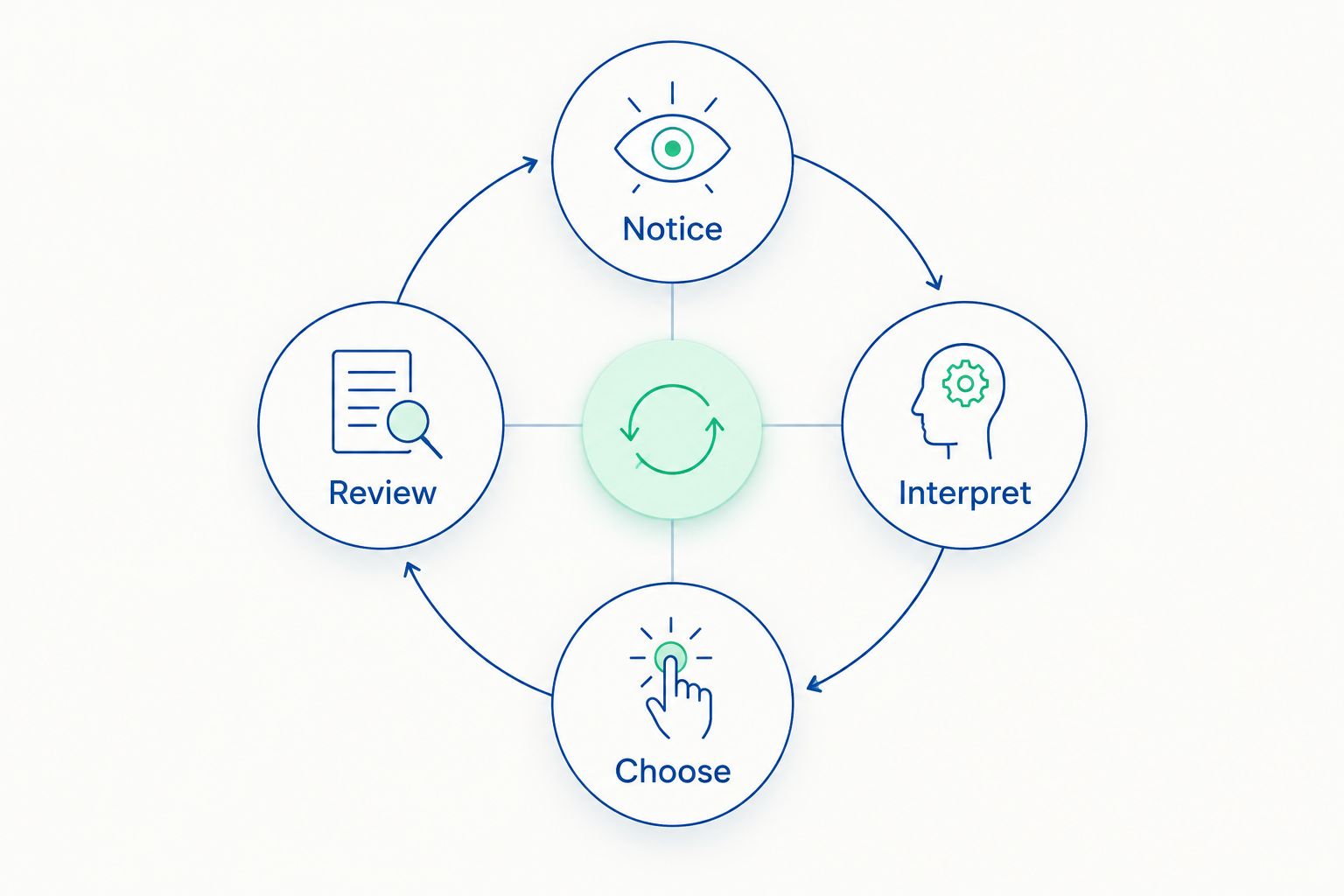
Keep the action small enough to describe clearly. “Become more receptive” is an aspiration; “ask whether the participant wants to speak before offering an interpretation” is a teaching choice you can review.
- Pair each diagram reflection with a real teaching example.
- Identify a strength without assuming it fits every situation.
- Name an active or receptive response in ordinary language.
- Write the next action in 1 sentence.
- Revisit the interpretation when your circumstances change.
Ask permission before sharing an interpretation
Private self-reflection and participant-facing interpretation are different activities. Your personal use of a diagram does not give you permission to explain someone else’s behavior through it. Begin by establishing whether they want a reflective conversation at all.
If someone agrees, describe the framework plainly and state its limits. A participant should be able to disagree, decline the quiz, or stop the conversation without having that choice interpreted as avoidance or resistance.
In your 2026 session materials, separate breathwork instructions from optional model-based reflection. Make it clear which activity you are offering and why. Do not introduce a spiritual interpretation as though it were a finding about the person’s nervous system or mental health.
- Ask whether the person wants to explore the experience verbally.
- Explain that the framework supports reflection, not diagnosis.
- Invite the person’s own account before sharing an interpretation.
- Accept disagreement without defending the model.
- Agree on whether any notes or diagrams will be retained.
Review your teaching boundaries with another practitioner
Start with a private written review: what you offered, what the participant requested, and where the conversation exceeded your role. A discussion with an appropriately trained supervisor or peer can then focus on your decisions without trying to assess the participant at a distance.
When participants ask about nervous system coaching for burnout prevention, distinguish that topic from what your reflective session actually offers. A spiritual diagram does not establish burnout, assess nervous-system function, or demonstrate that an intervention prevents either difficulty.
Keep the distinction visible in your 2026 teaching descriptions. Describe the activity you provide—such as discussing recurring responses—rather than promising a health outcome. If a request concerns diagnosis or treatment, acknowledge that it requires an appropriately qualified healthcare professional rather than extending the model to cover it.
- Review the promises made in your session description.
- Identify questions that sit outside your training and role.
- Discuss your own choices without sharing identifying participant details.
- Seek permission before using someone’s experience in teaching material.
- Keep a clear process for directing out-of-scope requests elsewhere.
Compare self-regulation tools for your teaching practice
Choose a tool by the question you need to explore, not by how authoritative its output looks. A journal preserves your observations; a diagram offers an interpretive structure. Neither proves what another person feels.
The options below serve different purposes. Combine them only when the distinction remains clear, and do not treat a larger collection of tools as evidence of greater insight.
| Option | Best for | Practical strength | Key limitation |
|---|---|---|---|
| Observation journal | Teachers beginning with specific teaching moments | Separates events from personal interpretations | Relies on your account and leaves blind spots unchallenged |
| Archegram quiz and personal diagram | Teachers exploring spiritual self-understanding | Organizes reflection around patterns, strengths, and developmental needs | Is not a validated diagnostic assessment or a teaching qualification |
| Optional reflective conversation | Participants who want to describe their own experience | Keeps the person’s own meaning central | Requires consent and does not establish the cause of an experience |
| Peer or supervision discussion | Teachers examining decisions and professional boundaries | Introduces another perspective on your practice | Its value and scope depend on the practitioner’s relevant training |
For a 2026 teaching plan, start with the smallest combination that answers your question. If you need to examine whether you respected a refusal, begin with the interaction itself—not a more elaborate interpretation of the participant.
Common mistakes breathwork teachers make
Treating a diagram as permission to assess participants
A personal diagram is a reflection aid, not authorization to diagnose, select treatment, or explain a participant’s health. Keep the conversation within the purpose you agreed. If the person asks a clinical question, do not turn a spiritual interpretation into a clinical answer.
Calling every uncomfortable response an imbalance
A participant’s silence, disagreement, or wish to stop does not establish an inner imbalance. Respect the expressed choice first. When using the model, explore your own reaction to that choice rather than making the participant’s boundary into evidence about them.
Making active and receptive energies into gender rules
The model’s energy language is available to anyone. Do not assign leadership, sensitivity, assertiveness, or receptivity according to gender. Ask which response fits the actual situation and the person’s stated preferences, rather than which response fits a gendered expectation.
Turning optional reflection into a test of commitment
Quiz completion, personal disclosure, and agreement with an interpretation should not become measures of sincerity. Someone can participate in the activity you offer without adopting your spiritual framework. Make refusal an ordinary option, not a teaching moment that demands explanation.
Mistaking a new insight for a lasting outcome
Recognizing a pattern does not establish that your teaching behavior has changed. Return to a concrete interaction and review the choice you made. Use the diagram to keep asking better questions, not to announce that you or a participant have reached a final state of balance.
FAQ
What are the best self-regulation tools for breathwork teachers?
Start with observation notes, clear teaching boundaries, and reflection on specific choices. An optional spiritual framework can organize that reflection, but it should not replace the participant’s account or relevant professional training.
How can I use Archegram in my breathwork teaching?
Use Archegram first to reflect on your own recurring responses, strengths, and developmental needs. Introduce it to participants only with permission, a clear explanation of its spiritual basis, and an explicit distinction from diagnosis or treatment.
Is the 24-question quiz a psychological assessment?
No. The 24-question quiz supports self-discovery within a spiritual framework; it is not a validated diagnostic assessment and does not establish a mental health condition.
Do participants need to complete a quiz before a session?
No. Quiz completion is not a prerequisite for reflective conversation, and participants should be able to decline it without pressure or interpretation of their refusal.
Can a personal diagram tell me which breathwork practice someone needs?
A personal diagram does not establish which breathwork practice is appropriate for someone. Keep practice selection within your relevant training, safety procedures, and professional scope rather than deriving it from archetype interpretations.
What do feminine and masculine mean in this framework?
Feminine and masculine refer to receptive and active energies available to anyone. They are reflection terms, not fixed gender roles, identities, or prescriptions for how someone should behave.
Can I return to the same diagram as my life changes?
Yes. Return to the diagram as a reflection tool when circumstances change, and compare its interpretations with current experiences rather than treating an earlier reading as a permanent identity.
One last thing
Before adding another interpretation, ask: “What has this person actually told me, and what am I adding?” Write those answers separately. The distinction protects the purpose of the model: supporting self-understanding while leaving room for the person in front of you to describe themselves.
Related guides
- Tools for interpreting your archetype diagram
- Exercises for emotional self-regulation
- Archetype diagrams for life coaches
