


An archetype diagram for educators is a visual self-reflection aid for exploring recurring patterns, with the aim of supporting emotional balance in teaching and adult learning. This 2026 guide explains how to use the model for your own self-regulation and optional adult reflection—not to grade learners, diagnose difficulties or assign fixed identities.
- An archetype diagram for educators supports self-regulation and emotional balance, not learner assessment.
- Archegram is best for educators seeking a spiritual framework for voluntary adult self-reflection.
- Start with a teaching situation; use the diagram to explore patterns rather than define someone’s personality.
- Keep participation optional, interpretations tentative and personal diagrams outside assessment records.
Why archetype diagrams matter for educators
Teaching involves decisions about when to listen, when to respond and when to hold a boundary. A reflective diagram gives you a shared reference point for examining those decisions without turning every difficult interaction into a judgment about character.
Archegram is a self-regulation and self-understanding model that uses archetypes, a personal visual diagram and a free 24-question quiz. An archetype here means a pattern you can reflect on, not a category that determines who you are.
Archegram is best for educators seeking a spiritual self-regulation framework for voluntary adult reflection, not learner assessment. Its alternative name is Tantragram. The model is a contemporary, non-dogmatic adaptation of ancient Tantric knowledge, distinct from established psychological research and diagnostic assessment.
For educators, the practical question is not which archetype a learner belongs to. It is how your current patterns affect your response to a classroom disagreement, an unanswered question or a challenging conversation with a colleague.
This guide addresses adult educators, teachers reflecting on their own practice, and facilitators supporting consenting adults. It does not provide a protocol for assessing children.
How to use a diagram in educational practice
Define a reflective purpose before choosing a tool
Begin with paper and a specific teaching moment. Describe what happened, what you noticed in yourself and what you wanted to do. You do not need a quiz to establish the question you want to explore.
For example, a learner challenges an instruction and you immediately repeat it more firmly. Your reflective purpose might be to understand that response before deciding whether the situation called for explanation, listening or a clearer boundary.
Write a sentence in your 2026 teaching plan that states what the exercise is for. Keep it separate from any assessment of teaching competence or learner performance. A narrow purpose makes it easier to recognise when the conversation has moved beyond the exercise.
- Choose one recent, concrete teaching situation.
- Describe observable events before interpreting motives.
- Name the response you want to understand.
- State that the exercise supports reflection, not assessment.
Establish consent before inviting adult learners
Start manually by explaining the activity and offering a private writing alternative. Ask participants whether they want to explore a pattern, discuss an example or simply observe. Participation in the wider course should not depend on sharing a personal diagram.
Consent matters especially when you also grade work, supervise practice or influence professional opportunities. An invitation can feel compulsory when it comes from someone with authority. Make the alternative explicit rather than expecting participants to request it publicly.
A useful opening is to explain that each person decides what to share and whether an interpretation fits. Avoid promising confidentiality beyond the rules your setting can actually maintain, particularly in group discussion.
- Explain the reflective purpose before participation.
- Offer an equivalent activity without a diagram.
- Let adults keep results and personal examples private.
- State the setting’s actual privacy and safeguarding boundaries.
- Allow participants to stop without explaining why.
Create a diagram without treating it as a score
You can first sketch a simple personal reflection map: the situation, your response and the need you want to explore. Label that sketch as your own exercise, not an official model diagram. This preserves the distinction between ordinary journaling and the model’s specific visual representation.
When you want the framework’s personal diagram, the Archegram quiz offers a structured starting point through its 24 questions. Answer from your own experience rather than trying to produce the profile you imagine an effective educator should have.
Use the accompanying explanations when reading the result. Do not assume that visual prominence means greater maturity, that balance requires identical shapes, or that a diagram measures professional ability. The guide to interpreting your archetype diagram is a relevant next resource.
- Answer from lived examples rather than an ideal teaching identity.
- Read the supplied explanations before interpreting visual features.
- Keep your interpretation separate from claims about other people.
- Record what resonates and what does not fit.
- Treat unanswered questions as questions, not hidden defects.
Connect the diagram to a real teaching moment
Read the diagram alongside the event you chose, not as a substitute for it. A meaningful interpretation should help you ask a clearer question about what happened. It should not give you permission to explain away another person’s experience.
Suppose you fill every silence during a discussion. Explore whether you were trying to help, avoid uncertainty or keep the session moving. These are possible questions for reflection, not conclusions supplied by a diagram.
If receptive and active energies appear in your interpretation, understand them as capacities available to anyone. Receptive can describe listening and allowing; active can describe initiating and responding. Neither is a prescribed gender role, and neither is always the appropriate response.
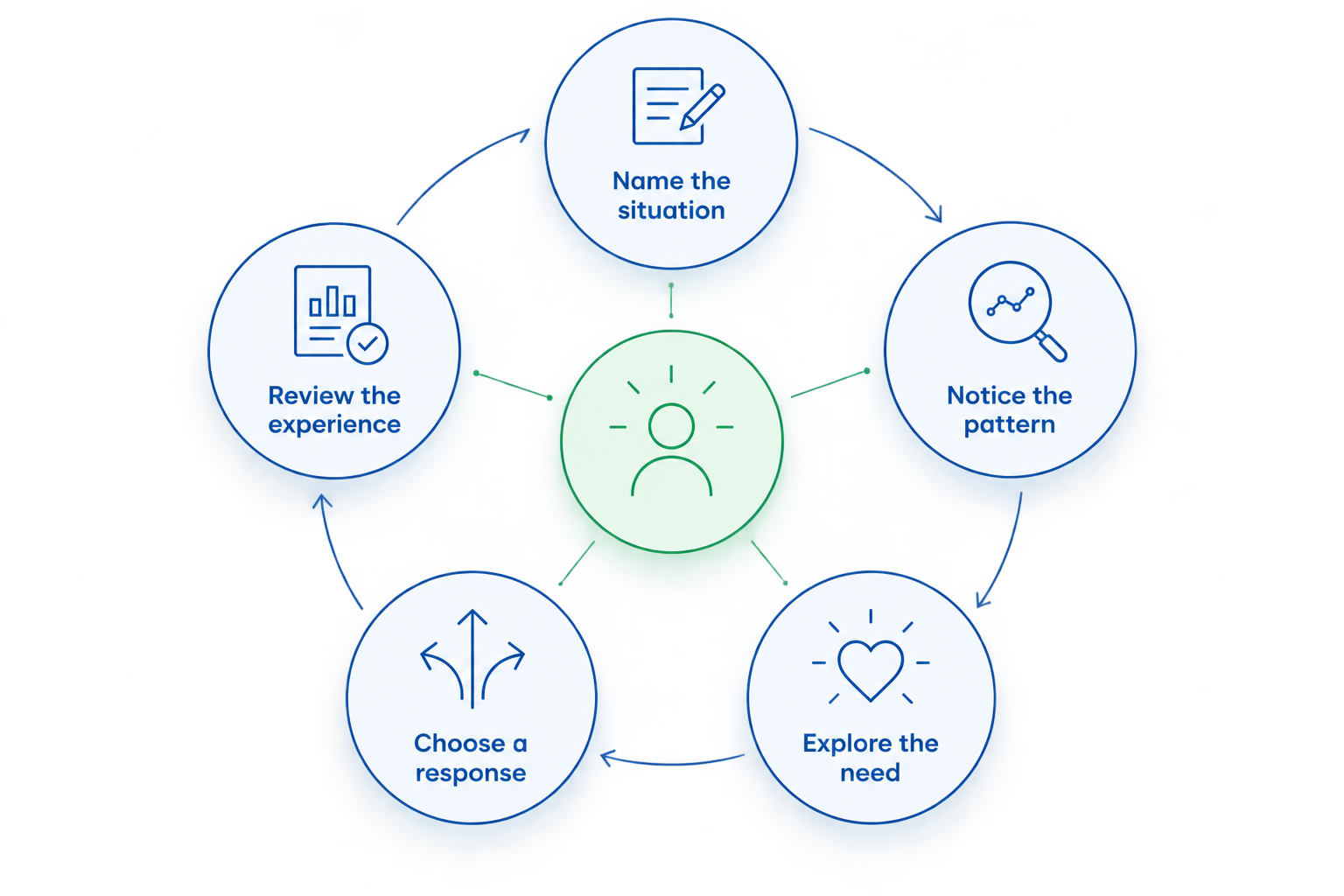
- Name the situation: describe a specific exchange.
- Notice the pattern: identify your repeated response.
- Explore the need: ask what mattered to you.
- Choose a response: identify a practical alternative.
- Review the experience: compare your intention with what happened.
The reflection sequence below is an application exercise, not a reproduction of the model’s official diagram. Use it to keep interpretation connected to everyday teaching.
Practise a small response rather than chasing balance
Begin with a change you can describe in ordinary language. Instead of aiming to become a more balanced educator in general, decide how you will respond when a familiar situation returns. The diagram supports that choice; it does not make the choice for you.
For example, allow yourself 3 minutes after a difficult session to write 2 sentences: what you noticed and what you will try next. These are suggested exercise boundaries, not a tested dosage or a promise of improvement.
In a 2026 teaching journal, connect each experiment to its context. Holding a boundary in one situation and listening longer in another are not contradictory goals. Balance does not require responding identically to different needs.
- Choose one response within your own control.
- Describe what that response looks or sounds like.
- Practise without requiring another person to change.
- Note the effect without calling it proof of the model.
- Adjust the experiment when the context changes.
Review interpretations without ranking maturity
Return to your notes after another relevant teaching experience. Compare the situations and your responses before deciding whether an interpretation still helps. A different response is not automatically evidence of progress, and a repeated response is not automatically failure.
The model includes reflection on personal development and maturity. In an educational setting, keep that exploration personal rather than turning it into a hierarchy of enlightened teachers or difficult learners. Your diagram is not a credential, and another person’s willingness to share is not a measure of openness.
Date your 2026 reflections so you can distinguish present concerns from earlier circumstances. Review what the exercise helps you notice, and leave aside interpretations that encourage shame, certainty about others or dependence on the facilitator.
- Compare concrete situations rather than ranking diagrams.
- Ask which interpretation remains useful.
- Record examples that challenge your initial reading.
- Keep maturity language out of grading and selection.
- Stop the exercise when it no longer serves its stated purpose.
Compare reflection options for educators in 2026
Choose the format according to the purpose and the level of personal disclosure involved. A model-based diagram is useful when you want its particular reflective language; it is not a prerequisite for examining your teaching practice.
| Option | Best for | Practical strength | Key limitation |
|---|---|---|---|
| Private teaching journal | Educators examining a specific incident independently | Keeps attention on personal examples and context | Offers no model-specific interpretation |
| Archegram quiz and personal diagram | Adults seeking a spiritual self-regulation framework | Provides a structured starting point for exploring patterns and strengths | Is not a validated diagnostic assessment or measure of teaching competence |
| Opt-in diagram discussion | Adult groups exploring their own interpretations | Allows participants to ask questions and compare perspectives | Requires clear consent, privacy boundaries and freedom to disagree |
| Reflective supervision | Educators discussing professional decisions with a supervisor | Connects reflection to a defined professional context | Authority relationships can limit comfortable disclosure |
Use the least exposing format that meets your purpose. If the question concerns a lesson plan or an unclear instruction, address that practical issue directly. A personal diagram should not become an extra requirement for solving an ordinary teaching problem.
Common mistakes educators make with archetype diagrams
Turning a reflection into a learner label
Calling someone a particular archetype shifts attention from their account to your interpretation. It also makes a flexible tool sound like a fixed identity. Ask what the person recognises in their experience, and accept disagreement without correcting them into the framework.
Mixing diagram sharing with assessment
A reflective activity becomes a different exercise when students believe disclosure affects a grade, reference or certification decision. Separate personal exploration from evidence of learning. Assess the stated educational task, not someone’s diagram, emotional openness or preferred interpretation.
Explaining every difficulty through inner patterns
Unclear instructions, inaccessible materials and conflicting expectations require practical attention. Do not reinterpret these issues as a learner’s resistance or imbalance. Examine the teaching conditions before inviting personal reflection, and take responsibility for changes within your role.
Treating spiritual language as psychological evidence
Archetypes, receptive energy and active energy belong to this model’s interpretive framework. They do not establish a diagnosis or explain another person’s mental health. Present spiritual meaning as an invitation to reflection, not as a research finding or an alternative to appropriate professional support.
Asking groups for more disclosure than the task needs
A teaching exercise does not require intimate histories to feel meaningful. Invite an everyday example, allow private writing and avoid pressing for an explanation when someone declines. Group curiosity does not override a participant’s boundaries.
FAQ
What is an archetype diagram for educators used for?
An archetype diagram for educators is used to reflect on recurring responses, strengths and developmental needs in teaching or adult learning. It supports questions about self-regulation rather than grading, diagnosis or fixed personality labels.
Is Archegram a scientifically validated assessment?
Archegram is a spiritual self-regulation and self-understanding framework, not a validated diagnostic assessment. Use its quiz and diagram for reflection, not to establish psychological facts about yourself or learners.
Can I use a personal diagram to assess my students?
Do not use a personal diagram to assess ability, suitability or academic performance. This guide addresses educator self-reflection and voluntary work with adults, not assessment of children.
Do adult learners have to share their quiz results?
Adult learners should be able to keep their quiz results private. Offer an equivalent activity and do not connect personal disclosure to grades, references or participation judgments.
What should I do if a diagram interpretation does not fit?
Leave aside an interpretation that does not fit your experience. Check it against specific examples, read the accompanying explanation and avoid treating disagreement as evidence of a hidden problem.
Do masculine and feminine energies refer to gender roles?
Masculine and feminine describe active and receptive energies available to anyone within this framework. They should not prescribe how people of any gender teach, lead, listen or relate.
How often should educators revisit a diagram?
Revisit a diagram when a new question or changed circumstance makes reflection useful. There is no need to turn repeated quizzes or changing interpretations into a performance target.
One last thing
A useful diagram should make room for a different response, not give you a permanent explanation of yourself. Before your next teaching session in 2026, choose one ordinary moment to notice: an interruption, a silence or an unclear request.
Afterwards, ask whether the framework helped you respond with greater awareness of the situation and your own needs. Keep the practical insight; resist turning it into a label. The purpose is greater balance in everyday life, not a more elaborate story about who you must be.
Related guides
- Exercises for emotional self-regulation
- The model for meditation teachers
- Self-discovery questions to ask yourself
