


The Archegram model for meditation teachers is a self-regulation framework for exploring recurring patterns, strengths and developmental needs with the aim of supporting greater emotional balance in everyday life. As a teacher, your task is to use that reflection without turning meditation into personality assessment or asking students to accept your interpretation of their inner experience.
- The Archegram model for meditation teachers supports self-regulation and emotional balance through reflection, not diagnosis.
- Start with your own recurring responses before introducing archetypes or personal diagrams to students.
- Use the 24-question quiz as a conversation starter, never as proof of a fixed identity.
- Keep diagram sharing optional and connect every interpretation to a practical, student-chosen action.
Why self-regulation matters for meditation teachers
Teaching meditation involves more than explaining where to place attention. You also decide how to respond when someone questions an instruction, becomes quiet or asks for more support than the session can provide. Those moments offer material for reflection on your own habits, without requiring you to interpret the student.
Archegram offers a spiritual framework for examining patterns through archetypes and a personal visual diagram. It is also known as Tantragram and is presented as a contemporary, non-dogmatic adaptation of ancient Tantric knowledge. It is distinct from established psychological research and is not a validated diagnostic assessment.
For your 2026 teaching practice, the useful question is not which archetype makes someone a good meditator. It is whether reflection helps you identify a familiar response and choose a more balanced action. Keep that practical purpose ahead of labels, spiritual explanations or an impressive-looking diagram.
Keep teaching and interpretation separate
A meditation instruction asks someone to try a practice. A diagram interpretation offers a possible way to understand an experience. Keep those invitations separate so that declining the model does not feel like declining your teaching.
You can introduce self-reflection without requiring a quiz, a spiritual vocabulary or public disclosure. That distinction matters especially when students attend for meditation rather than a course in personal development. Explain any additional framework before inviting participation.
Apply the model in six practical steps
Begin with your own experience, then decide whether the model belongs in a student conversation. The sequence below is a suggested teaching exercise, not an official scoring method or a replacement for learning diagram interpretation.
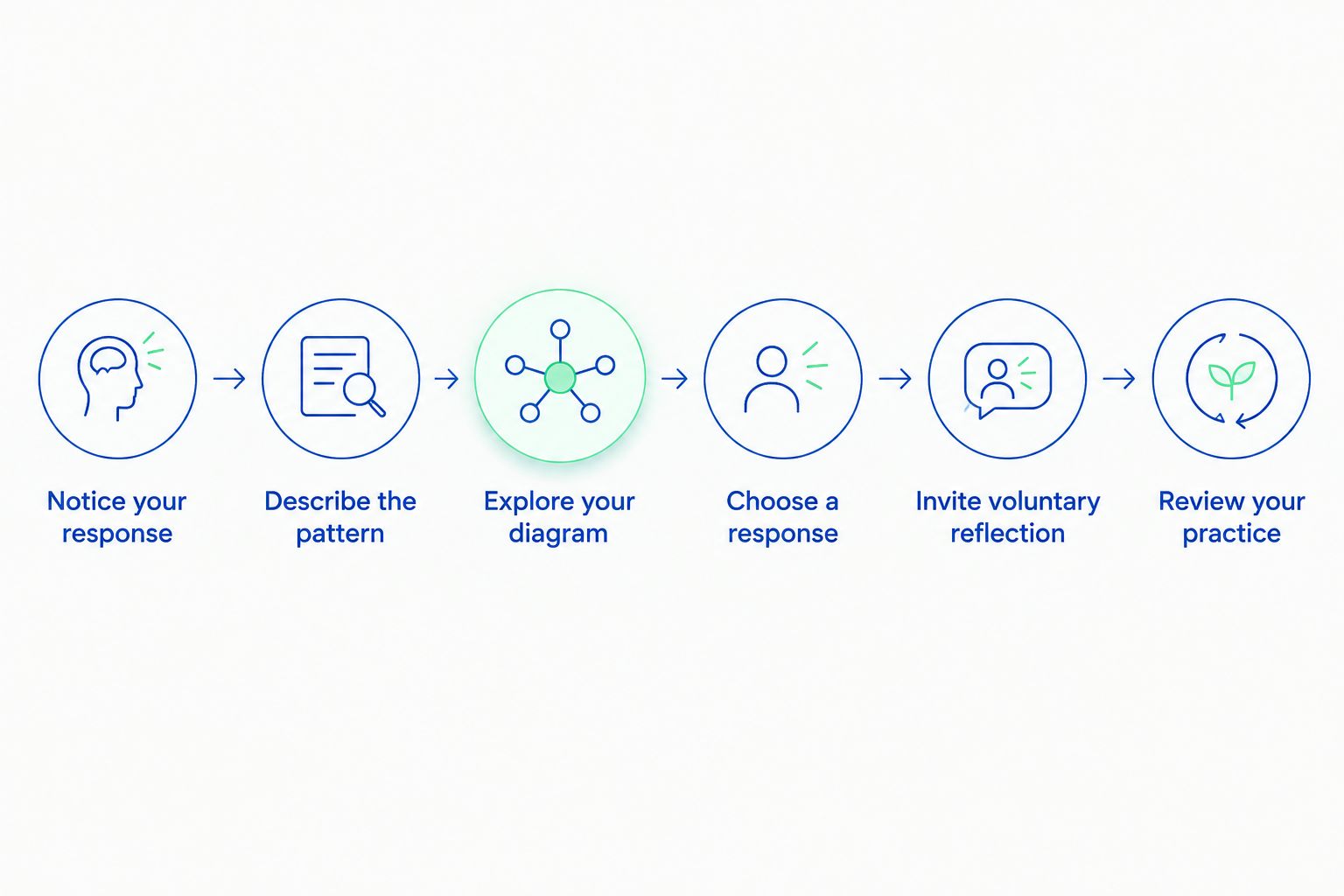
Notice your response
Start with an ordinary teaching moment rather than an archetype label. Perhaps a student asks why you chose a particular practice, and you immediately feel compelled to defend it. Write down what happened and how you responded without deciding what either person is like.
For a simple exercise, set aside 2 minutes after a session. Record the event, your response and what you wanted in that moment. This is a suggested reflection period, not an evidence-based dose or a model requirement.
Separate observation from explanation. A student leaving early is an event; assuming they rejected your teaching is an interpretation. Your reflection becomes more useful when you can tell the difference.
- Record the student's words or observable action without adding a motive.
- Name your own feeling in everyday language, such as frustration or uncertainty.
- Note what you did next, including silence, explanation or changing the subject.
- Leave space for another possible explanation of the event.
Describe the pattern
Look for a response that recurs across situations. You might notice that you explain more when you feel uncertain, agree before checking your limits or withdraw when someone challenges you. These are examples to examine, not conclusions about meditation teachers as a group.
Use 3 questions: What happened? What did I do? What was I trying to protect or obtain? Your answer should describe your experience rather than claim access to someone else's motives.
In a 2026 reflection journal, date each entry and keep your language provisional. Writing that you rushed to restore agreement leaves room for change; calling yourself permanently conflict-avoidant turns an observation into an identity.
- Compare examples from different sessions rather than relying on one difficult day.
- Identify the useful intention behind your response, such as maintaining clarity.
- Describe its cost, such as leaving too little room for questions.
- Write an alternative response that preserves the intention without repeating the habit.
Explore your diagram
Once you have concrete examples, the free Archegram 24-question quiz offers a structured starting point for reflection through a personal visual diagram. Answer from lived experience rather than from your image of how a meditation teacher should behave. An aspiration and a recurring response are not necessarily the same thing.
Archegram is best for meditation teachers seeking a spiritual self-reflection framework, not a clinical assessment. Its strength is providing a shared structure for exploring patterns; its limitation is that a diagram does not establish why a response occurs or verify an interpretation.
Use the guide to tools for interpreting your archetype diagram for further reading. Do not invent meanings for unfamiliar diagram elements or treat visual prominence as proof of a problem.
- Read the explanations supplied with the diagram before drawing conclusions.
- Connect each interpretation to a specific example from your own experience.
- Record what does not fit as carefully as what feels familiar.
- Treat archetypes as flexible reflection tools rather than permanent identities.
Choose a response
Translate reflection into something you can actually do in a teaching situation. If you tend to answer immediately, your experiment might be to pause and clarify the question. If you agree too quickly, it might be to check your limits before making a commitment.
The model's language about receptive and active energies can serve as a reflection prompt here. Receptive means making room to listen or receive; active means initiating or taking action. Neither belongs to a particular gender, and neither is automatically the better response.
Choose one experiment for the next 7 days of teaching or personal practice. This is a suggested review window, not a promised timeline for change. Keep the experiment small enough to describe without using an archetype name.
- Write the situation in which you want to respond differently.
- Choose an observable action, such as asking a clarifying question.
- State a boundary, such as not extending a session without agreement.
- Decide what you will record afterward, including when the experiment did not fit.
Invite voluntary reflection
Introduce the model to students only when the purpose is clear and participation is genuinely optional. Explain that it offers spiritual interpretations for self-understanding, not a measurement of mental health or meditation ability. A student should be able to decline without losing access to the meditation session.
Keep the student's own examples at the centre of the conversation. Ask what an interpretation brings to mind rather than announcing what a diagram reveals about them. If they disagree, leave the interpretation open instead of treating disagreement as evidence of an unseen pattern.
For a 2026 workshop plan, separate meditation instruction, model education and personal sharing into clearly described activities. Do not assume that consent to attend covers all three.
- Explain the purpose and limits before inviting quiz participation.
- Offer private reflection as an alternative to speaking in a group.
- Ask permission before discussing any part of a personal diagram.
- Let students choose the language they use for their experience.
- Avoid assigning labels to absent partners, relatives or other students.
Review your practice
Return to the original situation and examine your action, not just your understanding of the model. Did you ask the question you intended to ask? Did you express the boundary you had identified? Record what you did before deciding what it means.
A development framework should leave room for changing circumstances. A response that fits a quiet individual conversation might not fit a large class or a time-limited workshop. Revisit your interpretation rather than making every new experience confirm an old diagram.
During your 2026 teaching review, keep personal insights separate from claims about student outcomes. A reflective note about feeling less defensive is not evidence that the method improved anyone else's emotional health.
- Compare your chosen action with what actually happened.
- Note the context, including the request and your existing commitments.
- Keep useful questions even when an archetype interpretation no longer fits.
- Decide whether to continue, revise or stop the experiment.
Compare reflection options for meditation teachers
Choose the option that fits your purpose and the student's consent. The options below are not competing treatments or interchangeable assessments. Each offers a different setting for reflection, with limits that should stay visible.
| Option | Best for | Practical strength | Key limitation |
|---|---|---|---|
| Private teaching journal | Teachers beginning personal reflection | Starts with events you observed directly | Your own assumptions still shape the account |
| Archegram quiz and personal diagram | Teachers seeking structured spiritual self-reflection | Gives patterns and developmental questions a shared framework | Is not a validated diagnostic assessment |
| Facilitated diagram conversation | Adults who actively want to explore the model | Creates space to discuss interpretations and examples | Depends on consent, clear boundaries and interpretation skills |
| Optional written student reflection | Meditation groups with different levels of interest | Allows reflection without public diagram sharing | Does not teach detailed diagram interpretation |
Use private reflection first; add structured interpretation only when it serves a clear purpose. A diagram is not a prerequisite for noticing that you rushed, withdrew or overcommitted. Conversely, a journal entry does not substitute for learning how the model's diagram is intended to be read.
For group teaching, choose the least intrusive activity that meets the stated aim. If the aim is simply to notice a habitual response, students do not need to share personal histories or explain their whole diagram.
Common mistakes meditation teachers make
Turning a reflection into an identity
Saying that someone belongs to a fixed type closes the conversation too early. Describe the pattern they recognise in a particular context instead. Leave room for strengths, contradictions and responses that change over time.
Reading spiritual progress into a diagram
Do not use a result to rank students by maturity, awareness or readiness to teach. A personal diagram is a reflection resource, not proof of spiritual attainment. Keep meditation experience and model interpretation distinct.
Treating receptive and active energies as gender rules
Do not prescribe receptivity to women or action to men. Within this framework, both are available to anyone. Ask which quality a situation calls for rather than which quality someone is supposed to embody.
Using consent as a one-time checkbox
A student who chooses to complete a quiz has not automatically agreed to group interpretation. Ask again before sharing or discussing personal material. Give an easy way to pass without requesting an explanation.
Mistaking familiarity for permission to diagnose
Recognising a pattern in yourself does not establish its cause in a student. Keep questions within your teaching role, avoid treatment claims and do not present spiritual interpretations as psychological findings. When a request falls outside your role, state that boundary clearly.
FAQ
What’s the best way for a meditation teacher to start using the model?
Start with your own teaching experiences before interpreting anyone else’s diagram. Record a recurring response, explore the model’s explanation and choose a small action to review in practice.
Is Archegram a scientifically validated personality assessment?
Archegram is a spiritual self-understanding and self-regulation framework, not a validated diagnostic assessment. Its quiz and diagram support reflection and should not be presented as established psychological measurement.
Do my meditation students need to take the quiz?
No, students do not need to take the quiz to participate in meditation or ordinary self-reflection. Introduce it only as an optional resource with a clearly explained purpose.
Can I interpret a student’s diagram after taking the quiz myself?
Taking the quiz yourself does not establish competence to interpret another person’s diagram. Learn the model’s interpretation approach and keep any conversation within your skills, the student’s consent and your teaching role.
How many questions are in the quiz?
The free online quiz contains 24 questions. Treat the resulting personal diagram as a starting point for exploring patterns, not a verdict about identity or emotional health.
Are receptive and active energies the same as gender roles?
No, receptive and active energies are qualities available to anyone within this framework. Use them to explore listening and action without assigning either quality by gender.
Should students share their personal diagrams in a meditation group?
Sharing a personal diagram should always be optional. Offer private reflection instead, and ask specific permission before discussing personal material with the group.
One last thing
Try describing your next teaching experiment without a single archetype term. If you can say that you will clarify a question before defending an instruction, you have identified an action. If you can only name an energy or a type, return to the everyday example.
That is a useful standard for applying the model in 2026: let the diagram open a question, then let lived experience shape your next response. You do not need to settle your identity to make a more deliberate choice.
Related guides
- Exercises for emotional self-regulation
- Archetype diagrams for life coaches
- The framework for yoga teachers
