


The Archegram quiz has 24 questions in 2026, offering a starting point for exploring recurring patterns and greater balance in everyday life. The question count does not tell you how long you will spend reflecting on your answers or interpreting your personal diagram, and the quiz is not a clinical assessment.
- How many questions in the Archegram quiz? There are 24, supporting self-understanding rather than clinical diagnosis.
- Archegram is best for adults seeking a spiritual reflection framework for self-regulation and emotional balance.
- Use your personal diagram to explore patterns, strengths and developmental needs—not to assign yourself a fixed identity.
- Answer from everyday experience, then connect your reflections to a practical response you want to explore.
How many questions are in the Archegram quiz?
There are 24 questions in the quiz. You can explore the free quiz through Archegram, whose self-regulation model brings together archetypes, reflection and a personal visual diagram.
The number describes the questionnaire, not the depth of understanding you must reach before finishing. You do not need to resolve a recurring difficulty or make sense of every response while answering.
Here is the distinction to keep in mind when approaching the quiz in 2026:
| Part of the experience | What it supports | Best for | Important limit |
|---|---|---|---|
| 24-question quiz | Reflection on how you describe your patterns | Beginning a self-understanding exercise | Answers do not establish a diagnosis |
| Personal visual diagram | Exploring strengths, current balance and developmental needs | Giving your reflection a visual reference | Interpretation is not a fixed verdict about you |
| Everyday application | Connecting an observation with a deliberate response | Bringing reflection into ordinary situations | An insight is not a guaranteed change in behaviour |
These are connected parts of using the model, not competing assessments. The questionnaire gives you somewhere to begin; interpretation and application give you questions to keep exploring.
Why the question count matters—and what it cannot tell you
Knowing the quiz contains 24 questions makes the starting point clear. It does not establish a completion time, the accuracy of an interpretation or the amount of personal insight you will gain.
For self-regulation, the useful question comes after the count: what will you do with what you notice? A description becomes more practical when you connect it to an ordinary moment, such as withdrawing from a difficult conversation or agreeing to something before checking your own needs.
You might recognise a pattern without knowing how to respond differently yet. That is a reasonable place to begin. Treat the result as an invitation to observe, rather than a demand to transform yourself immediately.
The model is also known as Tantragram. It is presented as a contemporary, non-dogmatic adaptation of ancient Tantric knowledge, not as an established psychological assessment or a substitute for professional care.
How should you approach the 24 questions?
Answer from your lived experience rather than from an image of the person you think you should be. The following approach is a suggested reflection exercise, not an official scoring method or a description of the quiz interface.
1. Recall a situation
Bring an ordinary situation to mind before interpreting a broad statement about yourself. You might remember receiving criticism, making a decision with someone else or responding when plans changed.
Keep the example specific enough to describe what happened. Instead of deciding that you are always accommodating, recall whether you expressed a preference during a recent conversation. A concrete example gives you something to examine without turning it into a permanent identity.
2. Notice your response
Ask what you actually did, including any difference between your inward experience and outward behaviour. Perhaps you felt disappointed but said that everything was fine.
Neither part needs to become a judgment. The purpose is to recognise the response you are describing, not to reward yourself for answering in a spiritually impressive way.
3. Read the diagram
Approach your personal diagram as material for exploration. Look for interpretations that connect with recognisable experiences, and leave room for interpretations that do not fit.
A useful question is: where have I seen this pattern in my own life? If no example comes to mind, do not manufacture one to make the diagram feel correct. Uncertainty is a valid part of reflection.
4. Choose an action
Translate a relevant observation into something you can try in an everyday situation. If your reflection concerns agreeing too quickly, your chosen action might be to ask for time before making a commitment.
Keep the action separate from the archetype label. You are exploring a response, not proving that a category defines you. Afterwards, consider whether the action expressed your needs and respected the situation.
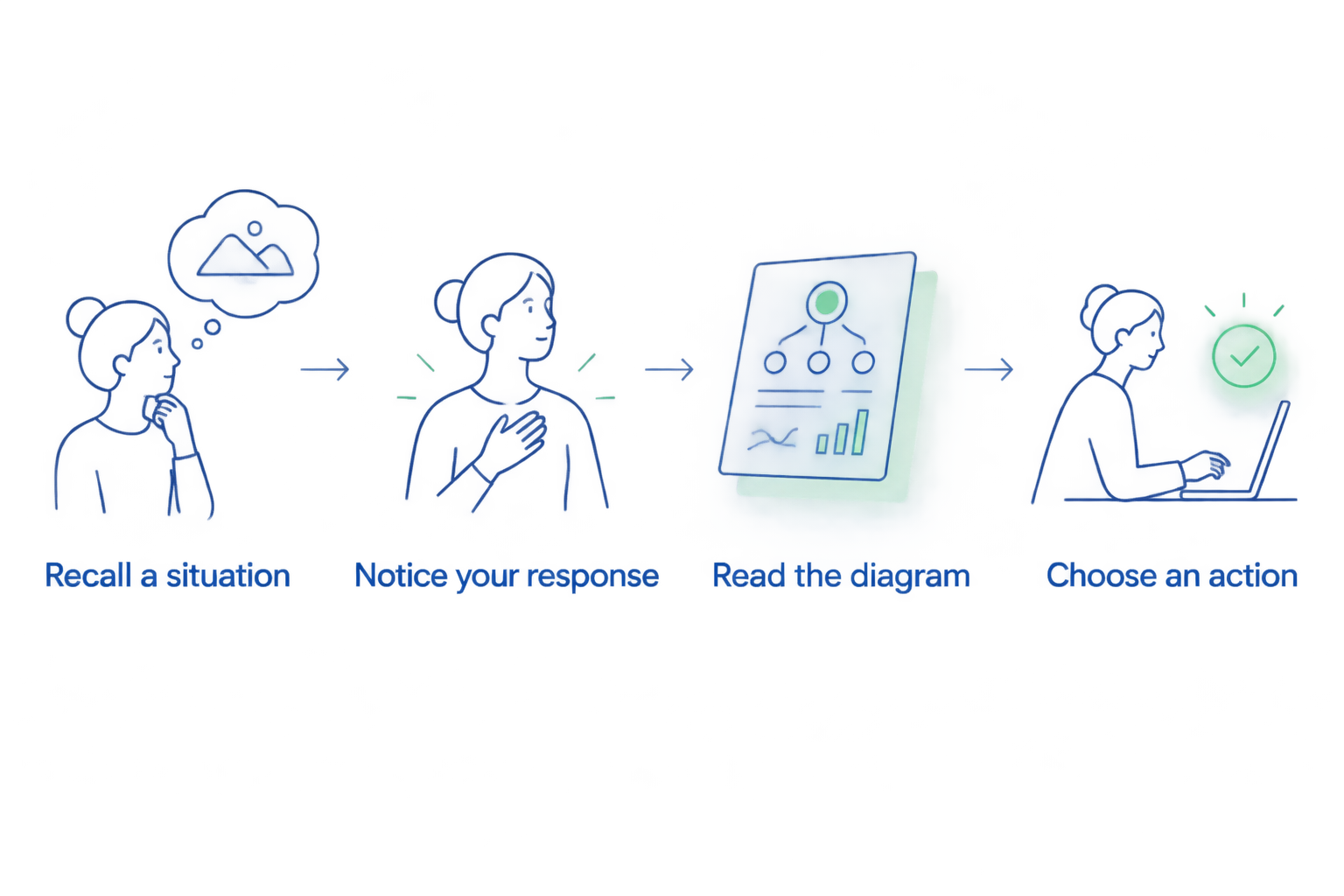
You can continue with the quiz-to-first-diagram workflow if you want a more focused next step. Keep your own examples alongside the interpretation so that reflection stays connected to daily life.
Why does the reflection experience vary?
The questionnaire contains 24 questions, but people bring different experiences and intentions to it. These factors describe the context of reflection; they are not claims about scoring or measured effects.
- Your purpose. You might be exploring a recurring reaction, seeking greater everyday balance or preparing for a reflective conversation.
- The situations you consider. A response that fits your working life does not necessarily describe how you behave with close friends.
- Your familiarity with the language. An unfamiliar archetype term needs explanation before you can decide whether its interpretation is useful.
- Your current circumstances. A transition or difficult period gives you a different context for considering strengths and developmental needs.
- Your next step. Reading a diagram, writing about an example and discussing an interpretation are different ways to continue reflecting.
None of these factors changes the stated question count. They change what you bring to the exercise and which observations you choose to examine afterwards.
How do the questions connect to self-regulation?
Within Archegram, archetypes support the broader purpose of understanding yourself and finding greater balance. An archetype is a reflective pattern or image in the model—not a complete account of your personality.
Consider an illustrative example: you notice that you repeatedly take responsibility for keeping a conversation comfortable. Rather than asking only which archetype describes you, ask what happens when maintaining harmony conflicts with expressing your needs.
Your next reflection might focus on the difference between caring for a relationship and automatically setting yourself aside. You can then choose a response to explore, such as expressing a preference without demanding agreement. This is a suggested application, not a promised result of completing the questionnaire.
The same care applies to receptive and active energies. In the model, these describe possibilities available to anyone, not instructions about how a particular gender should behave. Use the language only where it helps you understand a concrete experience.
What should you write down after the quiz?
Start with a brief note about an interpretation you want to explore. A detailed life story is not necessary; the aim is to preserve enough context to return to the observation later.
Try these 2 reflection prompts:
- What recent situation supports this interpretation, and what situation challenges it?
- What response would I like to explore when a similar situation happens again?
The first prompt gives disagreement a place in the exercise. You do not have to accept every interpretation simply because it appears connected to a diagram.
The second prompt brings the reflection back to self-regulation. Instead of collecting labels, you choose a way of responding that you can examine in practice.
If you are keeping a reflection journal in 2026, date the entry and describe the surrounding circumstances. Later, compare the examples themselves rather than treating a different interpretation as evidence that you answered incorrectly. The model's developmental approach allows you to return to reflection as your circumstances change.
Can you use the quiz when guiding someone else?
Use the questionnaire as a conversation starting point, not as permission to decide what another person is like. Coaches, facilitators and teachers should keep the distinction between reflective guidance and clinical assessment clear.
Ask the person what an interpretation means to them before offering your own reading. A question such as “Does this connect with anything you recognise?” leaves room for agreement, disagreement and uncertainty.
Avoid using the result to settle a conflict or explain away someone's concerns. A diagram does not make your interpretation more authoritative than the person's account of their own experience.
For people interested in guiding others, learning the model and its interpretation is a separate purpose from completing the quiz. Finishing the questionnaire alone does not establish professional competence or a qualification.
Is answering every question enough to understand yourself?
Completing 24 questions finishes a questionnaire, not the work of self-understanding. The result gives you material to consider, while your experiences provide the context for deciding what is meaningful.
Be especially careful with interpretations that sound flattering or absolute. A statement about a strength still needs context: when does that strength serve you, and when do you rely on it without considering another response?
Likewise, a developmental need is not a personal failure. You can acknowledge something you want to explore without treating the diagram as a ranking of your worth or maturity.
What if a result does not feel right?
A 24-question reflection tool does not require you to accept an interpretation that conflicts with your experience. Name the disagreement and look for a specific example rather than forcing a match.
You might also need a plain-language explanation of an unfamiliar term. Understanding the wording and agreeing with the interpretation are separate things; you can understand a concept and still decide it does not describe you.
Keep the model in its proper role. Questions about symptoms, diagnosis or treatment belong with an appropriately qualified healthcare professional, not with an archetype interpretation.
FAQ
How many questions are in the Archegram quiz in 2026?
The Archegram quiz has 24 questions in 2026. It supports reflection on recurring patterns, strengths and developmental needs rather than clinical diagnosis.
Do 24 questions tell me exactly how long the quiz takes?
No. A count of 24 questions does not establish a completion time. Reading, considering your answers and exploring a diagram are separate activities.
Is the quiz a validated personality assessment?
The quiz is a spiritual self-reflection resource, not a validated diagnostic assessment. Treat its interpretations as material to explore rather than established psychological findings about you.
Do I need to understand archetypes before answering?
You do not need to adopt an archetype identity to begin reflecting. Ask for plain-language explanations of unfamiliar terms and connect interpretations with experiences you recognise.
Does my diagram define a permanent personality type?
No. Archetypes are flexible reflection tools, not fixed identities. Explore your diagram in the context of your circumstances, strengths and developmental needs.
What should I do after completing the questions?
Choose an interpretation to explore through a specific everyday example. Then identify a response you would like to try, without expecting the quiz itself to produce change.
Can I use the quiz to diagnose someone I coach?
No. The quiz is not a diagnostic tool. Keep any use in coaching within reflective conversation and do not treat an interpretation as a clinical judgment.
One last thing
Before you close your notes, write down something the diagram does not capture about you. This simple recommendation keeps the framework in perspective: a tool for exploring your experience should leave room for the parts of your life it does not describe.
For your next reflection in 2026, begin with a real situation rather than a label. The practical question is not just what your pattern is, but how you want to respond when you recognise it.
Related guides
- Diagram to a self-regulation routine
- Can the quiz accurately find your archetype?
- Diagram to a shadow-work journal
