


The Archegram quiz can help you explore patterns that feel familiar, but it cannot establish your archetype as an objective fact or provide a clinical assessment. In 2026, the useful way to approach its 24 questions is as a starting point for self-understanding and self-regulation—not proof of a fixed identity. A result becomes personally meaningful when you examine it alongside your behaviour, circumstances and everyday choices.
- Can the Archegram quiz accurately find your archetype? Treat its result as a reflection prompt, not verified identification.
- The free 24-question quiz supports self-understanding; it is not a clinical assessment or treatment.
- Compare your personal diagram with everyday examples, including experiences that contradict your first interpretation.
- Use archetypes to explore emotional balance and self-regulation, not to assign permanent labels.
Why this matters
A description can feel deeply familiar without explaining everything about you. The question is what you do with that recognition: use it to investigate a recurring response, or turn it into a rule about who you must be.
Archegram is best for adults seeking a spiritual framework for reflection on self-regulation, not a diagnostic verdict. You can explore the free quiz through Archegram, while keeping your lived experience—not the result—as the reference point.
This distinction matters when you want greater emotional balance. A label alone does not tell you how to respond when someone interrupts you, a plan changes or you feel pulled between your own needs and someone else's expectations.
Can the Archegram quiz accurately find your archetype?
The quiz offers an interpretation within a particular self-discovery model. That is different from demonstrating that you possess a single, objectively measurable archetype. Use the interpretation as something to investigate, not something you must accept.
The following distinctions give you a practical standard for reading a result in 2026:
| Use of the result | Best for | Useful question | Limit |
|---|---|---|---|
| Recognising familiar patterns | Beginning personal reflection | Where does this description match my behaviour? | Familiarity does not establish accuracy. |
| Exploring a personal diagram | Considering strengths and developmental needs | What deserves attention in my current life? | A diagram is not a complete account of a person. |
| Planning a different response | Applying reflection to self-regulation | What could I do differently in this situation? | A suggested action is not a guaranteed outcome. |
| Assigning a permanent identity | Not recommended | Am I treating this result as a rule? | A fixed label conflicts with using archetypes flexibly. |
The model, also called Tantragram, is a contemporary, non-dogmatic adaptation of ancient Tantric knowledge developed at Samma Karuna. Its spiritual interpretations should remain distinct from established psychological research. Neither a meaningful experience nor a recognisable description turns a spiritual framework into a validated diagnostic assessment.
What does an accurate-feeling result actually tell you?
An accurate-feeling result tells you that you recognise something in the interpretation. That recognition is worth exploring, but it does not independently verify the model or establish a permanent identity.
For example, you might recognise a habit of taking responsibility before anyone asks. Rather than concluding that you always occupy a particular role, look at the circumstances: when is that response helpful, when is it unwanted, and when do you behave differently?
The contradiction matters as much as the match. If you take charge at work but avoid decisions at home, your reflection needs room for both experiences.
What can the personal diagram help you explore?
The personal diagram supports reflection on strengths, current inner balance, recurring patterns, coping strategies and developmental needs. Read these as areas for inquiry rather than scores of personal worth.
Begin with something you already recognise. If an interpretation suggests a familiar pattern, describe a recent situation in ordinary language before reaching for an archetype term. For example: you agreed to help, felt stretched, then became frustrated that nobody noticed.
Your next question is practical: what did you need, and how did you communicate it? That keeps self-understanding connected to emotional balance rather than collecting descriptions about yourself.
The diagram also belongs within a changing life. The model includes a cycle of personal development and maturity, so returning to it can support reflection as your circumstances change. Do not turn that cycle into a ranking of better and worse people.
A useful interpretation leaves room for complexity. You can recognise a strength and still examine the situations in which relying on it becomes limiting.
Why your interpretation varies
Several parts of the reflection deserve attention before you decide that a result describes you well. These are prompts for reading a self-report quiz carefully, not measured error rates for this quiz.
- The situation you have in mind. Ask whether you answered mainly about work, close relationships or life in general. Record the context rather than assuming the same pattern applies everywhere.
- Behaviour versus aspiration. Separate what you tend to do from what you wish you did. Both matter for growth, but they answer different questions.
- Your reading of the words. Put an unfamiliar archetype term into everyday language. If you cannot explain what it means to you, pause before adopting it.
- Your current circumstances. Consider the responsibilities or changes you are reflecting on. Avoid treating a response to one situation as your whole identity.
- The examples you include. Look for experiences that fit and experiences that do not. Do not discard a contradiction simply because the overall description feels appealing.
In 2026, keep the same boundary whether you read the result alone or discuss it with a guide: an interpretation should invite questions, not claim authority over your experience.
How do you check a result without turning it into a label?
Use the following 5-step reflection exercise after reading your diagram. This is a suggested way to work with the result, not an official scoring method or a test of scientific validity.
1. Notice
Choose one statement from the interpretation that catches your attention. Rewrite it in your own words, without an archetype name.
For example, turn a broad description into an observation such as: I often agree before checking whether I have the energy. Keep the wording specific enough that you can recognise the behaviour.
2. Describe
Write down 2 recent examples connected to that observation. For each, describe what happened, what you felt and what you did.
Do not make the examples prove the result. If you cannot find a clear example, leave the interpretation open rather than filling the gap with a story that sounds right.
3. Question
Find a counterexample: a time when you responded differently. Ask what was different about the situation, the relationship or your sense of choice.
This step protects the flexibility of the exercise. You are exploring a pattern, not building a case that you cannot change.
4. Choose
Select 1 small action connected to the situation you described. You might pause before agreeing, ask for clarification or say that you need time to consider a request.
Choose an action within your control. Another person's approval is not a reliable measure of whether you expressed yourself clearly.
5. Review
After a relevant situation, return to your notes. Ask whether the action helped you express a need, understand your response or notice something you had missed.
Keep, adapt or set aside the interpretation according to its usefulness. You do not owe loyalty to a quiz result.
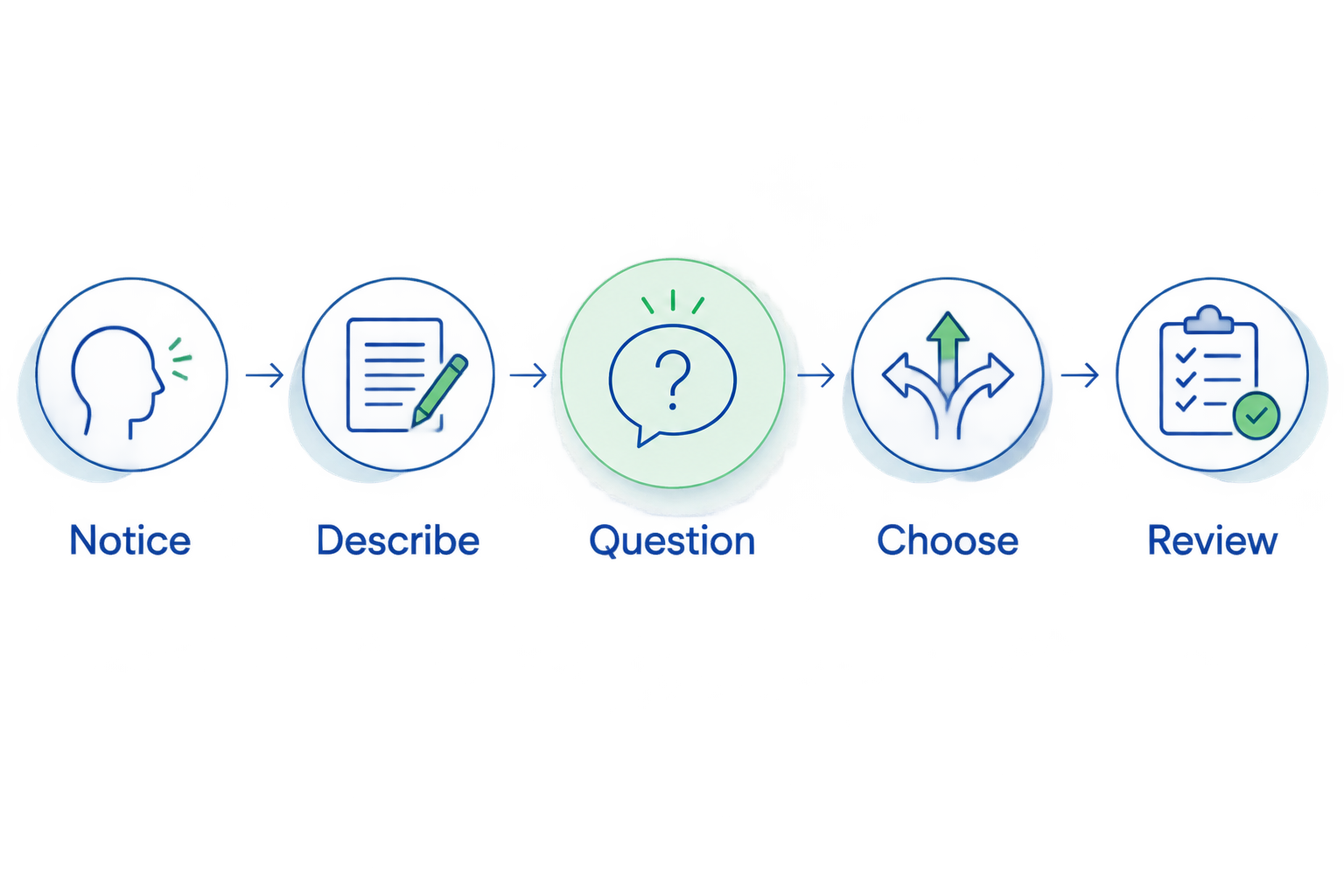
For a longer application of this process, explore the diagram-to-self-regulation routine. Keep the focus on an everyday response you want to understand, rather than finding a more flattering label.
Can a result be useful without being a diagnosis?
Yes. A result can supply language for reflection without establishing a diagnosis or objectively identifying your personality. Its practical value lies in the questions you explore and the choices you make—not in treating the interpretation as unquestionable.
For your 2026 reflection practice, separate these questions: Does this description feel familiar? Can I connect it to a specific situation? Does working with it suggest a constructive next step? A yes to one does not automatically answer the others.
The advantage is an accessible starting point for self-inquiry. The limitation is equally important: a reflective framework does not provide clinical conclusions or replace appropriate professional assessment.
Should you retake the quiz if the result feels wrong?
You do not need to accept a result that does not fit your experience. First, identify the mismatch: an unfamiliar term, an answer that did not represent you well, or an interpretation you simply do not recognise.
Retaking the quiz is not a substitute for examining that mismatch. If you choose to return to it, note what you answered differently and why, without treating either result as the final truth.
Repeatedly taking a quiz to obtain a preferred identity changes the purpose of the exercise. The more useful question is what you hoped the preferred result would confirm about you.
How should a coach or facilitator discuss the result?
A coach or facilitator should invite your interpretation rather than announce who you are. Useful questions include what feels familiar, what does not fit and which everyday situation you want to explore.
For guides using the model in 2026, treat disagreement as information, not resistance. Avoid using a diagram to explain every conflict, assess someone's psychological health or predict relationship compatibility. Relationship reflection should concern dynamics and possible conflicts, not guaranteed outcomes.
If receptive and active energies enter the conversation, describe them as possibilities available to anyone. They are not fixed gender roles, and they should not prescribe how a person must behave.
FAQ
Is the Archegram quiz scientifically validated?
Do not treat the Archegram quiz as a scientifically validated diagnostic assessment. It is a spiritual self-discovery resource intended to support reflection on patterns, strengths and developmental needs.
How many questions does the quiz have?
The free quiz has 24 questions. Use the resulting interpretation as a starting point for exploring your everyday responses, not as proof of a permanent identity.
What’s the best way to tell whether my result fits?
Compare the interpretation with specific experiences, including examples that contradict it. Rewrite broad descriptions in everyday language and ask what they help you understand about your choices.
Can my archetype result change over time?
Treat the result as open to reconsideration rather than a lifelong identity. The model supports returning to reflection as your circumstances and developmental needs change.
Does a result tell me which mental health condition I have?
No, the quiz does not provide a mental health diagnosis. Do not use its archetypes or personal diagram to draw clinical conclusions about yourself or someone else.
Can I use my diagram to work on emotional balance?
Yes, you can use the diagram as a prompt to explore recurring responses, strengths and developmental needs. Connect an interpretation to a specific situation and choose a small action rather than expecting the diagram itself to create change.
Is Tantragram a different model?
Tantragram is an alternative name for the same model. Its archetypes and diagram support spiritual self-understanding and reflection, rather than establishing a clinical assessment.
One last thing
The most revealing part of a result is not always the description you recognise. It can be the sentence you disagree with—and the concrete example that explains why.
Before choosing an archetype label, finish this sentence: I respond this way when… Then finish another: I respond differently when… Keeping both answers gives you a more flexible starting point for self-regulation than trying to make your whole life fit one description.
Let the diagram open a conversation, not close the question of who you are.
Related guides
- From the quiz to your first diagram
- Tools for interpreting your archetype diagram
- Self-discovery questions to ask yourself
