


Yes—the Archegram quiz is free to take in 2026 and contains 24 questions for reflecting on recurring patterns, strengths and developmental needs. It supports self-regulation and self-understanding, but it is not a clinical assessment or treatment.
- Is the Archegram quiz free? Yes—the 24-question quiz and personal visual diagram are free self-reflection resources.
- Best for adults seeking a spiritual framework for self-understanding and greater everyday balance.
- Treat archetypes as flexible reflection tools, not diagnoses, fixed identities or predictions.
- Use your diagram to explore a recurring pattern and choose a practical response.
Is the Archegram quiz free to take?
Yes. You can take the free 24-question quiz and use a personal visual diagram to explore your current patterns. The purpose is not simply to collect an archetype label. It is to support reflection on how you respond to life and where you want greater balance.
You can explore the free quiz and personal diagram as a starting point. Approach the questions with a recent, ordinary situation in mind rather than trying to describe an ideal version of yourself.
The distinction is simple: access to a reflection tool does not make its interpretations a clinical finding. Read the result as an invitation to investigate your experience, not as a conclusion you must accept.
Why this matters
A free quiz can answer an immediate question about access. The more useful question is what you want to do with the result: understand a repeated reaction, recognize a strength or find a different way to respond when life feels unbalanced.
Archegram is best for adults seeking a spiritual self-reflection model for everyday emotional balance, not a clinical assessment. That boundary helps you approach the experience with curiosity rather than expecting a definitive explanation of who you are.
For example, imagine that you regularly agree to requests and feel frustrated afterward. Instead of asking which label explains you, ask what happened between hearing the request and saying yes. The model gives that reflection a framework; your actual experience gives it substance.
What does the free experience include?
The free resources include the online quiz and a personal visual diagram. The quiz contains 24 questions; the diagram supports reflection on strengths, recurring patterns, current inner balance and developmental needs.
These are connected parts of a self-understanding process, not interchangeable forms of evidence. Answering questions gives you material to consider. Interpreting a diagram means relating that material to the situations you actually encounter.
| Resource or practice | Best for | Useful contribution | Limit to remember |
|---|---|---|---|
| Free online quiz | Beginning structured reflection | Offers questions about your patterns and personal growth | Does not establish a diagnosis or a fixed identity |
| Personal visual diagram | Considering patterns together | Provides a visual focus for exploring strengths and balance | Needs thoughtful interpretation rather than a quick label |
| Your own written reflection | Connecting the model to everyday life | Records a specific situation, response and possible alternative | Reflects your perspective, not an independent assessment |
Written reflection is an optional way to work with the model, not an additional quiz feature. A notebook or document is enough for recording what you notice; the point is to connect an interpretation with an example you can describe clearly.
What should you understand before answering?
Answer from lived experience
Choose answers that reflect how you actually respond, including the responses you find uncomfortable. You do not need to make your answers sound more balanced, spiritual or mature.
If a question brings different situations to mind, notice that difference. You might speak freely with friends but become quiet around authority. That contrast is useful reflection material rather than a problem to conceal behind a single identity.
Keep archetypes flexible
An archetype is a pattern or symbolic lens for reflection within this model. It is not a permanent category that explains every choice you make.
Use an interpretation to ask a better question. If a description seems to fit, look for an everyday example; if it does not fit, do not force your experience into it. Your task is to understand yourself, not to defend the result.
Separate spiritual interpretation from research
Archegram, also called Tantragram, is a contemporary, non-dogmatic adaptation of ancient Tantric knowledge. Its spiritual framework should not be confused with established psychological research or presented as a validated diagnostic assessment.
That distinction also applies when a description feels personally meaningful. Recognition can be a starting point for reflection without proving that an interpretation is objectively correct or clinically useful.
How can you use your result for self-regulation?
For your own 2026 reflection practice, start with 1 recent situation, 1 familiar response and 1 alternative action. This is an optional exercise, not an official scoring method or a test of progress.
The aim is modest: connect the diagram with something you can observe. You do not need to interpret every part of the model before considering a more deliberate response to an ordinary difficulty.
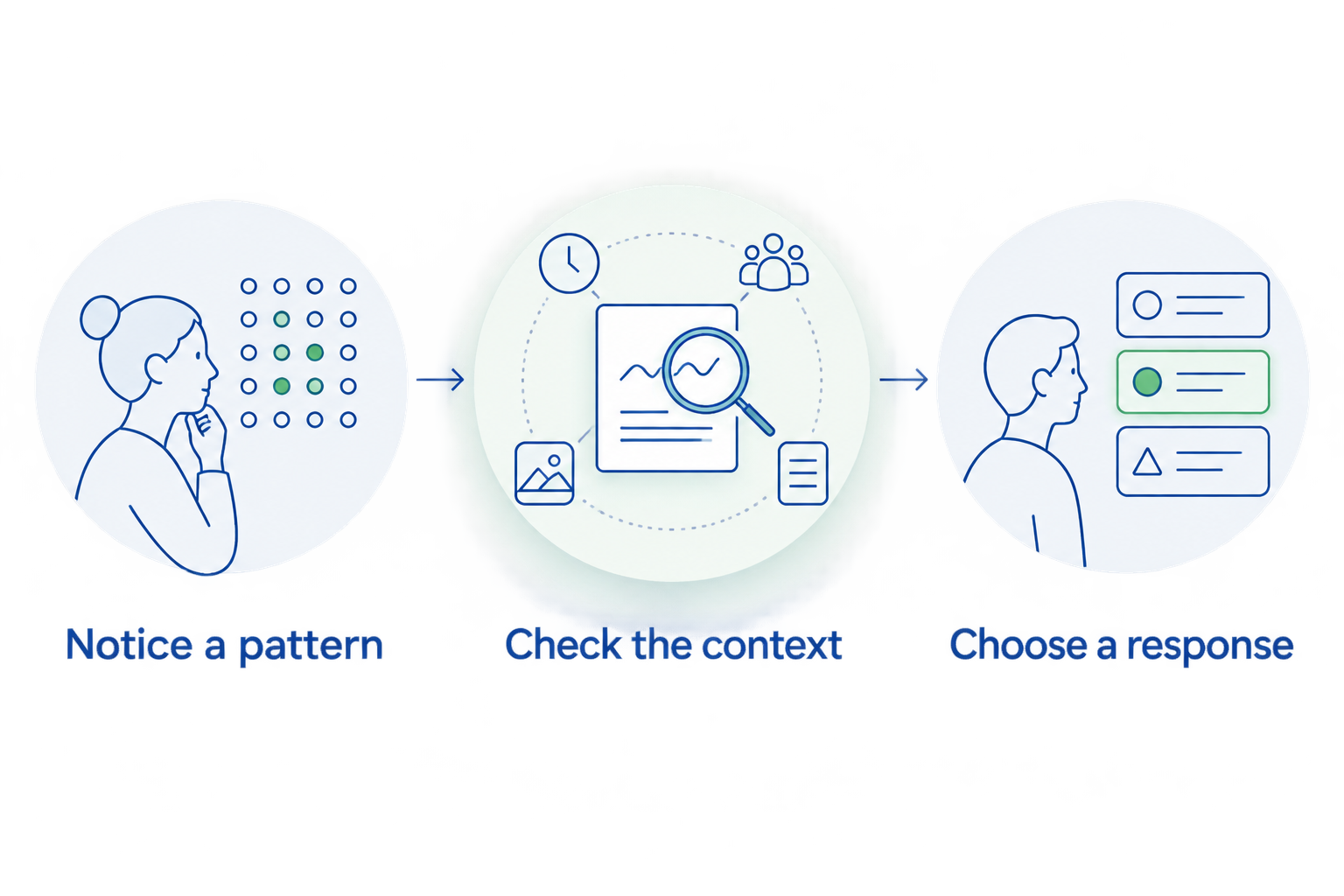
1. Notice a pattern
Choose a recent moment when you felt pulled away from balance. Describe what happened without turning the description into a judgment about your character.
For example, write that you agreed to another task while already feeling stretched. That is more specific than calling yourself weak or incapable of setting boundaries. Then consider which part of your diagram invites reflection on that response.
2. Check the context
Ask what mattered in that situation. Were you trying to preserve connection, avoid disagreement, meet an expectation or get something finished? These are possible reflection questions, not conclusions supplied by the quiz.
Also look for a contrasting example. Perhaps you declined a similar request in another setting. Comparing those experiences keeps the diagram connected to context instead of treating a pattern as something that controls you everywhere.
3. Choose a response
Choose an action that addresses the situation rather than trying to change your whole personality. In the example above, your action might be to pause before agreeing and check what you have already committed to doing.
Write the action in your own words. After a similar situation occurs, return to your note and consider what happened. You are gathering observations for reflection, not producing proof that the model works.
You can also leave an interpretation unresolved. A question that helps you notice your response is useful without requiring an immediate explanation of every feeling or decision.
Why does the usefulness of a result vary?
A diagram gives you material for reflection, not a guaranteed outcome. Its practical value depends on how you engage with it and how carefully you distinguish interpretation from experience.
- Your purpose: Exploring a recurring reaction gives the reflection a clearer focus than seeking a label alone.
- Your examples: Specific situations let you examine whether an interpretation fits your life.
- Your current circumstances: The model invites you to return to questions of balance as your circumstances change.
- Your openness to complexity: Strengths, coping strategies and developmental needs deserve consideration together.
- Your next action: A realistic response connects self-understanding with everyday choices.
Avoid turning these factors into another performance standard. You do not need a profound insight each time you reflect. A clearer description of a familiar situation is a reasonable place to begin.
What are the strengths and limits of this approach?
The model's practical appeal is its combination of questions, archetypes and a personal visual diagram. These give you different ways to approach reflection: through language, symbolic patterns and a picture of how those patterns relate.
The limitation is equally important. A meaningful-looking diagram can invite more certainty than it supports. Do not turn a reflection tool into a verdict about your personality, another person's intentions or your future.
A useful interpretation leaves room for disagreement and change. You can recognize a strength while noticing where a familiar response no longer serves the situation. You can also set aside a description that does not help you understand your experience.
For a 2026 self-discovery practice, make curiosity the goal rather than getting the right identity. The quiz is an entry point; the questions you bring back to daily life are where application begins.
Can you take the quiz for personal insight without becoming a coach?
Yes. The model serves adults exploring their own emotional balance as well as people learning to guide reflective conversations. You can approach the free quiz as personal exploration without turning that interest into a professional role.
Taking the quiz is not the same as learning to interpret diagrams for others. If your interest develops toward guiding people, distinguish your personal experience from the additional learning involved in facilitation.
Can you use a result in a relationship conversation?
Yes—as a reflection prompt, not as evidence that explains or predicts someone else's behavior. Begin with your own experience and invite the other person to describe theirs.
Instead of assigning an archetype to a partner, describe a recurring interaction and ask what each person notices. A relationship conversation should leave room for different perspectives; the diagram does not decide who is right or establish compatibility.
Should you repeat the quiz when life changes?
Returning to the model as circumstances change fits its emphasis on ongoing development and maturity. You can revisit your diagram and earlier notes to consider what feels relevant now.
Do not treat a different result as proof of improvement or decline. Compare the situations, concerns and responses you were reflecting on, rather than using a new diagram as a score for your personal growth.
FAQ
Is the Archegram quiz free in 2026?
Yes, the quiz is free to take and contains 24 questions. It supports self-understanding and reflection on emotional balance rather than clinical assessment.
Do I get a personal diagram with the free quiz?
Yes, the free self-discovery resources include a personal visual diagram. Use it to reflect on strengths, recurring patterns, current inner balance and developmental needs.
Is this a personality test or a self-regulation model?
The primary purpose is self-regulation and self-understanding. Archetypes, questions and a personal diagram support that purpose rather than defining a permanent personality type.
Can the quiz diagnose an emotional or mental health condition?
No, the quiz is not a clinical assessment or treatment. Do not use its interpretations to diagnose a condition or make medical decisions.
Do I have to agree with every part of my result?
No, you do not have to accept every interpretation. Compare descriptions with specific experiences and leave room for context, disagreement and change.
Are feminine and masculine archetypes fixed gender roles?
No, feminine and masculine refer to receptive and active energies available to anyone within this framework. They are not prescriptions for gender identity or behavior.
Can a coach use my diagram to predict relationship compatibility?
No, a diagram should not be used as a predictive guarantee of relationship compatibility. It can support reflection on interaction patterns and possible conflicts.
One last thing
Before taking a screenshot of your result and moving on, write down the question that brought you to the quiz. Perhaps you want to understand why you withdraw during disagreement or why you keep agreeing when you want to decline.
Keep that question beside your diagram. When you revisit your notes later in 2026, ask whether you can describe the pattern more clearly and identify a response you want to try. That is a more grounded use of the model than collecting another label.
Related guides
- From the quiz to your first diagram
- Use your diagram in a self-regulation routine
- Can the quiz accurately identify your archetype?
