


The Archegram quiz contains 24 questions, but its question count does not establish a fixed completion time in minutes for 2026. Your pace depends on how readily you answer and how much you pause to reflect; exploring your personal diagram is a separate activity, so leave room for that beyond the questionnaire itself.
- How long does the Archegram quiz take? It contains 24 questions; completion time depends on your answering pace.
- Separate answering the questionnaire from interpreting your personal diagram and exploring recurring patterns.
- Use this self-regulation model for reflection on emotional balance, not diagnosis or a fixed personality label.
- Choose a comfortable opportunity to answer, then return to practical reflection without making speed the goal.
How long does the Archegram quiz take to complete?
The useful planning distinction is between answering 24 questions and making sense of your diagram. Reading the prompts, choosing responses and considering what the results mean are different activities. A question count tells you the questionnaire's length, not how long your reflection should last.
Use this sequence to decide what you want from the experience:
- Answer the questions. Read each prompt and choose the response that best represents your experience.
- Explore the diagram. Look at the personal visual diagram as an invitation to consider strengths, recurring patterns and developmental needs.
- Connect it to life. Choose an everyday situation where you want greater balance, rather than trying to interpret everything immediately.
You do not need to turn the questionnaire into a lengthy personal review. Equally, finishing the questions does not mean you have exhausted what the model offers for reflection.
Why this matters
Archegram is best suited to adults seeking a self-regulation model for reflective self-understanding, not clinical assessment. That purpose changes how you approach the time commitment: the aim is not simply to finish, but to notice something you can examine in everyday life.
Perhaps you want to understand why you agree to requests and later feel stretched, or why you withdraw during a difficult conversation. These are examples to reflect on, not conclusions the quiz can establish about you. Your own circumstances remain essential to interpreting any pattern.
For your 2026 self-reflection plan, separate a manageable first encounter from deeper exploration. You can begin with curiosity without making a commitment to a course, adopting a spiritual identity or treating a diagram as an authority over your experience.
Answering the quiz and reflecting on it are different tasks
The questionnaire and the reflection serve different purposes. Answering gives you material to explore through the model; reflection asks whether that interpretation connects with situations you actually recognize.
| Activity | Best for | Useful focus | Limitation |
|---|---|---|---|
| Answering the questionnaire | Beginning your exploration | Responding to the 24 questions about your experience | Completing questions is not the same as understanding recurring patterns |
| Reviewing the personal diagram | Exploring the model's interpretation | Considering strengths, current balance and developmental needs | A diagram is not an independent verification of who you are |
| Applying an observation | Bringing reflection into everyday life | Choosing a response to try in a familiar situation | A useful insight does not guarantee a different outcome |
Keep the first task simple and the interpretation open. You do not need a complete account of your personality before answering, and you do not need to accept every interpretation afterward.
A helpful boundary is to finish the questionnaire before beginning a detailed journal entry. If a prompt brings up something meaningful, make a brief private note rather than expecting the questionnaire to hold your whole story.
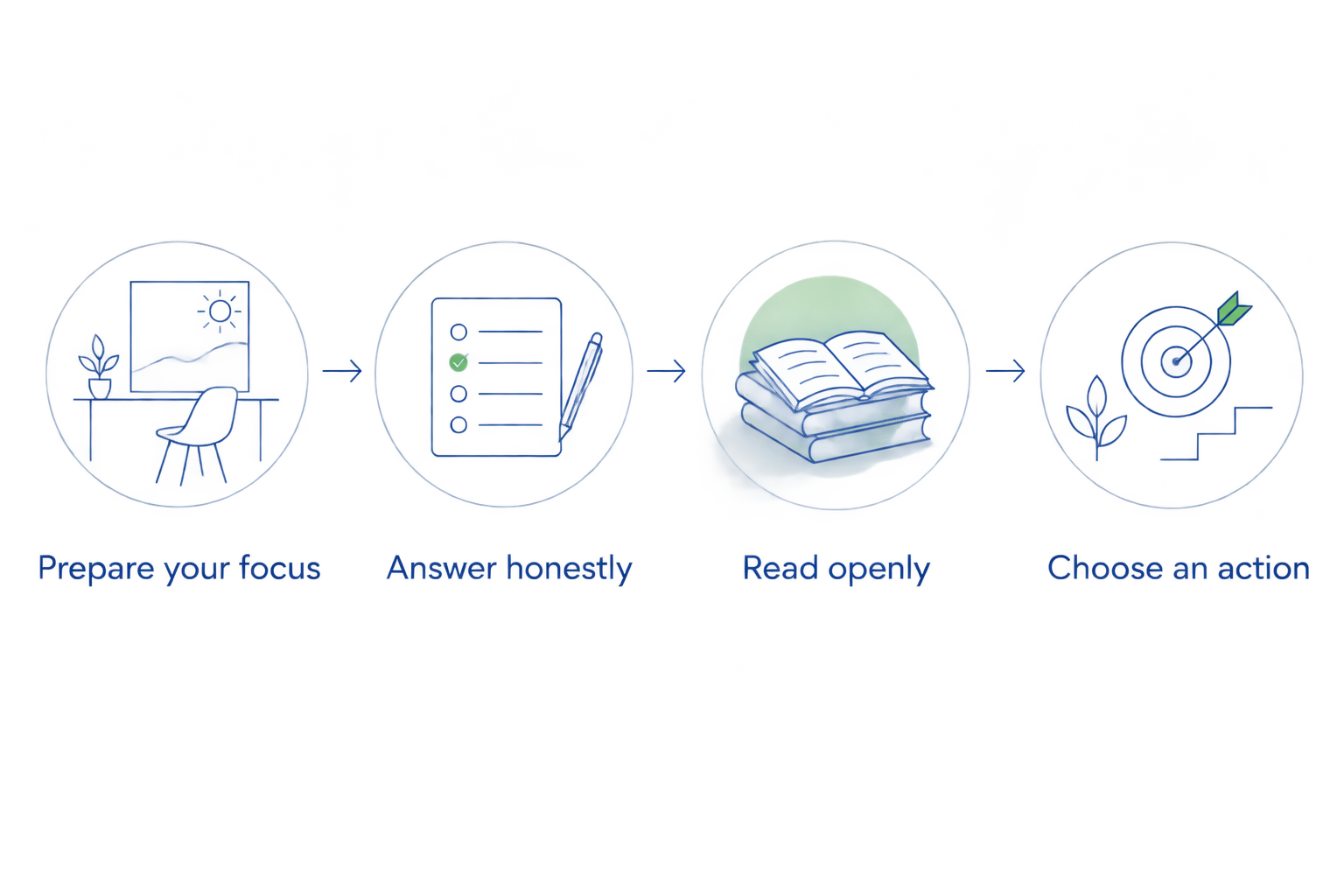
A practical 2026 completion workflow
This suggested workflow is a way to organize your attention, not an official scoring or interpretation method. Use it to keep the quiz connected to self-regulation rather than to the search for a perfect label.
Prepare your focus
Choose an ordinary situation you would like to understand more clearly. For example, you might be interested in how you respond when someone changes a plan, asks for help or disagrees with you.
Keep that interest in the background without forcing every answer to match it. The purpose is to give your later reflection a practical direction, not to steer the result toward an explanation you have already chosen.
Answer honestly
Follow the wording of each question rather than trying to work out which response sounds more balanced, spiritual or mature. Where a prompt asks about your experience, distinguish what you tend to do from what you wish you did.
If you recognize different responses in different settings, acknowledge that complexity to yourself. A brief questionnaire cannot contain every detail of your life, and you do not need to resolve every exception before continuing.
Read openly
Approach the personal diagram as a reflection tool. Ask what feels recognizable, what needs more context and what does not seem to fit.
Archetypes are patterns used for exploration, not fixed identities. An interpretation becomes a useful subject for inquiry when you can connect it to a concrete example, rather than accepting it because a description sounds appealing.
Choose an action
Translate an observation into something you can consciously try. If you notice a tendency to agree before considering your own needs, an example action is to pause and check your commitments before replying.
This is a suggested reflective practice, not a promised effect of taking the quiz. The value lies in examining your response with care, including what happened when your first interpretation did not fit.
For a closer look at the transition between questionnaire and interpretation, explore the quiz-to-your-first-diagram workflow. Keep your own examples beside any interpretation so that the model remains a starting point for inquiry.
Why your completion time varies
The questionnaire contains the same 24 questions, but people bring different levels of familiarity and reflection to them. These considerations help you plan without relying on an unsupported minute estimate:
- Reading and understanding. Give yourself room to understand what a prompt asks before choosing a response.
- Recognizing your experience. An answer can feel straightforward, or it can bring several contrasting situations to mind.
- Considering context. You might respond differently at work, with close friends or during a demanding period.
- Pausing for reflection. Thinking through an example adds a different activity to simply selecting an answer.
- Exploring the diagram. Interpreting the result belongs to the wider experience, not just the questionnaire's completion time.
None of these is a reason to judge your pace. Taking longer does not establish that your answers are better, and finishing readily does not establish that you have missed something.
Use question count to understand the task, not to set a performance target. The more useful question is whether you are answering attentively enough to recognize your own experience.
What are you making time to explore?
Archegram, also called Tantragram, is presented as a contemporary, non-dogmatic adaptation of ancient Tantric knowledge. Its spiritual framework uses archetypes and a personal visual diagram to support reflection on inner balance, recurring patterns and development.
That description is different from scientific validation. The quiz is not a validated diagnostic assessment, and its interpretations should not be presented as findings from established psychological research.
In practical terms, you are making space to consider questions such as:
- Which responses do you recognize in familiar situations?
- Where do your strengths help you, and where do you want more flexibility?
- What coping strategies do you want to examine rather than automatically repeat?
- What would a more balanced response look like in a specific conversation?
These are invitations for reflection, not additional quiz questions or a formal interpretation checklist. You can use them without deciding that an archetype defines you.
If you encounter references to feminine and masculine energies, understand them as receptive and active qualities available to anyone. They are not prescriptions for gender, identity or how you should behave.
How should you approach your first attempt in 2026?
Start with the intention to answer sincerely rather than obtain a preferred result. You are exploring how you understand yourself, not trying to qualify as a particular kind of person.
Avoid turning every answer into a debate about your entire history. Read the prompt, consider what it actually asks and respond as faithfully as you can. Where your experience feels mixed, keep that nuance available for later reflection.
Afterward, choose a familiar event to examine alongside the diagram. Describe what happened, how you responded and what you would like to understand. A concrete event gives you something clearer to discuss than a broad statement such as being bad at relationships or always needing control.
You can also leave an interpretation unresolved. Curiosity does not require agreement, and a thoughtful response sometimes means recognizing that a description does not represent your experience.
Should you interpret the diagram immediately?
The 24 questions and your diagram reflection do not need to become the same task. You can distinguish an initial look from a more considered exploration without treating the first reading as a final judgment.
When you reflect, start with something recognizable rather than the part that sounds most impressive or troubling. Ask for an example from your life, then consider whether another explanation also fits.
For coaches, facilitators and teachers, the same boundary matters. Invite the person to describe their experience instead of telling them what a diagram proves. The model supports reflective conversation; it does not authorize diagnosis or certainty about someone else's motives.
Does taking longer make the result more accurate?
The 24-question format does not establish that a longer completion time produces a more accurate result. Treating the questionnaire as a reflective resource is different from claiming that a particular pace improves its measurement properties.
Attention and honesty are sensible intentions, but neither turns a spiritual self-understanding framework into a clinical instrument. Keep interpretations flexible and check them against lived examples rather than assuming that effort guarantees truth.
FAQ
How long does the Archegram quiz take in 2026?
The Archegram quiz contains 24 questions, but that does not establish a fixed completion time in minutes. Your answering pace and the reflection you add determine your own time commitment.
How many questions do I need to answer?
The quiz contains 24 questions. Exploring the personal visual diagram is a separate part of using the model for self-understanding.
Do I need to understand archetypes before starting?
You can approach the quiz as a starting point for reflection rather than a test of archetype knowledge. Follow each prompt and leave deeper interpretation for your exploration of the model.
Should I answer as I am or as I want to be?
Answer according to what each prompt asks about your experience, rather than choosing an idealized response. Keep your aspirations separate from the patterns you currently recognize.
Does the quiz diagnose emotional or mental health problems?
No. The quiz is a spiritual self-reflection resource, not a validated diagnostic assessment or treatment.
Does finishing the quiz mean I have understood my diagram?
No. Completing the questions and interpreting the diagram are different activities. Use concrete examples from your life to explore an interpretation rather than treating it as a final identity.
Can I use my diagram in a reflective conversation with a coach?
Yes, a personal diagram can serve as a starting point for reflective conversation. Keep the discussion grounded in your experience and avoid treating the interpretation as a diagnosis or proof of your motives.
One last thing
For your 2026 practice, choose a situation to revisit after the quiz rather than a label to remember. Notice what you did, what you needed and what response you would like to explore next.
The free quiz offers a way into the Archegram self-regulation model. Let the diagram open a question about your life, not close the conversation about who you are.
Related guides
- Diagram to a self-regulation routine
- Tools for interpreting your archetype diagram
- Can the quiz accurately find your archetype?
