


No. Archegram is a self-regulation and self-understanding model, not another name for archetypal psychology. It uses archetypes, a personal visual diagram and a 24-question quiz to support reflection on emotional balance; shared language about archetypes does not make the approaches equivalent or make the quiz a clinical assessment.
- Is Archegram the same as archetypal psychology? No: shared archetype language does not mean a shared framework.
- Archegram is best suited to adults seeking spiritual self-reflection in support of everyday self-regulation.
- Archetypal psychology is associated with James Hillman; Archegram presents a contemporary adaptation of ancient Tantric knowledge.
- Treat the personal diagram as a conversation starter, not a diagnosis or fixed identity.
Is the Archegram the same as archetypal psychology?
Archegram and archetypal psychology have different origins, purposes and ways of working. Archegram, also called Tantragram, was developed at Samma Karuna as a contemporary, accessible and non-dogmatic adaptation of ancient Tantric knowledge. Its practical focus is understanding yourself and exploring greater balance in everyday life.
Archetypal psychology refers more specifically to the approach associated with psychologist James Hillman. It draws on the work of Carl Jung while giving particular attention to images, imagination, myth and psychological meaning. Hillman's Re-Visioning Psychology is a primary source for understanding that approach, rather than assuming every archetype-based model belongs to it.
For the model's own introduction, the About Us page provides a starting point. This 2026 comparison keeps a clear boundary between the model's stated purpose and claims about psychological assessment.
| Comparison | Archegram | Archetypal psychology |
|---|---|---|
| Starting point | Contemporary adaptation of ancient Tantric knowledge | Hillman's approach, developed in dialogue with Jungian thought |
| Main emphasis | Self-understanding and everyday self-regulation | Images, imagination, myth and psychological meaning |
| Materials discussed here | A 24-question quiz, personal diagram and reflective resources | Hillman's writing and the interpretive tradition around it |
| Best for | Adults seeking a structured spiritual reflection tool | Readers seeking to study Hillman's approach to psyche and imagination |
| Useful quality | Connects reflection with recurring patterns and possible responses | Offers a language for engaging with images and symbolic meaning |
| Limitation | Quiz results do not establish a diagnosis or scientific validity | Its use of psychological language does not validate a separate archetype quiz |
Why this matters
Confusing these approaches changes what you expect from a result. A visual diagram intended to invite reflection becomes misleading when you read it as proof of your personality, an explanation of someone else's behaviour or evidence of a mental health condition.
You do not need to settle every theoretical question before exploring the model. You do need to know what kind of claim you are making: a meaningful interpretation is not the same as a measured psychological finding.
That distinction also protects your freedom to disagree. A description that does not fit your experience is something to question, not an identity you must accept.
What does Archegram offer for self-regulation?
Archegram places emotional balance and finding balance in life ahead of collecting archetype labels. The archetypes help organise reflection on strengths, recurring patterns, coping strategies and developmental needs. The personal diagram gives you a visual reference for that conversation.
For example, imagine agreeing to another commitment while already feeling stretched. Rather than asking only which archetype describes you, ask what you noticed, what mattered to you and what response you want to practise next time. The model becomes relevant through the situation, not through the label alone.
The strength of this approach is its practical focus. Its limit is equally important: an interpretation does not establish why you behave a certain way, and recognising yourself in a description does not prove that the model accurately measures you.
Archetypes are reflection tools, not permanent identities
Use an archetype description as an invitation to look more closely. You might recognise a strength in one setting and see a different pattern under pressure. Neither observation requires you to declare a permanent type.
The model also includes a cycle of personal development and maturity. You can return to its questions as circumstances change, without treating a previous diagram as a final account of who you are.
Receptive and active energies are available to anyone
When Archegram uses feminine and masculine language, understand these as receptive and active energies available to anyone. They are not instructions about gender, relationships or the kind of person you should become.
Keep the discussion concrete. Ask whether a situation calls for more listening, clearer expression or a deliberate decision, rather than assigning a behaviour to a gender.
What does archetypal psychology mean here?
Archetypal psychology is not a general label for every system that mentions archetypes. In the specific Hillman tradition, images and their meanings receive sustained attention; the approach is not simply a method for sorting people into personality categories.
This distinction matters when you encounter familiar words. An image, symbol or archetype can appear in different traditions without carrying the same definition or serving the same purpose. Similar vocabulary is a reason to ask questions, not evidence of equivalence.
For a careful reading in 2026, start with the named source rather than a quiz description. Hillman's Re-Visioning Psychology addresses archetypal psychology; Archegram's educational materials explain its own model. Neither source should be substituted for the other.
The value of studying Hillman is engagement with that particular body of thought. The limitation for this question is that reading Hillman cannot, by itself, establish the accuracy or validity of an unrelated personal diagram.
Why do people confuse the approaches?
The overlap is mainly in language and subject matter. These shared features explain the confusion without establishing a shared method:
- Archetypes: Both discussions use the word, but a shared term does not guarantee the same definition.
- Inner patterns: Readers encounter language about recurring experiences and personal meaning in both contexts.
- Symbolic interpretation: A symbolic explanation can feel personally relevant without functioning as a psychological measurement.
- Self-understanding: Both attract people interested in examining their inner lives, although their approaches differ.
- Psychological vocabulary: Words about personality or development can sound clinical even when the activity is spiritual reflection.
Before adopting a claim, ask what supports it. Is it a statement about the model's spiritual framework, an interpretation of your experience or a finding from psychological research? Keeping those categories separate prevents an appealing explanation from becoming an unsupported certainty.
How can you apply the model without treating it as a diagnosis?
Start with an everyday situation, then use the diagram to ask better questions about your response. The following exercise is a suggested reflection practice, not a validated assessment procedure or an official scoring method.
For your 2026 reflection notes, choose 1 situation and work through 3 prompts. Keeping the scope small gives you something specific to examine rather than a broad verdict about your character.
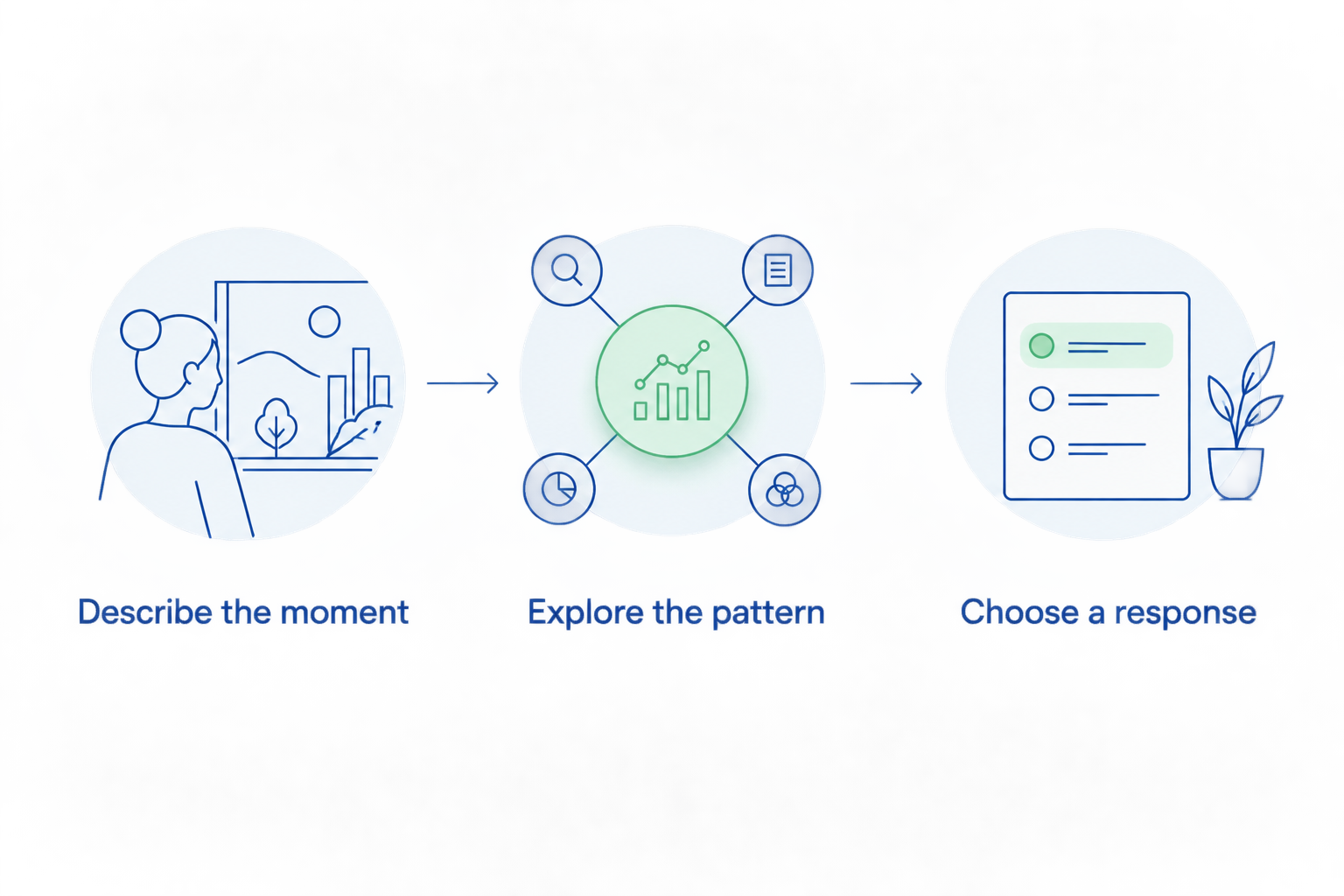
Describe the moment
Choose an ordinary experience: accepting a request, withdrawing from a conversation or delaying a decision. Write down what happened before explaining it through an archetype.
Your first prompt is: What did I actually notice? Separate observable events from your interpretation of another person's motives.
Explore the pattern
Look at the personal diagram and any descriptions that seem relevant. Your second prompt is: What strength, need or familiar response does this help me consider?
Include what does not fit. If the diagram suggests an interpretation that conflicts with your experience, record the disagreement instead of forcing a match.
Choose a response
Your third prompt is: What would a more balanced response look like in a similar situation? Choose something observable, such as asking for time before accepting a request or stating a preference clearly.
The purpose is to turn reflection into a choice you can revisit. It is not to prove that an archetype caused your behaviour.
Keep the notes alongside your diagram rather than turning them into a permanent profile. If you want a more structured application, the Archegram diagram to a self-regulation routine workflow continues this practical focus.
Does the 24-question quiz prove your archetype?
The 24-question quiz supports reflection; it does not prove a fixed identity or establish a clinical finding. Its results belong within the model's spiritual and interpretive framework.
A result can give you language for something you recognise. That usefulness is different from evidence that a questionnaire reliably measures a psychological construct or predicts behaviour. Do not use personal resonance as a substitute for that evidence.
When reviewing a result in 2026, compare it with specific experiences, including exceptions. Ask where the description fits, where it fails and whether it helps you identify a constructive next step.
You can explore the quiz through the model's resources without committing to its interpretation. Curiosity and disagreement can sit together.
Can coaches use the diagram without making clinical claims?
Coaches, facilitators and teachers can keep diagram-based conversations reflective by leaving interpretation with the participant. Ask whether a description fits their experience instead of announcing what their result means about them.
A useful question invites detail: What happens when you feel pressure to agree? An unhelpful declaration closes the conversation: Your archetype means you cannot set boundaries. The first explores a situation; the second turns a label into a limitation.
The same boundary applies to relationships. A diagram can support discussion of dynamics and possible conflicts, but it does not guarantee compatibility, explain another person's intentions or predict the future of a relationship.
In a 2026 workshop or individual conversation, explain the activity's scope before interpreting results. Describe it as spiritual self-reflection, not diagnosis, treatment or proof of professional psychological expertise.
FAQ
Is Archegram the same as archetypal psychology?
No. Archegram is a self-regulation and self-understanding model drawing on a contemporary adaptation of Tantric knowledge; archetypal psychology refers to the approach associated with James Hillman. Shared archetype language does not make them equivalent.
Is Tantragram different from Archegram?
Tantragram is an alternative name for Archegram. The names refer to the same model, rather than separate psychological assessments.
Is the Archegram quiz a psychological diagnosis?
No. The 24-question quiz is a self-reflection resource, not a clinical assessment or treatment. A result should not be used to diagnose yourself or another person.
Do I need to study Jung before exploring the model?
No prior study of Jung is necessary to begin reflecting on your experiences with the model. Its own definitions matter, because its archetype language should not be assumed to match Jungian or Hillmanian concepts.
Can my personal diagram change over time?
Treat the personal diagram as a reference you can revisit as your circumstances change, not a permanent identity. Compare its interpretation with current experiences rather than assuming an earlier reading must always fit.
Does feminine or masculine energy determine my gender role?
No. Within the model, feminine and masculine refer to receptive and active energies available to anyone. They are not fixed gender roles or prescriptions for behaviour.
Can a coach use a diagram to tell whether a couple is compatible?
A diagram can support reflection on relationship dynamics and possible conflicts, but it cannot guarantee compatibility. Keep the conversation focused on experiences, needs and responses rather than predictions.
One last thing
The most useful question is not whether a label describes you perfectly, but whether the reflection helps you notice a choice. A flattering description can leave your habits untouched; an honest question can give you something concrete to explore.
Before closing your notes, write down an observation that does not fit your preferred interpretation. Keeping that exception visible helps you use the model without shrinking yourself to it.
Related guides
- Archegram quiz to your first diagram: complete workflow
- Archegram diagram to a shadow work journal workflow
- Best self-discovery questions to ask yourself
