


Retaking the Archegram quiz after a big change makes sense as a fresh reflection on your current patterns, not as proof that you have become a different person. Use the new personal diagram alongside your earlier observations to explore what feels different and what supports greater balance now. A changed result is not a diagnosis, a maturity score or evidence that the earlier result was wrong.
- Can you retake the Archegram quiz after change? Use a fresh reflection to explore current patterns, not confirm a new identity.
- The 24-question quiz supports self-understanding; it is not a validated diagnostic assessment.
- Compare everyday examples alongside diagrams before deciding what a changed result means.
- Choose a practical self-regulation response rather than aiming for a particular archetype result.
Why this matters
A major change can give you new situations to reflect on: different responsibilities, unfamiliar relationships or a daily rhythm that no longer resembles your old one. The useful question is not simply whether your result changes. It is whether the model helps you understand your responses and choose what to do next.
Archegram is a self-regulation model for adults seeking emotional balance through reflective self-understanding. Developed at Samma Karuna, it uses archetypes and a personal visual diagram to explore strengths, recurring patterns and developmental needs. For a broader starting point, explore these self-discovery quizzes for life transitions.
Can you retake the Archegram quiz after a big change?
Returning to the quiz fits the model's reflective purpose: you can revisit your inner balance as your circumstances change. In 2026, the useful distinction remains between repeating a reflection exercise and treating repeated results as a validated measurement of personal change.
The quiz contains 24 questions. Answer from your present experience rather than trying to reproduce an earlier diagram or obtain an archetype you prefer. The aim is to understand what is happening, not to earn a better result.
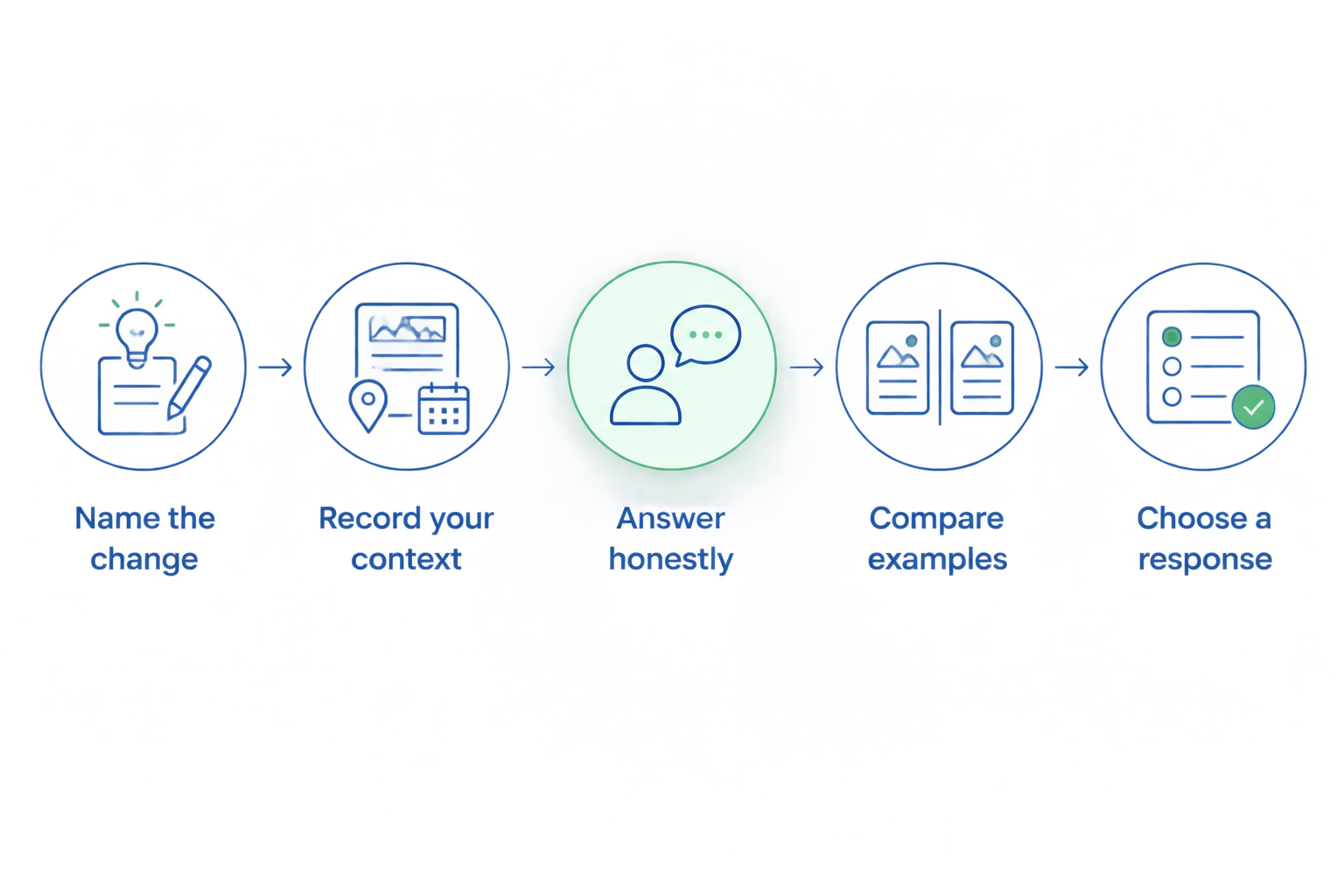
Use this sequence to make a repeat reflection useful:
- Name the change. Describe the event or transition without deciding what it must mean about your personality.
- Record your context. Note the responsibilities, relationships and pressures shaping your current experience.
- Answer honestly. Respond from how you actually behave, rather than how you hope to behave.
- Compare examples. Put everyday observations beside any similarities or differences in your diagrams.
- Choose a response. Identify a practical action that addresses a current need or recurring pattern.
These are suggested reflection steps, not an official scoring or retesting protocol. They keep your attention on the purpose of the model: finding a more balanced response in everyday life.
Should you retake the quiz or revisit your existing diagram?
You do not need a new result every time something feels difficult. Sometimes your existing diagram already offers a useful starting point; sometimes fresh answers give you more to explore. Neither approach proves that you have grown or fallen behind.
The following comparison helps you choose a reflection activity. These are ways to use the model, not different quiz tiers.
| Approach | Best for | What it offers | Limitation |
|---|---|---|---|
| Fresh quiz reflection | Reconsidering your answers after changed circumstances | A new starting point for exploring current patterns | A different result does not establish lasting change |
| Existing diagram review | Looking more closely at a pattern you already recognize | Continuity with your earlier reflections | Earlier answers need context rather than automatic acceptance |
| Diagram and journal comparison | Connecting the model with everyday situations | Specific examples to discuss or revisit | Your notes remain personal interpretations, not objective measurements |
Choose the approach that helps you name a need and act on it. If repeating the quiz only leads you to search for a preferred label, revisit a concrete situation instead.
For example, consider a difficult conversation after a change at work. Rather than asking which archetype should describe you, ask what you noticed, what you needed and how you responded. Then use the diagram to explore that example without forcing it to fit.
Why your answers and interpretation can vary
A different result needs context before it needs an explanation. These factors provide useful questions to consider; they do not establish why a particular answer changed.
- Changed circumstances: Are you answering about a different daily life, set of responsibilities or relationship situation?
- Different examples: Are you thinking about your behavior at home this time, rather than your behavior at work?
- Greater self-recognition: Have you begun noticing a recurring response that you previously overlooked?
- An idealized self-image: Are your answers describing what you value, rather than what you currently do?
- A stronger focus on one event: Are you letting a recent experience stand in for your wider experience?
Keep the distinction between observation and interpretation clear. An observation describes what happened; an interpretation proposes what it means. Both belong in reflection, but they are not interchangeable.
For instance, repeatedly agreeing to requests while wanting to decline is an observation you can explore. Deciding that this proves a permanent archetype identity goes beyond that observation. The model is more useful when it opens questions than when it closes them.
How do you compare an old diagram with a new one?
Compare the meaning you give each diagram with examples from the period it represents. Do not treat visual differences alone as evidence of improvement. A personal diagram supports reflection on strengths and needs; it does not certify your level of emotional balance.
Start with context
Date your notes and describe what was happening around each reflection. If you revisit the quiz in 2026, record the circumstances beside that date rather than relying on memory later.
Keep the description ordinary and specific: a changed role, a new relationship arrangement or a different responsibility. There is no need to turn the transition into a story of success or failure.
Separate continuity from change
Create 2 columns in your notes: what still feels familiar and what feels different. Give each observation an everyday example. If an interpretation has no example behind it, leave it as a question.
You might recognize the same tendency to take responsibility for others, while noticing that you now express a limit more clearly. That offers a more useful reflection than simply deciding that your diagram looks better.
Connect insight with action
Choose a response that addresses the situation you described. This might mean clarifying a request, making room to listen or acknowledging a need before agreeing to something.
For help connecting reflection with practice, see the Archegram diagram to a self-regulation routine workflow. Keep the action small enough to describe clearly, and revisit what actually happened rather than judging yourself against an ideal.
How long should you wait before retaking the quiz?
Use a meaningful reflection question rather than a calendar deadline. This guide does not prescribe a retest interval: the purpose is to revisit your experience, not to follow a measurement schedule.
Before repeating the quiz, ask what you want to understand that your existing diagram does not help you explore. If the answer is simply that you dislike the current result, pause the retake and examine that reaction with curiosity.
For your 2026 reflections, a useful checkpoint is whether you have different experiences to consider. You do not need to prove that a transition is complete before reflecting, and you do not need repeated results to authorize a practical change in your life.
Does a changed result mean you have a new archetype?
A changed result does not establish a new, permanent identity. Archetypes in this model are flexible tools for exploring patterns, strengths and developmental needs, not fixed categories that tell you who you must be.
Archegram, also called Tantragram, is presented as a contemporary, non-dogmatic adaptation of ancient Tantric knowledge. Its spiritual interpretations are distinct from established psychological research. The quiz is not a validated diagnostic assessment, and it does not measure treatment outcomes.
The same care applies to receptive and active energies, sometimes described as feminine and masculine. These are available to anyone within the framework; they are not gender prescriptions. A new diagram is an invitation to reflect, not a rule about how you should live or relate.
A reflection exercise before your next quiz
Before starting again, write responses to these 3 prompts:
- What changed around me? Describe the transition without assigning yourself an archetype.
- What response keeps returning? Choose a recognizable behavior rather than a broad judgment about your character.
- What would balance look like here? Describe an action you could recognize in everyday life.
Keep these notes beside your diagram. They give you something concrete to return to after the initial interest in a result fades.
Imagine that you have taken on a new responsibility and regularly agree to more than you intended. Your reflection does not need to establish which archetype caused it. It can explore what agreeing does for you, what it costs you in that situation and what a clearer response would sound like.
This is a suggested writing exercise, not an additional part of the quiz. You can use it with an existing diagram or before a fresh reflection.
Using a repeat reflection with a coach or facilitator
Bring your own examples into the conversation rather than asking another person to decide which diagram is the real you. A facilitator can invite reflection without treating either result as a definitive account of your identity.
Useful discussion questions include what you recognize, what does not fit and which interpretation helps you understand a specific response. Keep room for disagreement. The person completing the quiz remains the source of their lived experience.
Avoid using changed diagrams to rank maturity, predict relationship compatibility or claim clinical improvement. The practical focus stays on understanding patterns and considering different responses, not assigning authority to a label.
FAQ
Can you retake the Archegram quiz after a breakup or job change?
A breakup or job change is a relevant occasion to revisit the quiz as a reflection exercise. Compare your answers with current experiences rather than treating a new result as proof of a changed identity.
How many questions do I answer in the Archegram quiz?
The Archegram quiz contains 24 questions. It supports self-understanding and a personal visual diagram, not a clinical diagnosis.
Should I keep my old diagram when I reflect again?
Keeping your old diagram gives you earlier material to reflect on alongside your current experience. Add context and examples to both rather than assuming the newer diagram is more accurate.
Does getting the same result mean I have not grown?
Getting the same result does not establish that you have not grown. Explore changes in how you recognize needs, handle familiar situations and choose responses instead of using the result as a maturity score.
Can I use my 2026 result to measure my mental health?
Your 2026 result is not a mental-health measurement. Archegram is a spiritual self-regulation and self-understanding framework, not a validated diagnostic assessment or treatment.
What if my new diagram does not feel like me?
Treat a diagram that does not feel familiar as a prompt for questions, not a verdict you must accept. Revisit the examples behind your answers and leave interpretations open when they do not fit your experience.
One last thing
You do not need a different result to choose a different response. Even if your diagrams look similar, you can still recognize a need sooner, express a limit or approach a familiar conversation differently.
Let your next reflection in 2026 begin with something you want to understand, not a label you want to obtain. If a fresh quiz helps, explore it without pressure. If your existing diagram already raises a useful question, begin there.
Related guides
- Archegram quiz to your first diagram workflow
- Tools for interpreting your archetype diagram
- Can the Archegram quiz accurately find your archetype?
