


Instead of improvising your first reflective conversation after certification, prepare a clear agreement, a personal diagram and a simple session plan so your participant knows what to expect. This 2026 workflow takes you from checking your training scope to guiding a first conversation about everyday self-regulation, without turning archetypes into diagnoses.
- Use this archegram certification first session workflow to establish scope, consent and a practical self-regulation focus.
- Archegram is best for adults seeking spiritual self-reflection about emotional balance, not clinical assessment.
- Treat the personal diagram as an invitation to explore, never a verdict about someone.
- Close with a participant-chosen action and permission-based follow-up.
Why this matters
Your first session needs a clear boundary more than an elaborate interpretation. A participant should understand what the model offers, what your role includes and how they can disagree or stop.
Archegram is a self-regulation and self-understanding model, also known as Tantragram. Its contemporary, non-dogmatic spiritual framework draws on ancient Tantric knowledge; it is not a validated diagnostic assessment or a substitute for mental health care.
Your task is to help someone explore a recurring pattern and choose a response, not establish their identity. A diagram gives the conversation a shared reference point. The participant's lived experience remains central.
Before you start
- Have your training materials and credential wording available. Check your completion status, the exact title issued and any guidance about practising with others. Do not infer professional accreditation or permission to provide treatment from a Level 1 label.
- Prepare the participant's materials with permission. You need their willingness to explore the model, access to their personal diagram and an agreed way to meet. The free 24-question quiz supports reflection; completion is not proof of readiness for a session.
- Agree on the boundaries before receiving personal information. Explain note-taking, storage, confidentiality limits and whether anything will be recorded. The easily missed issue is interpretation without consent: having someone's diagram does not give you permission to analyse it or share it.
If you cannot explain your scope in plain language, postpone the guided session and ask your training provider for clarification. A practice conversation is still a conversation with a real person, not an exception to these boundaries.
Session agreement
Set the purpose and scope
- Check your certification wording. Use the title exactly as issued. For your 2026 introduction, separate completed training from experience you have not yet gained; do not describe yourself as licensed or clinically qualified unless you independently hold those credentials.
- Ask for an everyday focus. Invite the participant to describe a situation where they want greater balance, such as agreeing to requests too quickly or withdrawing during disagreement. Keep the focus specific enough to explore within the meeting.
- Explain the reflective approach. Describe archetypes as flexible ways to explore tendencies, strengths and developmental needs. State that an interpretation is something to consider together, not a finding the participant must accept.
- Agree on participation and privacy. Ask whether the participant wants notes taken, whether they want a copy and what should happen to the notes afterward. Explain any applicable confidentiality limits rather than promising absolute secrecy.
- Confirm the right to pause. Make it clear that the participant can skip a question, reject an interpretation or end the session. Obtain separate permission for any recording; do not make recording the default.
Expected result: You both understand the session's purpose, boundaries and handling of personal information before opening the diagram.
Prepare a short document with your own headings: Purpose, Scope, Consent, Notes and Follow-up. These are suggested document labels, not website controls or official certification requirements. Keep the agreement readable enough to discuss aloud.
Diagram preparation
Prepare the shared reference
- Ask how the diagram was created. Establish whether the participant completed the quiz themselves and whether they want to discuss the resulting diagram. Do not complete answers on their behalf to produce a preferred pattern.
- Invite an initial response. Ask what feels familiar, unfamiliar or unclear. Listen before explaining; a participant's disagreement is useful context, not resistance you need to overcome.
- Choose a relevant feature. Work with a feature you understand from your training and connect it to the agreed everyday situation. Avoid interpreting every part of the diagram simply because it is visible.
- Separate description from interpretation. Note what the diagram displays, what the model suggests and what the participant actually reports. These are different kinds of information and should remain distinguishable in your notes.
- Translate unfamiliar language. Explain any archetype term before using it repeatedly. If receptive and active energies arise, describe them as possibilities available to anyone, not prescriptions based on gender.
Expected result: You have a shared reference and a participant-approved question to explore, rather than a complete personality explanation to deliver.
For a 2026 session record, include the session date and the diagram's date if known. An older diagram can support discussion, but do not assume it describes the participant's present circumstances unchanged.
Keep the diagram open to correction. If the participant says a description does not fit, set it aside or explore the mismatch gently. Never claim that disagreement proves an unconscious pattern.
Guided conversation
Build the session around an everyday example
Use the following 45-minute example agenda as a planning aid, not an official course standard. Adjust the pace with the participant; finishing the agenda matters less than maintaining clear consent and a manageable focus.
- Opening — 5 minutes. Reconfirm the purpose, scope and permission to continue. Ask what would make the conversation useful today without promising a particular emotional outcome.
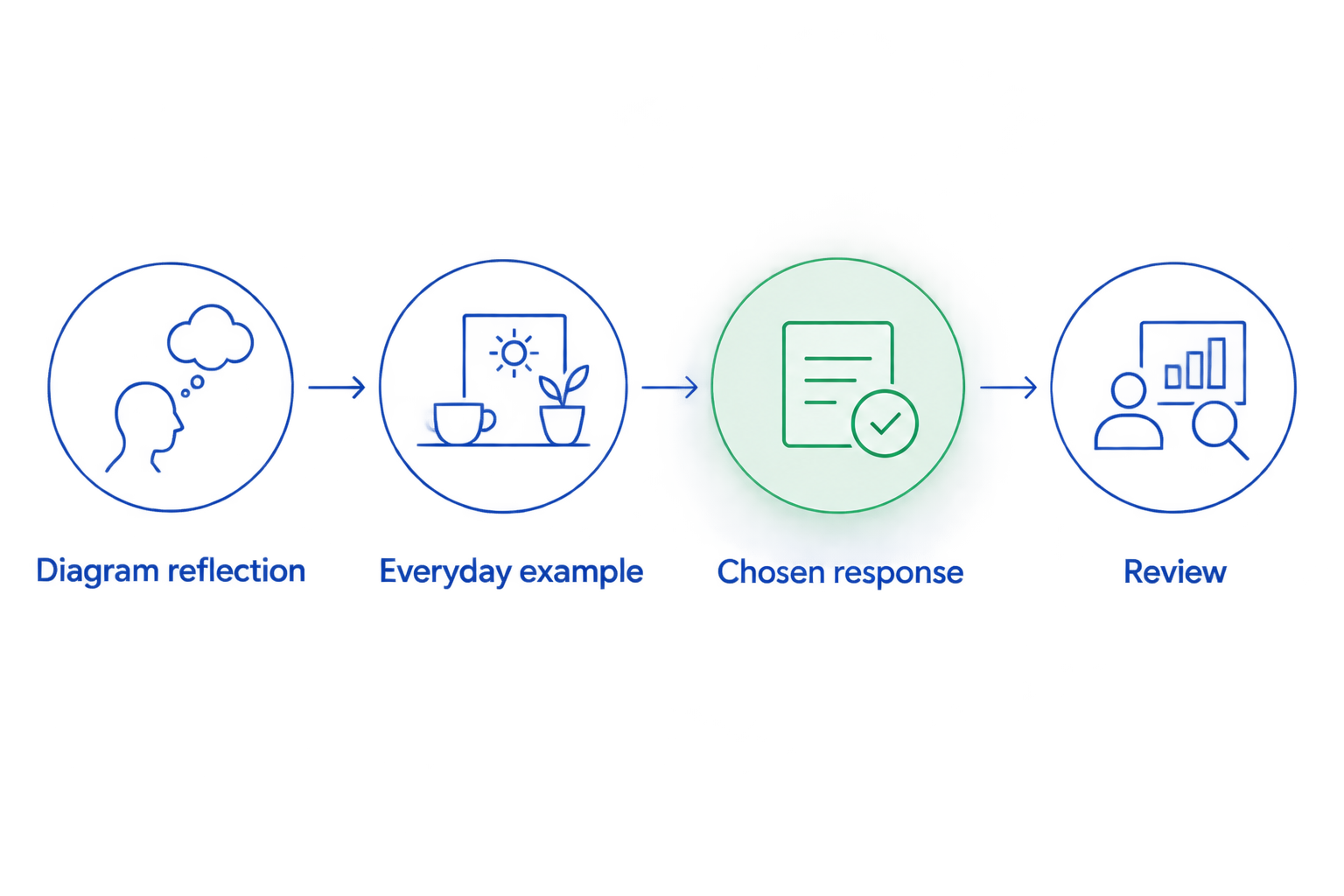
- Diagram reflection — 10 minutes. Explore the selected feature alongside the participant's own description. Ask where the tendency feels supportive and where it becomes less helpful.
- Everyday example — 15 minutes. Discuss a recent, manageable situation. Ask what happened, what the participant noticed, how they responded and what they wanted at the time.
- Chosen response — 10 minutes. Invite a small alternative that fits the situation. Someone who agrees too quickly might choose to check their commitments before answering the next request.
- Closing — 5 minutes. Ask the participant to describe the action in their own words. Confirm whether they want a written summary or a later check-in, and leave room for corrections.
Expected result: The participant leaves with a personally meaningful observation and an action they chose, not an identity assigned by the facilitator.
Keep the conversation organised around Diagram reflection, Everyday example, Chosen response and Review. This is a suggested facilitation sequence for applying the model, not a claim about its official diagram structure.
Ask open questions rather than leading the participant toward an interpretation. For example, explore when a response helps them protect time or maintain connection, then ask what becomes difficult when that response is repeated automatically.
Avoid asking for traumatic details to make an interpretation feel deeper. If the conversation moves beyond your competence, stop interpreting and explain your boundary. A spiritual framework does not extend your professional scope.
Follow-up record
Close the loop without creating a fixed label
- Write a brief, neutral summary. Record the agreed focus, the participant's observations and their chosen action. Attribute interpretations clearly instead of presenting them as established facts.
- Invite corrections. Let the participant clarify anything that misrepresents their experience. Do not turn a tentative observation into a permanent description in your records.
- Confirm the next contact. Agree whether there will be a check-in, how it will happen and what information the participant wants to share. Follow-up should be an invitation, not a condition of participation.
- Review your facilitation separately. Note where you explained too much, assumed meaning or lost the everyday focus. Keep your learning notes free of unnecessary identifying information.
Expected result: The participant knows what they chose to explore, while your record preserves uncertainty and respects the agreed privacy boundaries.
For any 2026 follow-up, ask what actually happened rather than whether the participant followed instructions. Not trying an action can also open a useful conversation about relevance, circumstances or the need to choose something smaller.
A second workflow: returning after circumstances change
A returning participant does not need the first session repeated automatically. Start with the previous everyday focus, ask what has changed and decide together whether revisiting the diagram would serve the conversation.
| Workflow | Best for | Strength | Limitation |
|---|---|---|---|
| First-session reflection | Someone new to guided diagram interpretation | Establishes shared language, consent and a practical focus | Requires time for explanation before deeper exploration |
| Returning-session reflection | Someone reviewing a previous action or changed circumstances | Connects reflection with lived experience | Can reinforce an old interpretation if you do not question it |
Both workflows offer structure, but neither establishes a diagnosis or predicts development. Choose the returning-session workflow when there is an earlier conversation to review, not simply because a diagram already exists.
Ask whether the previous interpretation still feels useful. If the participant wants to revisit the quiz, clarify what they hope to understand; do not treat a different result as proof of improvement or deterioration.
Keep earlier and current reflections distinct. A change in circumstances deserves fresh attention, not an explanation forced into the previous pattern.
Troubleshooting
The participant expects a diagnosis
Pause before interpretation and restate the scope. Explain that Archegram supports spiritual self-reflection and self-regulation exploration; the quiz does not identify disorders or establish treatment needs. If the participant wants a clinical assessment, direct that request to an appropriately qualified professional.
The diagram does not feel accurate
Ask which parts do not fit and return to the participant's example. Set aside the disputed interpretation rather than defending the model. You can still explore a chosen response without resolving every feature of the diagram.
The participant asks what their archetype means they must do
Remove the prescription. Offer the interpretation as a question about possibilities, then ask what fits their circumstances and values. No archetype obliges someone to adopt a role, stay in a relationship or make a major decision.
The conversation becomes too intense to continue
Stop the exercise and ask whether the participant wants to pause or end. Do not press for disclosure, interpret distress as progress or attempt treatment outside your qualifications. Discuss appropriate professional support when the person's needs exceed your role.
Your credential or training scope is unclear
Do not improvise a public claim. Check your issued documents and ask the provider to clarify what the credential signifies. The site's contact page provides an inquiry route; avoid treating this workflow as confirmation of current course terms.
Customize your workflow
Once the basic conversation feels clear, adapt the participant's between-session reflection rather than adding more interpretations. Offer a short written prompt, a private note or simply an invitation to notice the same situation again; ask what feels useful and manageable.
For coaches, facilitators and teachers, keep this model distinct from any other approach you use. Explain when you are offering a spiritual interpretation and do not borrow scientific authority from unrelated psychological research.
Review your 2026 session template whenever your training, responsibilities or information-handling arrangements change. A reusable structure should make consent easier to understand, not turn the conversation into a script.
FAQ
What should I do before my first session after Level 1 certification?
Check your completion status, credential wording and training scope before arranging a guided session. Then agree on the participant’s purpose, consent, privacy boundaries and use of their diagram.
Does Archegram certification qualify me to diagnose people?
No. The model and quiz are not clinical diagnostic assessments, and a model-specific credential must not be presented as a clinical licence. Any separate professional qualifications have their own scope.
How long should my first reflective session last?
This guide offers a 45-minute example agenda, not an official requirement. Agree on a suitable duration with the participant and leave enough room to explain consent and close without rushing.
Does everyone need to take the quiz before a session?
A quiz-derived personal diagram can provide a shared reference for diagram interpretation, but participation should remain voluntary. If someone does not want to use the quiz or diagram, agree on a different scope rather than interpreting them without permission.
What if someone disagrees with their archetype interpretation?
Accept the disagreement and ask what does or does not fit their experience. Archetypes are flexible reflection tools, not identities the participant must accept.
Should I repeat the quiz at every follow-up?
Do not make a repeat quiz the automatic purpose of every follow-up. Start with the participant’s experience and decide together whether revisiting the diagram would help explore current circumstances.
Is Tantragram a different certification system?
Tantragram is an alternative name for the same model. Use the exact credential title on your issued documents rather than assuming that alternative model names establish interchangeable certification titles.
One last thing
A useful first session can end with an interpretation left unresolved. If the participant understands their situation more clearly and chooses a response that fits their life, you do not need to make every part of the diagram agree.
Before closing, ask what they want to keep, question or leave behind. Their ability to disagree belongs inside the workflow, not outside it.
Related guides
- Quiz to your first diagram: a complete workflow
- Diagram to a self-regulation routine
- Archetype diagrams for life coaches
