


Spiritual mentors’ self-regulation work with Archegram, also called Tantragram, is guided reflection on recurring patterns, strengths and developmental needs with the aim of supporting greater emotional balance in everyday life. This 2026 guide explains how to use the model without turning spiritual interpretation into diagnosis or treating a personal diagram as someone’s identity.
- Archegram is best for spiritual mentors seeking a non-clinical self-regulation framework for reflective conversations.
- Use tantragram for spiritual mentors to explore emotional balance, not to diagnose or assign fixed identities.
- Start with a real situation; use the 24-question quiz and personal diagram as prompts, not verdicts.
- Keep interpretations optional, agree on one everyday action, and review what the person actually experiences.
Why self-regulation matters for spiritual mentors
A spiritual conversation needs somewhere practical to land. When someone describes feeling disconnected, overwhelmed or caught in a repeated conflict, your task is not to declare their spiritual condition; it is to help them explore what happens and what they want to do differently.
Archegram offers a self-regulation model, a free online quiz and a personal visual diagram for that exploration. Its archetypes provide a language for discussing patterns, while the practical focus remains greater balance rather than collecting labels.
For spiritual mentors, the distinction matters because symbolic language carries interpretive weight. A person can disagree with a reflection prompt; disagreeing with a mentor’s declaration about their true nature is a different conversation.
Keep the person’s lived experience above the model’s interpretation. That is the central working boundary throughout this 2026 guide.
Understand the framework before guiding anyone
The model is a contemporary, accessible, non-dogmatic adaptation of ancient Tantric knowledge developed at Samma Karuna. Tantragram is its alternative name, not a separate assessment that you need to administer alongside it.
An archetype is a symbolic pattern used to support reflection. Here, archetypes are flexible tools for exploring strengths, recurring responses and developmental needs—not permanent personality categories or evidence of spiritual attainment.
The personal diagram gives that exploration a visual reference. Treat it as a starting point for questions about someone’s current experience, not a complete account of their character, history or relationships.
The framework’s spiritual interpretations are distinct from established psychological research. The quiz is not a validated diagnostic assessment, and its results do not establish a mental health condition, treatment need or guaranteed path to change.
When receptive and active energies arise in discussion, explain them as capacities available to anyone. Do not translate feminine and masculine terminology into prescriptions about gender, relationships or how someone ought to behave.
Apply the model in a reflective mentoring conversation
Agree on the purpose and boundaries
Start without a quiz. Ask what the person wants help understanding and whether a symbolic self-reflection framework feels useful to them.
For example, someone might want to understand why they agree to commitments and later feel resentful. That gives your conversation a clearer purpose than asking which archetype they are.
Explain your role before introducing interpretations. Spiritual mentoring is not permission to diagnose, direct someone’s healthcare or claim special knowledge about their inner life.
If you use this guide to review your 2026 mentoring practice, begin with the language in your invitation and consent process. It should describe reflection, not promise transformation.
- Ask what greater balance would look like in daily life.
- Explain that participation and interpretation are optional.
- Agree on what notes, if any, you will keep.
- State that a diagram does not establish a diagnosis.
- Invite the person to correct or reject your interpretation.
Describe one recurring situation
Use an ordinary example before introducing symbolic language. A notebook and a conversation are enough to separate what happened from what the person thinks it means.
Ask for one recent situation, such as receiving criticism, facing a delayed reply or accepting an unwanted responsibility. Stay with that example rather than building a sweeping account of the person’s life.
Use 3 reflection prompts: What happened? What did you notice in yourself? What did you do next? These are suggested conversation prompts, not a scoring method or a formal part of the model.
A statement such as “I always abandon myself” can then become something more specific: “I agreed to help before checking whether I wanted to.” The second statement gives you something concrete to explore.
- Separate observable events from interpretations.
- Invite everyday emotion words rather than spiritual labels.
- Ask what the response was trying to protect or achieve.
- Notice exceptions when the pattern did not occur.
- Record the person’s wording rather than replacing it with yours.
Introduce the quiz as an optional starting point
A manually written account remains useful on its own. When someone wants a structured starting point, the free 24-question quiz offers another way into the model’s personal diagram and reflection process.
Archegram should enter the conversation as a resource, not a prerequisite for being understood. Explain what the quiz supports: exploration of patterns, strengths and developmental needs within a spiritual self-understanding framework.
Do not coach someone toward answers that fit your initial impression. If a question feels difficult to answer, let that uncertainty remain part of the conversation rather than treating it as resistance.
Afterward, ask what feels familiar, unfamiliar or incomplete. Agreement with every part of a result is not the goal.
- Explain the non-clinical purpose before the quiz.
- Let the person answer without your direction.
- Avoid describing results as objectively accurate.
- Invite examples that support or challenge an interpretation.
- Continue without the quiz if the person prefers.
Read the diagram through lived examples
Begin with the person’s own description of their diagram. Ask what draws their attention and what they want to understand, rather than announcing the most important feature yourself.
Connect each interpretation to a real situation. If the discussion suggests a familiar strength, ask when that strength helps and when relying on it leaves another need unattended.
For a 2026 mentoring session, keep the distinction between observation and interpretation visible in your notes. A diagram feature is something you discuss; the meaning you attach to it remains open to examination.
Use the guide to interpreting your archetype diagram for further reading, without treating an article as permission to interpret beyond your understanding.
- Ask which interpretation fits an actual experience.
- Explore strengths alongside their possible overuse.
- Discuss developmental needs without assigning deficiency.
- Treat receptive and active capacities as available to everyone.
- Leave unfamiliar or disputed features unresolved.
Translate reflection into an everyday response
Return from the diagram to the situation you chose earlier. Ask what the person wants to notice or try when something similar happens again.
Keep the action small and chosen by the person. Someone who agrees too quickly might practise saying they need time to consider a request; someone who withdraws might choose to name that they need a pause.
Compare 2 possible responses, then select one to explore. This is an optional mentoring exercise, not a prescribed technique or a promise that a particular response will produce emotional balance.
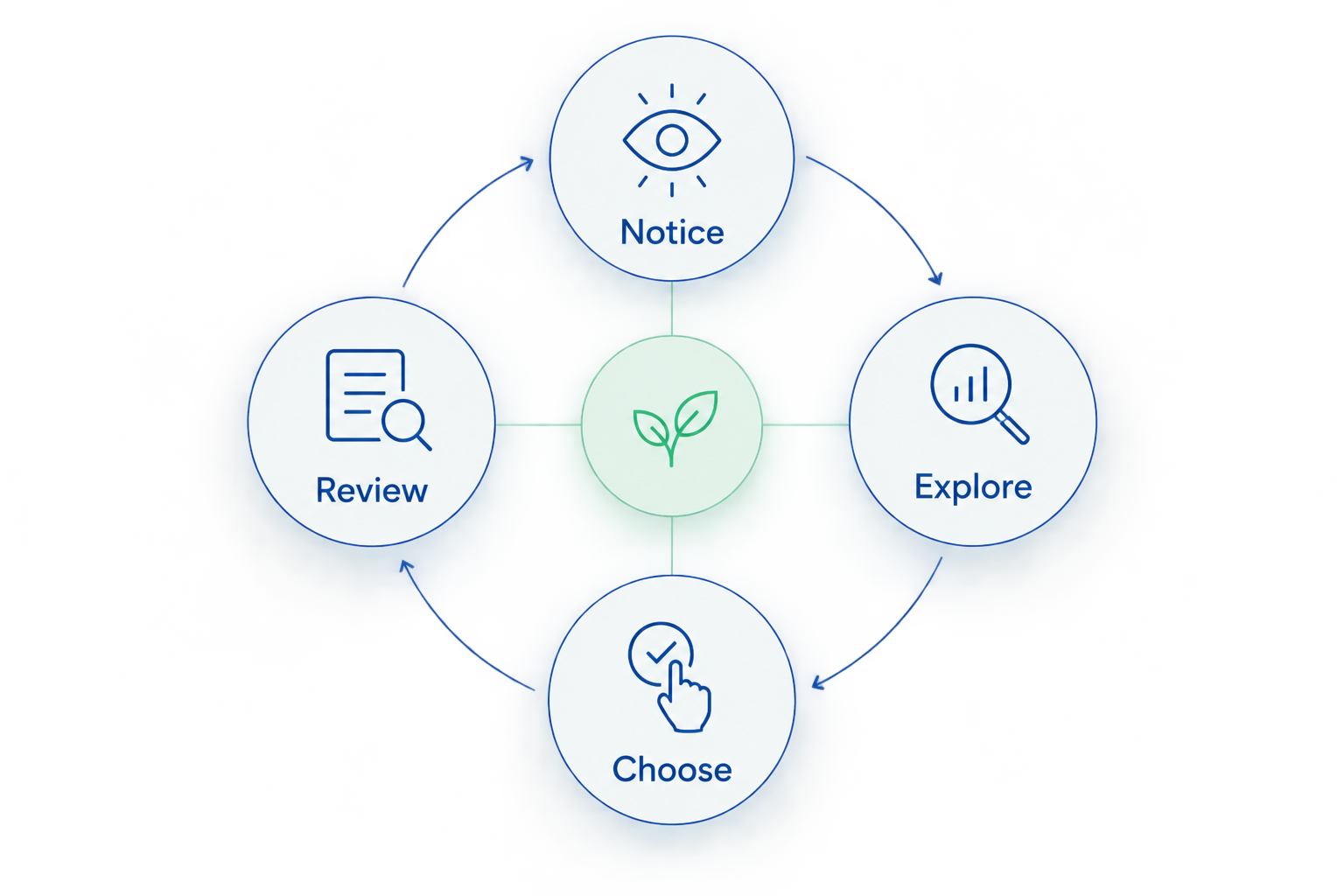
The working sequence is: Notice, Explore, Choose, Review. It is a conversation structure for applying reflection, not an official diagram or a replacement for learning the model.
Give the action a clear context. “When a request arrives, I will check my existing commitments before answering” is easier to revisit than “I will become more balanced.”
- Name the situation that will prompt the action.
- Let the person choose the response.
- Check that the action respects other people’s boundaries.
- Write the action in plain, observable language.
- Agree on what to discuss at the next conversation.
Review experience without grading progress
At the next conversation, ask what happened before returning to the diagram. The person’s experience matters more than whether their behaviour appears to confirm your interpretation.
Review 1 everyday example in detail. Ask whether the chosen response felt useful, difficult, irrelevant or incomplete, and what the person learned from trying it.
The model includes a cycle of personal development and maturity. Use that idea to support returning to reflection as circumstances change, not to rank people as spiritually advanced or behind.
Across a 2026 mentoring programme, keep goals revisable. Someone’s priorities can change without making an earlier conversation wrong or a later diagram more authoritative.
- Ask what actually happened rather than what should have happened.
- Notice practical changes without assigning spiritual status.
- Explore obstacles without calling them failure.
- Revise the action when it does not fit.
- Revisit the model only when it serves the person’s question.
Compare options for spiritual mentoring
These options serve different purposes. Choose according to the conversation you have agreed to hold, not according to which format looks most authoritative.
| Option | Best for | Practical advantage | Key limitation |
|---|---|---|---|
| Open reflective conversation | Someone who prefers ordinary language | Starts directly with a lived situation | Provides no shared visual reference |
| Structured journaling | Someone who wants private reflection between meetings | Preserves examples in the person’s own words | Written reflections still require interpretation |
| Archegram quiz and personal diagram | Someone who welcomes a spiritual self-regulation framework | Adds a shared structure for exploring patterns and balance | Is not a validated diagnostic assessment or a complete account of the person |
| Diagram-guided mentoring | Someone who wants to discuss interpretations with a mentor | Connects symbolic language with everyday examples | Depends on clear boundaries and the mentor’s understanding |
Use the least interpretive option that serves the person’s purpose. A diagram adds value when it supports a useful conversation; it does not need to appear in every meeting.
For mentors seeking further learning in 2026, check the current course information before describing certification, included materials or participation requirements. Do not turn course participation into a claim of clinical competence.
Common mistakes spiritual mentors make
Treating a pattern as a permanent identity
“You are this archetype” closes a conversation that should remain exploratory. Ask where a pattern appears, where it does not, and whether the language fits the person’s experience.
A useful interpretation leaves room for change. It does not make every disagreement further evidence that the label is correct.
Using spiritual language to bypass ordinary needs
A discussion about receptive energy should not replace a straightforward question about whether someone wants to accept a responsibility. Bring the conversation back to choices, boundaries and circumstances.
When using tantragram for spiritual mentors, keep spiritual meaning alongside everyday reality. Neither needs to erase the other.
Inferring a hidden history from the diagram
Do not infer trauma, family events or a mental health condition from a visual pattern. A diagram does not establish someone’s history or explain every recurring response.
Ask only what serves the agreed conversation. The person decides what to share.
Interpreting relationships as a prediction
Use relationship reflection to discuss dynamics and possible conflicts, not to declare that two people are compatible or incompatible. Do not interpret an absent partner as though you have assessed them.
Stay with the participating person’s observations, choices and boundaries. Avoid making the framework an authority over a relationship decision.
Confusing mentorship with permission to practise beyond your role
Familiarity with symbolic interpretation does not establish diagnostic ability or professional credentials. Describe your training accurately and keep your work within its scope.
If someone asks for diagnosis or treatment, explain that this framework does not provide either. Encourage them to seek an appropriately qualified professional rather than offering a diagram-based substitute.
FAQ
What is Tantragram for spiritual mentors?
Tantragram for spiritual mentors is the use of Archegram’s self-regulation framework to support reflective conversations about patterns, strengths and emotional balance. It is a spiritual self-understanding model, not a diagnostic assessment.
Do I need to use the quiz in every mentoring session?
No, the quiz is optional. You can begin with an everyday situation and use the diagram only when the person wants that additional structure.
Is the 24-question quiz a validated psychological test?
No, the quiz should not be presented as a validated psychological or diagnostic assessment. Use it as a self-reflection resource within the model’s spiritual framework.
How do I discuss a result that someone disagrees with?
Accept the disagreement and ask what does not fit their experience. Do not treat rejection of an interpretation as proof that the interpretation is correct.
Can I use the diagram to assess relationship compatibility?
Use the diagram to reflect on relationship dynamics, not to predict compatibility. Keep the discussion focused on observed interactions and the participating person’s choices.
Do receptive and active energies mean women and men?
No, receptive and active energies describe capacities available to anyone. Do not use feminine and masculine terminology to prescribe gender roles or behaviour.
Can spiritual mentors use the model to treat emotional difficulties?
No, the model is not treatment and does not establish clinical competence. Keep mentoring reflective and direct requests for diagnosis or treatment to an appropriately qualified professional.
One last thing
Before closing a diagram-based conversation, ask: What would you take from today if you set the diagram aside? The answer should be understandable without specialist language.
Archegram belongs in the service of that everyday understanding. Keep the chosen action visible, let the interpretation remain revisable, and leave the person free to decide what is useful.
Related guides
- Exercises for emotional self-regulation
- Archetype diagrams for life coaches
- The model for meditation teachers
