
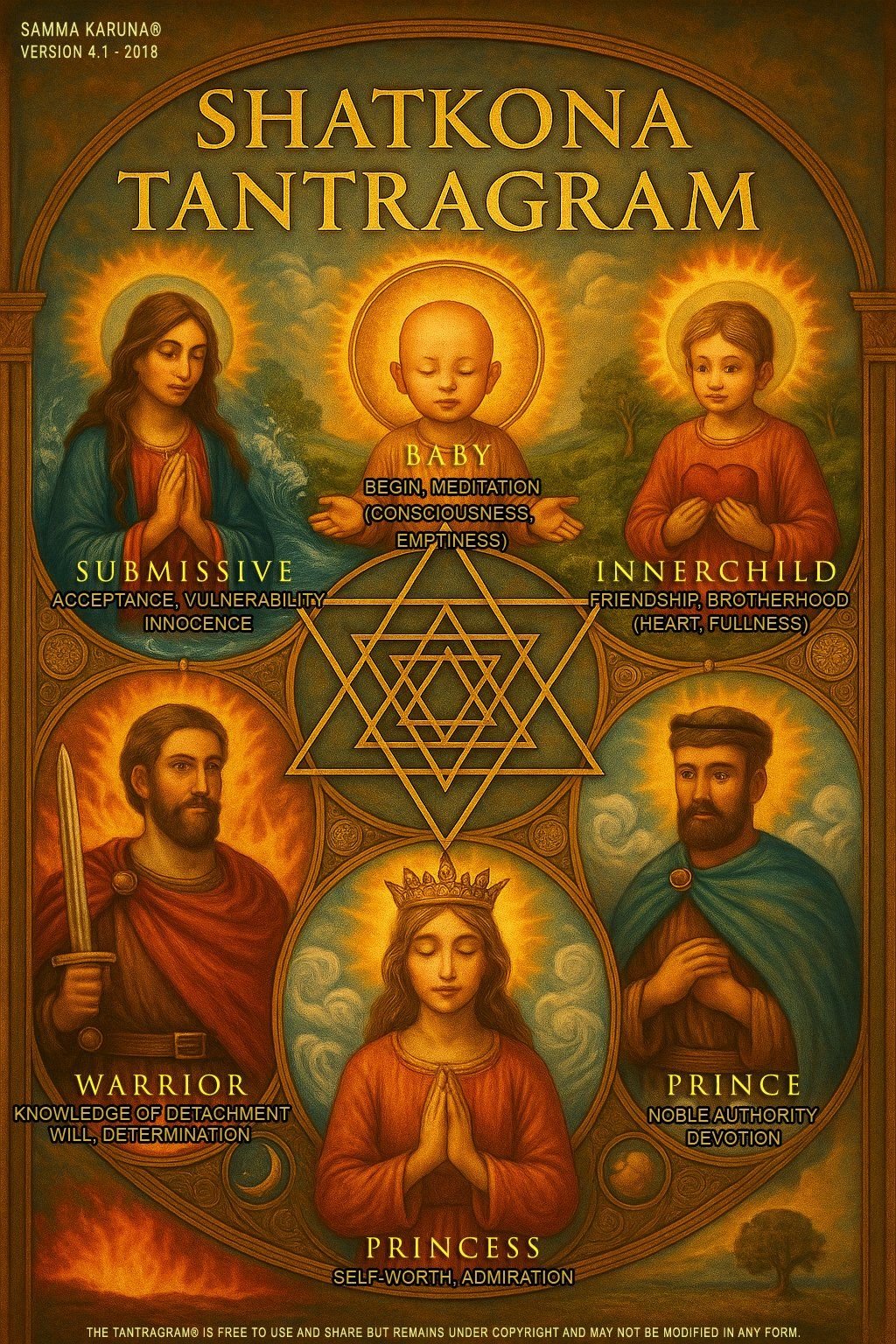

The Archegram connects perception, connection and response through three fields: Wisdom, Connection and Inner Strength. Each has an inward and an outward aspect, giving six perspectives on the same experience rather than six independent steps. This is Ishi’s educational account of the model, also called Tantragram, not a scientifically validated account of consciousness.
- Archegram perception, connection and response describe three fields, each with an inner and an outer aspect.
- Wisdom concerns perception; Connection concerns meaning and relationship; Inner Strength concerns regulation and response.
- The six perspectives influence one another rather than forming a rigid sequence.
- Use the model to examine a real experience, not to assign yourself a permanent type.
How does the Archegram connect perception, connection and response?
In Ishi’s manuscript, the explanatory starting point is that you perceive an experience, relate to it and respond to it. Each field includes what happens within you and how you engage with the world. The Archegram introduction gives the wider context; this guide focuses specifically on that inner–outer structure.
| Field in the model | Inner aspect | Outer aspect | Question to explore |
|---|---|---|---|
| Wisdom | Perception of thoughts, emotions, needs and sensations | Perception of people and circumstances | What am I noticing? |
| Connection | Relationship with your inner experience | Relationship with other people and the world | What meaning am I giving this? |
| Inner Strength | Regulation of your internal response | Words, choices and actions | How am I responding? |
These are six aspects of one experience. They are not a scoring formula, a diagnosis or a claim that you can always identify the exact cause of a feeling.
Why this distinction matters when learning the model
A list of archetype names can sound like a list of personalities. The inner–outer structure gives those names a different context: the model asks how qualities work together within an experience, rather than deciding which single character you are.
You might notice a difficult message, interpret it as disapproval and prepare a defensive reply. Looking only at the reply misses the meaning you gave the message. Looking only at the feeling misses the practical choice about what to say.
The Archegram self-discovery framework suits adults exploring the relationship between their perceptions, interpretations and choices. Its strength is organising reflection; its limitation is that an organised explanation is not proof of why an experience happened.
Wisdom: explore what you perceive
Wisdom is the field of perception in this explanation of the Tantragram. Ishi distinguishes awareness of your inner experience from awareness of the surrounding situation.
An inner observation might be that your chest feels tense or that you are imagining an argument. An outer observation might be that a colleague asked for a revision. The imagined argument and the actual request are not the same information.
Try separating them before assigning a meaning:
- Describe what was said or done.
- Notice thoughts or images that arose alongside it.
- Acknowledge sensations without declaring what caused them.
- Leave uncertainty where the information is incomplete.
This field connects with the Baby–InnerChild archetype, which Ishi associates with wisdom. In its spiritual expression, the Baby refers to observing awareness and the InnerChild to the spiritual heart and connection. Those descriptions belong to his teaching; they do not establish an anatomical location or a measurable state of awakening.
Inner perception does not outrank outer information
Noticing a strong feeling does not tell you everything about an event. Equally, describing the external facts does not make the feeling irrelevant.
The model invites you to include both perspectives. If someone says a commitment has changed, that statement is information worth checking, even if you initially interpret it through an old expectation.
A balanced exploration keeps your interpretation open. You can ask for clarification rather than deciding that the other person intended rejection or disrespect.
Connection: examine the meaning you give the experience
Connection is the field of relationship in the model. Inner connection concerns how you relate to yourself and what you feel; outer connection concerns how you relate to others and the world.
After receiving a request for a revision, you might treat yourself as a failure and the other person as an enemy. You might instead recognise a disagreement about the work while remaining open to a conversation. These examples illustrate different relationships with the event, not different levels of human worth.
This field connects with the Prince–Princess archetype. In Ishi’s account, the pair explores care for others alongside self-worth and self-appreciation.
- The Prince provides language for outward dedication and care.
- The Princess provides language for how you value and relate to yourself.
- The pair asks whether one direction of care excludes the other.
You can care about a colleague’s needs without agreeing to every request. You can respect your own effort without concluding that the colleague is wrong to raise a concern.
Meaning is not identical to fact
The sentence that a task needs another revision does not automatically mean that your work has no value. The second statement is an interpretation.
Within the Connection field, you examine what that interpretation does to your relationship with yourself and the other person. You do not have to replace it with an artificially positive story. A more accurate account might simply be that you need further information.
The point is to notice meaning, not to insist that every disagreement is a reflection of a hidden issue within you. Real circumstances and other people’s conduct remain relevant.
Inner Strength: consider regulation and expression together
Inner Strength is the field of response. Ishi’s explanation pairs inner regulation with outer response, including speech, decisions and action.
The Warrior–Submissive archetype gives this field its characteristic relationship between will and acceptance. Warrior language concerns making an appropriate change; Submissive language concerns accepting and adapting to what is present.
A reply can look calm while you are silencing an important concern. A firm reply can also be thoughtful rather than reactive. The outward action alone does not settle the interpretation.
Questions for this field include:
- What response is actually available to me?
- What am I trying to change?
- What fact or feeling am I unwilling to acknowledge?
- Does my response respect both practical responsibilities and boundaries?
Here, acceptance does not mean obedience to another person. The model’s terminology should never require tolerating abuse, abandoning consent or ignoring a health concern.
Action and acceptance can occur together
You might accept that the deadline is close while asking which revision matters most. You might acknowledge feeling disappointed while explaining that you cannot take on additional work today.
These examples keep both facets of Inner Strength in view. Acceptance concerns the reality of the situation; action concerns what you choose to do within it.
The purpose of the pair is not to make every response equally forceful and receptive. It is to examine whether both capacities remain available when circumstances change.
A worked example through all three fields
Imagine a friend cancels a plan shortly before you were due to meet. You feel unsettled and begin composing a message about how little they care.
Through Wisdom, separate the cancellation from the conclusion about their feelings. You know the plan changed; you might not yet know why. Your disappointment is part of the experience, but it does not by itself establish their motive.
Through Connection, explore how the event affects your relationship with yourself and your friend. Are you interpreting the cancellation as evidence that you do not matter? Is there a repeated practical problem that needs discussion?
Through Inner Strength, consider a response. You could ask what happened, explain the inconvenience or arrange another time. If cancellations are frequent, a boundary might be appropriate.
| Field | Observation in this example | A possible next question |
|---|---|---|
| Wisdom | A plan changed and disappointment arose | What do I know, and what am I assuming? |
| Connection | I am attaching meaning to the cancellation | How am I relating to myself and my friend? |
| Inner Strength | I want to send a critical message | What response fits the situation and my values? |
This is an illustrative application, not a reading of your personal diagram. Different circumstances could require a different response.
Why the six aspects are not a fixed sequence
The manuscript presents perception, relating and responding in an order that makes the teaching easier to explain. It also says that the aspects influence one another continuously.
For example, sending a message changes the external situation. The response you receive supplies new information and can alter the meaning you give the original event. You do not finish perception permanently before moving to connection.
Treat the model as different views of a connected experience. Avoid turning the teaching into a requirement to identify every aspect before you can speak, decide or act.
This distinction also keeps interpretation modest. The model can suggest a useful question without establishing a complete causal explanation of your mind.
How the diagram relates to this explanation
The model includes three archetypal pairs and six named facets: Warrior, Submissive, Prince, Princess, Baby and InnerChild. Its personal diagram offers a visual way to explore their relationships.
The manuscript describes a quiz with 24 questions, grouped into eight questions per archetype and four per named facet. Those counts explain the organisation of the questionnaire; they do not make its scores a clinical measure.
An event-based reflection and a questionnaire answer different questions. The event helps you explore a particular experience. The questionnaire invites broader self-report according to its instructions.
You can learn the three fields without taking the quiz. If you do create a diagram, return to concrete examples rather than treating the shape as more authoritative than your life.
What a facilitator should keep separate
A facilitator can ask about each field without deciding the answer for you. Questions about perception, meaning and action are invitations, not proof that an interpretation is correct.
Keep these distinctions clear:
- A reported sensation is not a diagnosis.
- A diagram pattern is not evidence of another person’s motives.
- A spiritual description is not a validated developmental ranking.
- A suggested interpretation can be declined or revised.
A reflective conversation should remain specific enough that you can explain what you noticed in your own words. If the model’s vocabulary obscures that account, return to ordinary language first.
FAQ
What are the three fields of the Archegram?
The three fields are Wisdom, Connection and Inner Strength. In Ishi’s explanation, they concern perception, relationship and response.
Why does the Tantragram include six perspectives?
Each of its three fields has an inner and an outer aspect. Together, they offer six perspectives on one experience.
Are these perspectives separate stages?
No. The manuscript explains them in an accessible order but describes them as continuously influencing one another.
How does this connect to the archetypes?
Wisdom connects with Baby–InnerChild, Connection with Prince–Princess, and Inner Strength with Warrior–Submissive in the model.
Do I need a diagram to explore perception and response?
No. You can use a specific everyday event to explore the model’s questions before creating a personal diagram.
Does the six-part structure prove the model scientifically?
No. A coherent conceptual structure does not establish scientific validation. This guide presents Ishi’s educational and spiritual framework.
One last thing
The most useful part of the model can be the distinction you had missed: an interpretation mistaken for a fact, care that excludes yourself, or an action that overlooks what you cannot control. Start there rather than trying to explain everything at once.
Related guides
Based on the model explanations supplied by Ishi, creator of the Archegram, in his manuscript 112 Tips for Awakening & Healing. This is an original educational article about the model, not a reproduction of a manuscript chapter.

Free personality quiz number of questions: Best 2026 - November 10, 2026
[…] Perception, connection, and response […]
Self-discovery journal: easiest formats ranked 2026 - November 10, 2026
[…] Archegram perception, connection, and response […]
Coping strategies quiz: best fits for 2026 - November 11, 2026
[…] Perception, connection, and response […]
Best Self-Regulation Exercises: Start With a Pause | 2026 - November 12, 2026
[…] the perception, connection and response guide alongside these exercises when you want to explore how you understand a situation, relate to it and […]
Archetype diagram creation tool: Best picks 2026 - November 12, 2026
[…] Look at your personal diagram and identify an interpretation you want to explore. Ask whether the event supports that reading, challenges it, or leaves you unsure. For model-focused context, explore perception, connection, and response. […]
Masculine and Feminine Energy Quiz: Best Pick 2026 - November 12, 2026
[…] guide to perception, connection and response offers a related model-specific topic to explore alongside your […]