


Best overall: “What am I feeling, and what do I need before I respond?” Best for recurring patterns: “What keeps happening, and how do I participate?” Best for relationships: “What is mine to express, and what is not mine to control?” These self-discovery questions turn reflection into practical choices; Archegram offers a self-regulation model, free quiz and personal diagram for exploring those choices in 2026.
- The best self-discovery questions connect an everyday situation with a need and a practical response.
- Archegram suits adults seeking spiritual self-reflection about emotional balance, not a diagnostic assessment.
- Start with feelings and needs; explore recurring patterns when you have room for deeper reflection.
- Treat archetypes as flexible perspectives, not permanent identities or instructions about gender.
Why this matters
Self-discovery can become a search for the perfect explanation of who you are. A more practical question is what you need to notice before your next conversation, commitment or decision. You do not need a final definition of yourself to make a different choice.
Archegram, also called Tantragram, is a contemporary, non-dogmatic adaptation of ancient Tantric knowledge. Its archetypes and personal visual diagram support reflection on strengths, recurring patterns and developmental needs. This is a spiritual framework, not a clinical assessment or an established psychological diagnosis.
For your 2026 reflection practice, use questions to connect that framework with ordinary life: accepting another responsibility, withdrawing during disagreement or finding it difficult to ask for help. The aim is greater understanding and balance, not a flattering label.
What makes the best self-discovery questions?
The questions below earn their place through these criteria:
- A specific starting point: You can answer using a recent situation rather than a theory about your personality.
- Room for complexity: The question allows different needs, strengths and responses to coexist.
- A connection to balance: The answer helps you consider what deserves more attention or a different response.
- A practical next move: Reflection leads toward something you can express, request, try or reconsider.
- Freedom from fixed labels: You can revise your interpretation as your circumstances change.
These criteria matter when using an archetype diagram. A useful question helps you examine your interpretation; it does not turn that interpretation into proof.
The best self-discovery questions at a glance
The ranking follows a practical sequence, starting with your present experience before moving toward patterns, relationships and development. Each question serves a different purpose.
| Rank | Self-discovery question | Best for | Standout feature | Key limitation |
|---|---|---|---|---|
| 1 | What am I feeling, and what do I need before I respond? | An immediate emotional check-in | Connects reflection with your next response | Naming a need does not resolve the situation |
| 2 | What keeps happening, and how do I participate? | Recurring patterns | Examines your contribution without defining your identity | Requires care around blame |
| 3 | Which strength am I relying on, and what needs attention? | Exploring your diagram | Holds strengths and developmental needs together | Depends on your interpretation |
| 4 | Am I making room to receive, or is action needed? | Balancing receptivity and action | Makes energy language practical | Does not replace situational judgment |
| 5 | What is mine to express, and what is not mine to control? | Relationship reflection | Separates communication from control | Cannot explain another person's inner experience |
| 6 | What small response would express the balance I want? | Turning insight into practice | Ends with a specific experiment | A single action does not establish lasting change |
1. What am I feeling, and what do I need before I respond?
Best for: an immediate emotional check-in. This is the strongest starting question because it stays close to your current experience. You do not have to interpret your whole diagram before answering it.
Suppose you receive a message asking for another favour. Before deciding whether you are a generous person or an avoidant person, notice your response: irritation, hesitation, willingness or something harder to name. Then consider whether you need information, space to decide or a clearer boundary.
Within Archegram, this question keeps self-regulation ahead of self-labelling. Your interpretation becomes a starting point for reflection rather than an instruction you must obey.
Question 1 pros:
- Starts with something happening now.
- Makes room for mixed feelings.
- Connects awareness with a possible response.
Question 1 cons:
- Feelings and needs are not always easy to name.
- Understanding your need does not guarantee agreement from others.
Verdict: Use this first when you need a place to begin.
2. What keeps happening, and how do I participate?
Best for: recognising recurring patterns. Choose a situation that feels familiar, then describe what actually happened. Separate the observable sequence from your explanation of it.
Perhaps you accept a task without discussing your workload, feel resentful and then become distant. The useful question is not whether you belong to a supposedly difficult archetype. It is where you made a choice, what you hoped that choice would protect and what you might express differently.
Keep responsibility precise. Examining your participation does not mean accepting responsibility for another person's conduct.
Question 2 pros:
- Brings reflection into a concrete sequence.
- Leaves room to examine coping strategies.
- Identifies a point where you can try something different.
Question 2 cons:
- Can become self-blame if you ignore the wider situation.
- Your account does not establish another person's motives.
Verdict: Use this for repeated situations, not to put yourself on trial.
3. Which strength am I relying on, and what needs attention?
Best for: exploring strengths alongside developmental needs. Use this question while looking at your personal diagram. Consider which interpretation fits a recent experience, and which parts need more thought.
For example, you might recognise your willingness to support others as a strength while noticing that you rarely state your own preferences. Both observations can belong in the same reflection. You do not need to reject the strength to explore a different response.
Treat the diagram as a prompt, not independent confirmation. Write down an example that supports your interpretation and an example that complicates it.
Question 3 pros:
- Avoids reducing reflection to perceived weaknesses.
- Connects diagram interpretation with everyday examples.
- Makes room for apparently contradictory qualities.
Question 3 cons:
- A visual result can feel more definitive than it is.
- Familiar interpretations can become labels if you stop questioning them.
Verdict: Use this to open your interpretation, not settle your identity.
4. Am I making room to receive, or is action needed?
Best for: exploring receptive and active energies. In Archegram, feminine and masculine language refers to receptive and active energies available to anyone. It does not prescribe gender roles or tell you how a woman or man should behave.
Make those terms ordinary. Receiving might mean listening to feedback or accepting help; action might mean stating a preference or making a decision. Ask what the particular moment calls for rather than which category describes you.
Your 2026 practice does not need equal amounts of each response in every situation. Balance is a question to explore in context, not a quota.
Question 4 pros:
- Translates abstract language into recognisable choices.
- Allows receptivity and action to coexist.
- Avoids assigning capacities by gender.
Question 4 cons:
- The terminology will not resonate with everyone.
- A simple contrast cannot capture every situation.
Verdict: Use this when the distinction clarifies your choices; skip the terminology when it distracts.
5. What is mine to express, and what is not mine to control?
Best for: reflecting on relationship dynamics. Start with your own experience, request or boundary. Then distinguish it from the response you want another person to have.
For example, you can say that a last-minute change upset you and ask for more notice. You cannot use a diagram interpretation to establish why the other person changed plans or require them to agree with your account.
When applying the model to relationships, explore possible dynamics and conflicts without predicting compatibility. Another person's interpretation belongs to them.
Question 5 pros:
- Keeps your reflection connected to your own choices.
- Creates space for a clear request.
- Discourages using archetypes to explain someone without their input.
Question 5 cons:
- Cannot resolve a disagreement by itself.
- Does not reveal another person's intentions.
Verdict: Use this before a reflective conversation, not as evidence against someone.
6. What small response would express the balance I want?
Best for: translating insight into an everyday experiment. Choose something you can describe clearly. Asking for clarification before agreeing to a task is more specific than deciding to become a more balanced person.
Connect the experiment with your reflection on strengths, patterns or developmental needs. Afterwards, ask what happened and whether your original interpretation still fits. You are exploring a response, not proving a type.
For a 2026 journal, record the situation and your chosen response in 2 sentences. Add another observation after you have tried it, without grading yourself as a success or failure.
Question 6 pros:
- Gives reflection a practical endpoint.
- Leaves room to revise your interpretation.
- Makes your chosen response easy to revisit.
Question 6 cons:
- A single experience cannot establish a general pattern.
- An experiment can become another demand if you treat it as a test.
Verdict: Use this to finish a reflection session with a manageable next move.
How to use the questions with your diagram
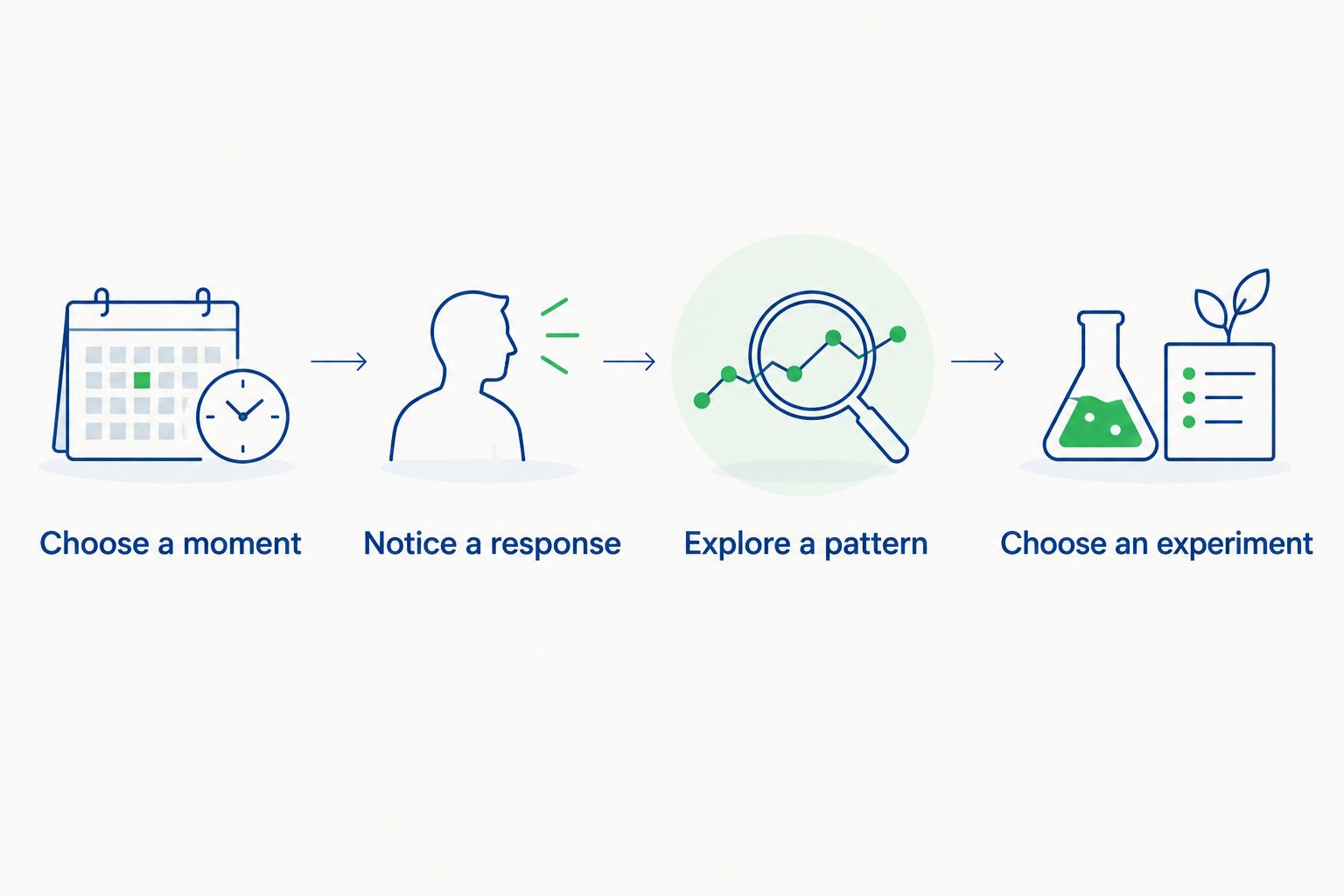
Set aside 5 minutes as an optional starting point, not a requirement. Choose one question rather than answering the entire list, and use this sequence:
- Choose a moment: Describe a recent event without explaining everyone involved.
- Notice a response: Name what you felt, wanted or did.
- Explore a pattern: Consider how your diagram interpretation relates to the event, including where it does not fit.
- Choose an experiment: Identify a response you want to try in a similar situation.
You can return to the same question as circumstances change. A different answer does not mean the earlier reflection was wrong; describe what has changed before deciding what it means.
If you guide others, invite their interpretation before offering your own. Ask permission to explore a theme, leave room for disagreement and avoid presenting a spiritual reading as a psychological finding.
How these questions are ranked
The ranking prioritises immediate relevance, openness and practical application. Feelings and needs come first because they provide a starting point before diagram interpretation. Pattern, strength and relationship questions serve more specific purposes; the final question turns reflection toward action.
This is an editorial selection for applying the model, not a scientifically validated ranking. No question establishes an archetype, diagnosis or guaranteed outcome.
Which self-discovery question should you choose?
Start with feelings and needs if you are undecided. Choose the recurring-pattern question when a situation keeps returning, and the strengths question when you want to reflect with your diagram.
Archegram is best suited to adults who want a spiritual self-regulation framework for exploring emotional balance, not a diagnostic assessment. Its free 24-question quiz and personal diagram offer another way into that reflection; you can also begin with a recent experience and one question from this page.
FAQ
What’s the best self-discovery question to ask myself first?
Start with: What am I feeling, and what do I need before I respond? It connects reflection with a current situation without requiring a complete explanation of your personality.
How do I use self-discovery questions with Archegram?
Choose a recent situation and explore how your personal diagram interpretation relates to it. Look for examples that fit and examples that complicate your reading, then consider a practical response.
Do I need to take the quiz before answering these questions?
No, you can begin with an everyday experience. The free 24-question quiz and personal diagram provide additional material for reflection rather than a prerequisite.
Can self-discovery questions tell me my true personality?
These questions do not establish a final or fixed identity. Use them to explore your current experiences, recurring patterns and choices while leaving room for change.
Is this model a validated psychological assessment?
No, it is presented here as a spiritual self-understanding and self-regulation framework, not a validated diagnostic assessment. Its interpretations should not be treated as clinical findings.
Can I use these questions with my partner?
Yes, if both of you want a reflective conversation. Speak about your own experience and invite the other person’s interpretation rather than using archetypes to label them or predict compatibility.
How often should I revisit my answers in 2026?
Revisit an answer when a relevant situation returns or your circumstances change. There is no required schedule for this exercise; focus on whether the reflection helps you identify a clearer next choice.
One last thing
Keep a place for examples that do not fit your diagram interpretation. If you think of yourself as someone who always takes charge, record a moment when you listened, waited or accepted support. That exception belongs in your self-understanding too.
The question is not only whether a description sounds familiar. Ask whether it leaves enough room for the choices you can make now.
Related guides
- Exercises for emotional self-regulation
- Tools for interpreting your archetype diagram
- Quizzes for identifying your coping strategies
- Self-discovery quizzes for life transitions
