


Instead of interpreting your diagram from scratch whenever a familiar reaction appears, turn one observation into a cue, a small action and a review note. Archegram is best for adults seeking a reflective self-regulation model, not a diagnostic assessment; this 2026 workflow shows you how to bring that reflection into everyday decisions.
- Archegram diagram self-regulation works as a reflection practice, not a diagnosis or a fixed identity.
- Choose one recurring pattern, connect it to a real situation, and plan one manageable response.
- Use your personal diagram alongside lived experience; do not treat its interpretation as proof.
- Review emotional balance through concrete examples rather than trying to achieve a perfect diagram.
Why this matters
A diagram gives you something to reflect on. A routine gives that reflection a place in your day. The connection is a specific situation: what happens, what you notice, and what you choose to do next.
Archegram, also called Tantragram, is a contemporary, non-dogmatic adaptation of ancient Tantric knowledge developed at Samma Karuna. Its spiritual framework uses archetypes and a personal visual diagram to explore strengths, recurring patterns and developmental needs. It is distinct from established psychological research and should not be presented as a scientifically validated assessment.
You can explore the model and its free 24-question quiz through Archegram. The routine below is a suggested way to apply your reflections, not an official scoring method or a claim that particular diagram features cause particular behaviours.
Before you start
- Have your personal diagram and its accompanying explanation available. If you have not created one, begin with the quiz-to-your-first-diagram workflow. Do not guess what unfamiliar labels or diagram features mean.
- Prepare a private notebook or document and one ordinary situation to explore. Choose something manageable, such as agreeing to a request before checking your capacity. Date your starting note in 2026 so later reflections have context.
- Keep interpretation separate from observation. A prominent feature is not automatically an excess, and a less prominent feature is not automatically a deficiency. Record what the model says separately from what you have actually noticed in daily life.
No integration, paid application or automated reminder is required. The bold labels below are suggested notebook headings, not buttons or fields in the quiz interface.
Pattern selection
Start with one situation rather than your whole personality. The purpose is to make the diagram useful without asking it to explain everything.
- Read the explanation. Revisit the guidance accompanying your diagram. Write down one strength, recurring pattern or developmental theme that you want to understand better, using the explanation's wording accurately.
- Add an observation. Under What happened, describe one recent event without interpreting anyone's motives. For example: a colleague asked for help, and you agreed before checking your existing commitments.
- Separate the meaning. Under My interpretation, write the connection you are exploring between that event and your diagram. Phrase it as a question: does this theme help me understand why I agree so quickly?
- Choose a focus. Under This week's focus, name one behaviour you can notice. Replace a broad aim such as becoming balanced with something observable, such as checking capacity before accepting a request.
Expected result: you have one diagram-based question and one real-life behaviour to observe. You have not turned an archetype into a verdict about who you are.
A useful note leaves room for disagreement. If a theme does not fit your experience, record that too; do not search for evidence merely to make your life match the diagram.
Response plan
The next step is to connect the chosen pattern with a different response. Keep the action within your control: you can change how you answer a request, but you cannot make another person welcome your answer.
- Name the cue. Under When I notice, describe an event you can recognise: receiving a request, feeling hurried to answer, or beginning to explain yourself at length.
- Name the need. Under What needs attention, write an everyday need such as time, clarity, rest or room to express a preference. Treat this as your reflection, not something the diagram has established for you.
- Choose one action. Under My next response, write a behaviour small enough to try in that situation. For the request example, check your commitments before giving an answer.
- Write a fallback. Under If I miss it, decide what you will do after the familiar reaction occurs. You might revisit the commitment and clarify what you can realistically offer.
Expected result: your plan follows a clear structure: when this cue appears, I will try this response; if I miss the cue, I will take this follow-up action.
Within the model, receptive and active energies are available to anyone, not assigned by gender. You can use that language to ask whether a situation calls for receiving information, taking action, or making room for both. It is a reflection prompt, not a formula that determines the correct response.
Daily cue
Give your plan a reliable place to appear. You do not need to reread your entire diagram each morning; use a short note that connects its selected theme to the day ahead.
- Attach the note to an existing activity. Choose a moment such as opening your planner or reviewing your commitments. Avoid a reminder that arrives when you cannot act on it.
- Prepare a 2-minute check-in. Use that duration as a suggested limit, not a proven therapeutic dose. Read your focus, picture a relevant situation and recall your planned response.
- Keep the wording visible. Put the cue and response together in your notebook or private reminder. Use plain language you will understand when distracted.
- Protect the context. If you use a shared calendar or visible notification, keep personal interpretations out of the reminder. A neutral label such as Daily check-in is enough.
Expected result: you have a repeatable cue that brings one part of your diagram into an ordinary decision, without requiring a full interpretation session.
The whole workflow has four parts: Pattern selection, Response plan, Daily cue and Review notes. Keep them together so that reflection leads to an action and the action leads back to observation.
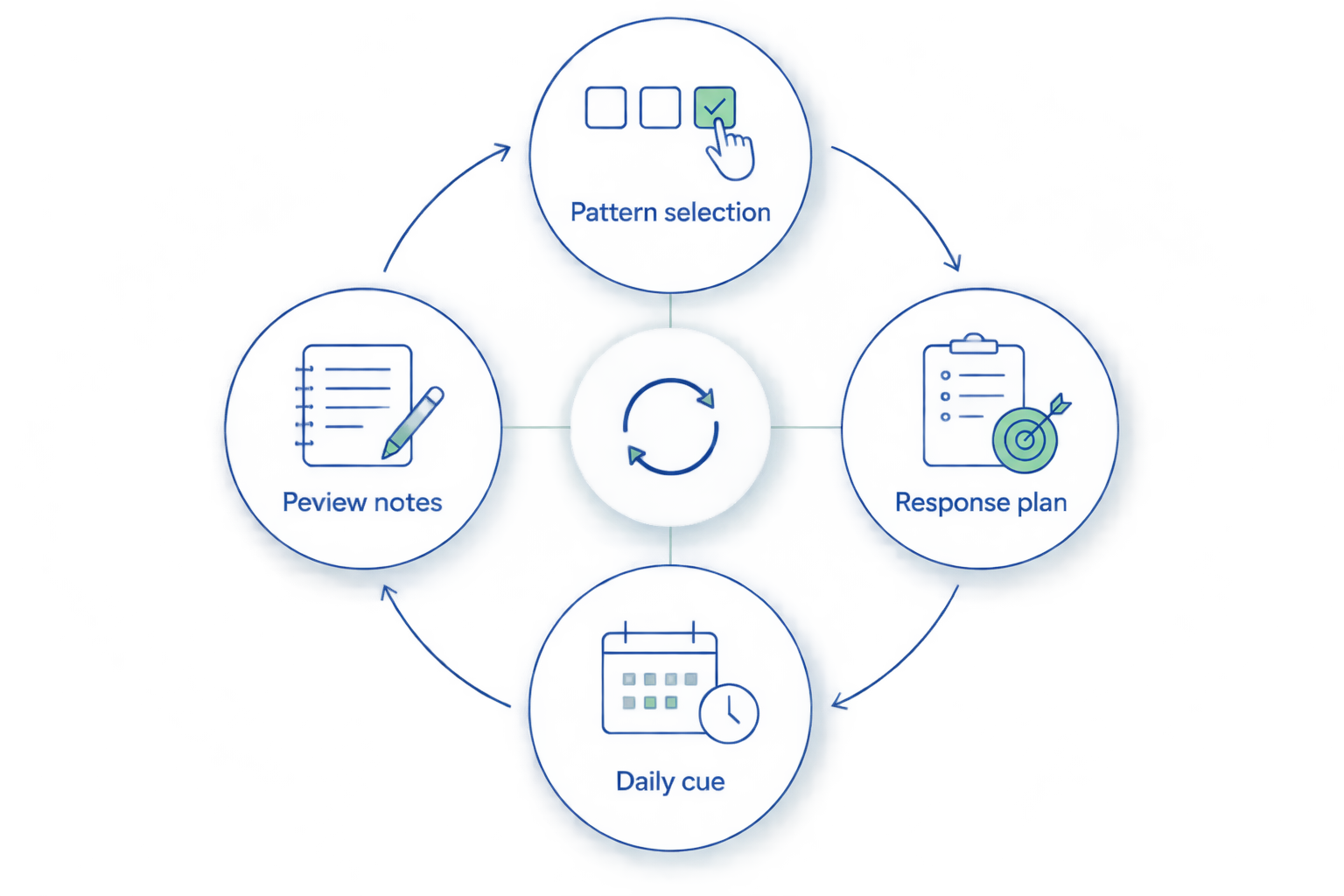
Review notes
Review what happened, not whether you performed your chosen archetype correctly. Keep your 2026 notes dated so you can distinguish an ongoing pattern from a response to a particular circumstance.
- Record the event. Under What happened, describe the situation briefly. Include enough context to understand it later without documenting every detail.
- Record your response. Under What I tried, note the action you actually took. If you noticed the cue only afterwards, say so without turning the entry into self-criticism.
- Record the consequence. Under What followed, describe an observable outcome: you asked for more time, clarified a commitment or left something unresolved. Do not assume you know another person's feelings.
- Choose the next adjustment. After a suggested 7-day trial, decide whether to keep, simplify or replace the action. This is a planning interval, not a promise that a pattern changes within a week.
Expected result: you have examples that help you judge whether the routine fits your life. You also have questions to bring back to the diagram's explanation or a reflective conversation.
For the request example, noticing the cue after agreeing still gives you useful information. Your next adjustment might be to place the reminder beside your commitments rather than expecting yourself to remember it during conversation.
Judge the routine by the choices you can describe, not by whether your diagram looks more balanced. Do not assign meaning to a changed shape or result without the model's accompanying guidance.
A second workflow: a 2026 life-change reset
Use the same process when your circumstances change. A new responsibility, relationship change or altered schedule gives you a different context in which to explore an existing pattern; it does not automatically require a new identity or diagram.
Choose between these two entry points. Both are suggested reflection routines rather than separate products or official model protocols.
| Entry point | Best for | Advantage | Limitation |
|---|---|---|---|
| Daily cue | Practising a response in a familiar situation | Keeps the selected behaviour close to an everyday decision | A reminder becomes background noise if it does not match the situation |
| Life-change reset | Reconsidering a routine after circumstances change | Makes room for new responsibilities and needs | A broad review becomes vague unless it ends with one concrete action |
To reset, reread your original observation and ask what has changed around it. Keep the distinction between the diagram's interpretation and your current experience, then choose one new situation for practice.
For example, checking capacity before agreeing might now mean consulting a changed family schedule rather than your work calendar. The underlying question remains useful, while the practical response changes.
Do not repeat the quiz solely to obtain a result that feels more reassuring. First ask whether you need a clearer interpretation, a more realistic action or a better description of your present circumstances.
Troubleshooting
The diagram feels accurate, but nothing changes
Replace the broad intention with a visible action. Understanding a description does not specify what to do when the relevant moment arrives. Write down the cue and the next behaviour together.
If your note says to be more receptive, specify what that means in the chosen situation: hear the request fully before deciding, for example.
Your interpretation feels like a fixed identity
Return to behaviour and context. Replace statements about what you always are with descriptions of what you noticed in one situation. Archetypes are flexible reflection tools, not permanent categories or excuses for behaviour.
Keep examples that do not fit your interpretation. Those examples belong in the reflection rather than being dismissed.
The routine becomes another demand
Reduce the task before adding reminders. Keep one cue, one response and one short note. A detailed tracking system is not required to explore a recurring pattern.
If the practice becomes distressing, stop it. This spiritual self-understanding framework is not a substitute for professional mental health support.
You cannot tell what a diagram feature means
Do not invent an interpretation. Return to the explanation supplied with your diagram and note the exact question you still have. Avoid importing meanings from other personality or spiritual frameworks.
You can still record the everyday situation while leaving the diagram connection unresolved. Uncertainty is more useful than a confident label without a basis.
Customize your workflow
Expand only after the first routine has a clear purpose. You might explore the same pattern in a different setting, but keep separate notes so that work pressures and relationship dynamics do not become one sweeping explanation.
For additional practice ideas, explore these emotional self-regulation exercises. Choose an exercise that serves your specific question rather than adding activities simply to make the routine longer.
If you guide others, invite the person to describe their own experience before offering an interpretation. Ask permission to discuss their diagram, let them disagree and keep the conversation within reflective education rather than diagnosis or treatment.
FAQ
How do I use an Archegram diagram for self-regulation?
Choose one diagram theme, connect it to a real situation and plan one manageable response. Record what happens, then revisit your interpretation without treating it as a diagnosis or fixed identity.
Do I need to take the quiz every day?
No daily quiz is required for this routine. Work with your existing diagram and record current examples rather than repeatedly seeking a different result.
What if I do not understand part of my diagram?
Leave that interpretation open and return to the accompanying explanation. Do not assume that size, position or prominence means something without guidance from the model.
How long should my daily check-in take?
Try a 2-minute check-in as a practical starting point. This is a suggested planning limit, not an evidence-based treatment duration or a requirement of the model.
Can a coach use this routine with someone else?
A coach can use the routine to structure a reflective conversation, while staying within their competence and role. The person should remain free to question interpretations, decline discussion and keep their diagram private.
Is this a scientifically validated emotional assessment?
No; this guide presents a spiritual self-understanding framework, not a validated diagnostic assessment. It should not be used to diagnose a condition, prescribe treatment or claim clinical improvement.
Should I restart my routine when life changes in 2026?
Revisit the routine when its context changes, rather than restarting automatically. Check whether the cue, response and review still fit your responsibilities and current needs.
One last thing
Keep a note titled When this interpretation does not fit. An example that challenges your reading of the diagram can open a more useful question than another example that confirms it.
Your task is not to become a better match for a diagram. It is to use the model thoughtfully while making choices in the life you actually have.
Related guides

Can the Archegram quiz accurately find your archetype? 2026 - November 24, 2026
[…] a longer application of this process, explore the diagram-to-self-regulation routine. Keep the focus on an everyday response you want to understand, rather than finding a more […]