


Instead of repeatedly arguing about what each person meant, use an archetype diagram relationship conversation to connect two personal diagrams with one everyday situation and one shared agreement. Start with Archegram, then follow this 2026 workflow to describe your own patterns without using either diagram to define your partner.
- An Archegram archetype diagram relationship conversation supports self-regulation, not compatibility scoring.
- Interpret your own diagram first; ask your partner what their diagram means to them.
- Discuss one recent situation, then agree on one observable action.
- Pause when either person cannot listen; no diagram overrides consent or boundaries.
Why this matters
A relationship conversation loses its purpose when a reflection tool becomes evidence against someone. A diagram can provide a starting point for describing your experience; it cannot establish another person's motives or settle whose interpretation is correct.
Archegram is best for adults seeking a spiritual self-regulation framework, not a relationship diagnosis. Also known as Tantragram, it is a contemporary, non-dogmatic adaptation of ancient Tantric knowledge. Its interpretations are part of that spiritual framework, not a validated psychological assessment.
The purpose here is practical: notice a recurring response, explain it without accusation, and choose a different action together. You do not need matching diagrams, identical spiritual beliefs, or agreement about every archetype term.
Before you start
- Prepare your materials. Each person needs their own diagram, somewhere to write, and access to the free 24-question Archegram quiz if they have not created a diagram. Keep results private unless you actively choose to share them.
- Agree on the container. As a suggested starting point, reserve 20 minutes, choose one manageable situation, and agree that either person can stop. These timings are practice suggestions, not requirements of the model.
- Avoid the hidden trap. Do not combine the diagrams into a compatibility score or interpret your partner before hearing from them. This workflow creates conversation notes, not a merged diagram or an automated relationship report.
Use this exercise only when both people can disagree freely. If raising a concern brings intimidation, threats, or fear of retaliation, do not use a shared diagram exercise to negotiate safety; seek appropriate individual support instead.
Personal reflection setup
Prepare separate notes
- Open your own diagram and read the explanations provided with it. Copy unfamiliar terms exactly rather than filling gaps with meanings borrowed from other personality systems.
- Create a private note titled Relationship reflection — 2026. This is a worksheet heading you create yourself, not a website field or button.
- Add three headings: What I notice, A recent example, and What I need. Under each, write a short observation about yourself.
- Separate interpretation from experience. For example, record that a description resonates with you, then name something you actually did during a recent conversation.
Spend a suggested 5 minutes preparing independently. Private preparation gives each person room to find their own words before responding to the other's account.
Expected result: each person has a personal observation, a specific example, and a need to discuss. Neither person has written a diagnosis of the other.
Translate the diagram into everyday language
An Archegram diagram supports reflection on strengths, recurring patterns, coping strategies, and developmental needs. For this conversation, translate those ideas into ordinary verbs: asking, interrupting, waiting, withdrawing, agreeing, or deciding.
An archetype is a reflection lens, not a fixed identity. If a term does not fit your experience, leave it open rather than forcing yourself into it.
If receptive and active energies appear in your interpretation, describe them as capacities available to anyone. Listening and initiating are possible examples of receptive and active actions; neither belongs to a particular gender.
For unfamiliar terminology, use the guide to interpreting your archetype diagram before assigning meaning to a feature. Do not infer a partner's maturity, intentions, or worth from a visual difference.
Shared conversation setup
Choose the situation
- Choose one recent interaction that both people remember. Keep the scope narrow: deciding how to spend an evening is more workable than discussing the entire relationship.
- Describe the event without an explanation of motive. Record that a question went unanswered rather than deciding the silence meant indifference.
- Let each person correct factual details about their own actions. Leave disputed details marked as different recollections.
- Agree on the question you want to explore, such as how to ask for thinking time without leaving the other person uncertain.
Expected result: you have one shared topic, even if you remember parts of it differently. The conversation does not depend on agreeing about every detail.
Take turns describing experience
- Give the first speaker a suggested 2 minutes without interruption. Describe the situation, your response, and the need you now recognize.
- Let the listener summarize what they heard before offering their own account. Ask whether the summary fits rather than assuming it does.
- Reverse roles. Apply the same listening agreement even when the second account challenges the first.
- Bring in the diagram only where the speaker finds it relevant. Ask which part helps them describe their experience, not which label explains their partner.
Expected result: each person can state the other's concern in language that person accepts. Agreement about the cause is not required.
For example, one person might describe asking repeated questions because a decision felt unfinished. The other might describe becoming quiet because they wanted room to think. These are illustrative accounts, not interpretations that a particular diagram automatically produces.
The useful next question is what each person needs to do differently. Repeating an archetype name is not an answer.
Shared agreement setup
Choose the action
- Under What I notice, identify your own contribution to the interaction. Keep responsibility specific; do not take responsibility for another person's behavior.
- Under What I need, turn a broad wish into a request. Being understood is a wish; asking someone to summarize your concern before answering is an observable request.
- Agree on one action each person freely accepts. A request is not an agreement until the other person has consented.
- Write down how you will recognize the action. If someone asks for a pause, include how you will arrange to return to the topic.
Expected result: your notes contain a small behavioral agreement, not a promise to change personality.
Set the review
Add a Review date — 2026 heading to your shared note. Choose a date together rather than treating the exercise as an open-ended commitment.
At the review, ask whether the agreed action happened, how each person experienced it, and what needs adjusting. Keep diagram interpretation separate from that observation: an action can be unhelpful even when its explanation feels meaningful.
The agreement is the output; the diagrams are supporting material. Do not judge success by whether both people adopt the same vocabulary.
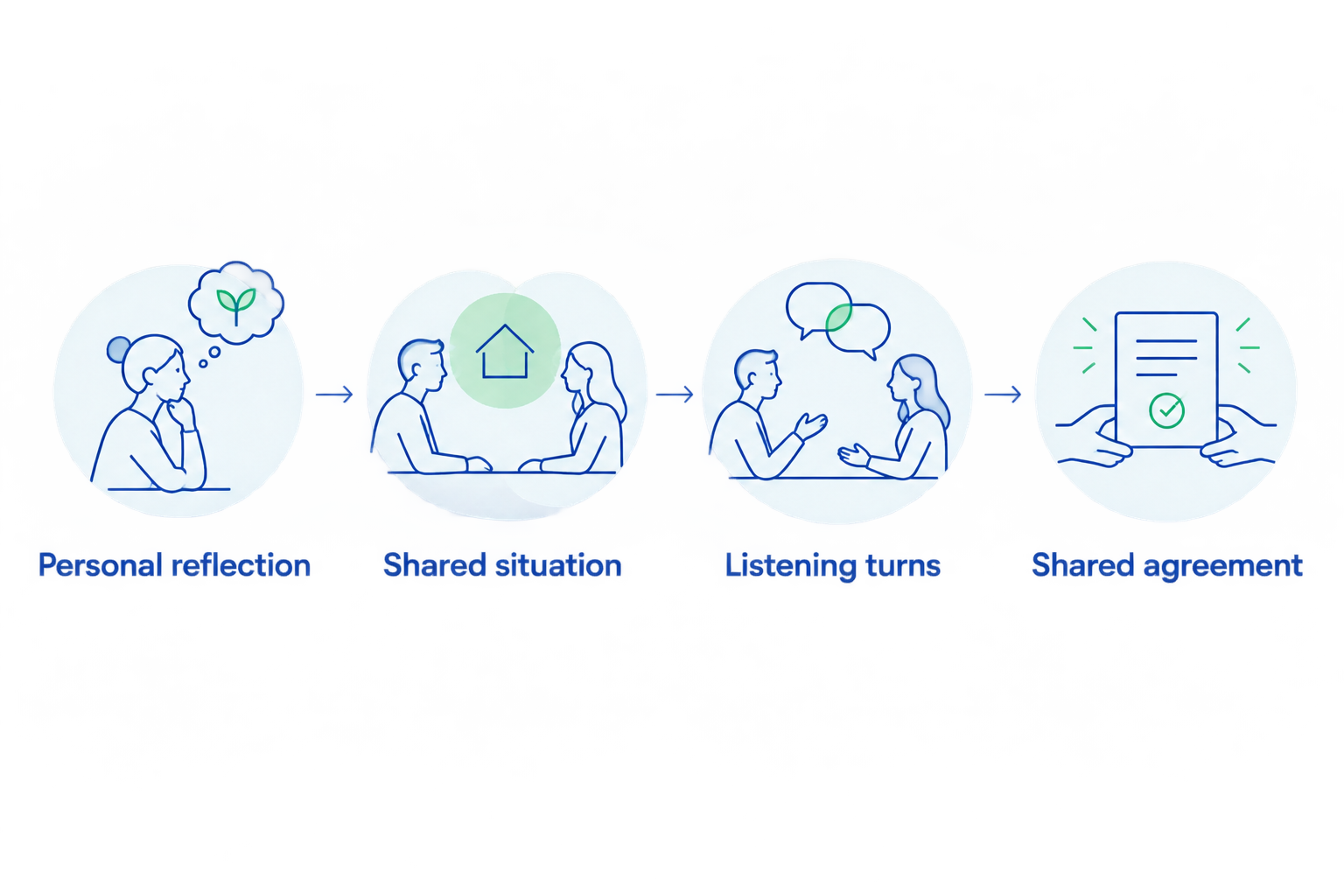
The workflow has four stages: Personal reflection, Shared situation, Listening turns, and Shared agreement. Return to an earlier stage whenever you discover that you are discussing different events or needs.
Repeat the conversation when circumstances change
A second workflow starts with a changed circumstance rather than an unresolved interaction. Use it when a new responsibility, routine, or personal reflection gives you something different to discuss. A fresh quiz result is optional, not a prerequisite.
Both workflows keep self-regulation at the center. Choose according to the conversation you actually need, not according to which diagram looks more balanced.
| Workflow | Best for | Practical advantage | Limitation |
|---|---|---|---|
| Situation-led conversation | Understanding one recurring interaction | Keeps attention on observable behavior | Can become an argument about recollections |
| Change-led conversation | Revisiting needs after circumstances change | Makes room for a different current experience | Can become abstract without a recent example |
For a change-led conversation:
- Review your previous notes privately and identify what no longer fits.
- Describe the changed circumstance before discussing any diagram difference.
- Ask which existing agreement still serves both people and which needs revision.
- Record one revised action under Current agreement — 2026, keeping the earlier note separate.
Expected result: you have an updated agreement without declaring the earlier diagram wrong or the newer one more mature.
Keep the original context beside older notes. Comparing a difficult week with a settled period without naming that difference turns reflection into a misleading before-and-after judgment.
Troubleshooting
Your partner disagrees with your interpretation
Return ownership of the diagram to the person it describes. Ask what fits their experience and what does not; do not keep explaining why your reading is more accurate.
You can still discuss observable behavior without agreeing on its symbolic meaning. Remove the disputed interpretation from the shared agreement.
The conversation becomes overwhelming
Stop interpreting diagrams and stop pressing for an immediate answer. A discussion of emotional flooding in relationships concerns the experience of overwhelm during conflict; it should not become another label you assign to your partner.
Ask whether the person wants to stop. If both agree to resume later, decide how to arrange that conversation without making continued participation a condition of being heard.
Different diagrams become a ranking
Remove words such as advanced, inferior, or more evolved from the comparison. No diagram authorizes one person to make decisions for the other.
Ask each person to name a strength they recognize in themselves and an action they want to practice. Keep development self-directed rather than grading a partner's progress.
You understand the pattern but keep repeating it
Shrink the agreement. Replace a broad commitment to communicate better with one action, such as asking whether the other person wants listening or discussion before responding.
Review what happened without using the diagram as an excuse. An explanation of a pattern does not remove responsibility for its effects.
One person does not want to share
Keep that person's diagram private. Offer a conversation about the situation without using archetype language, and accept a refusal to do the exercise.
A shared practice requires shared consent. You can use your own reflection to choose your response without requiring your partner to participate.
Customize your workflow
Keep the same structure when you adapt the exercise: private reflection, one situation, listening, and a voluntary agreement. Change the prompts rather than adding more interpretations.
If you are a coach or facilitator, ask permission before bringing diagrams into a conversation. Let participants describe their own experience, clarify what notes you will retain, and do not present spiritual interpretation as clinical assessment.
For personal practice, keep a short record of your own chosen action between conversations. Record what happened, not whether your partner performed correctly. This keeps self-regulation from becoming supervision of someone else.
FAQ
How do I start an archetype diagram relationship conversation?
Start with one recent situation and describe your own response before discussing either diagram. Take turns listening, then agree on one observable action that both people accept.
Can Archegram tell us whether we are compatible?
Archegram does not provide a validated prediction of relationship compatibility. Use its diagrams to reflect on dynamics and possible conflicts, not to decide whether a relationship should continue.
Do we both need to take the 24-question quiz?
Both people need their own diagram for the two-diagram workflow. If only one person wants to use the model, keep the diagram work personal and discuss shared situations in everyday language.
What if our diagrams look very different?
Different diagrams are not a verdict on your relationship. Ask what each person recognizes in their own interpretation, then connect those observations to a specific interaction.
Should we repeat the quiz before every conversation?
No, this workflow does not require a new quiz result before every conversation. Review your current experience first and revisit your diagram when you have a clear reason to explore it again.
Can a coach use this workflow with couples?
A coach can use the workflow as a voluntary reflection exercise within their competence and agreed scope. The diagrams do not confer clinical assessment skills or replace appropriate professional support.
How should we organize our relationship reflection notes in 2026?
Keep private reflections separate from shared agreements, and date each shared note. Record the situation, the action each person accepted, and the review date without storing interpretations your partner has not agreed to share.
One last thing
Ask what would remain useful if you put both diagrams away. If the answer is a clearer request, a respected boundary, or a more specific agreement, keep that part of the conversation.
Archegram supports this process as a reflection framework, not an authority over either person. Your partner's own account of their experience belongs in the conversation even when it does not match your interpretation.
Related guides
- Archegram diagram to a self-regulation routine
- Relationship dynamics tools for couples coaches
- Archegram diagram to a shadow-work journal
