


Instead of rebuilding your questions from scratch for every client, use an archegram diagram coaching session workflow that connects the personal diagram to one everyday situation, one recurring pattern and one practical response. Start with the client’s own interpretation, agree on a small self-regulation experiment, and leave with a clear way to review what happens.
- An archegram diagram coaching session should turn personal reflection into one practical self-regulation experiment.
- Archegram is a spiritual self-regulation framework, not a validated diagnostic assessment.
- Ask clients what fits their experience before offering your interpretation of the diagram.
- Keep the diagram optional, agree on privacy, and review the client’s experience rather than judging scores.
Why this matters
A diagram can give a reflective conversation somewhere to begin. It cannot tell you what a client needs without their participation. Your task is to connect the model with their lived experience, not to make their life fit an archetype description.
Archegram is best for adults and reflective practitioners seeking a spiritual self-regulation framework, not a clinical assessment. The Archegram model uses archetypes and a personal visual diagram to explore strengths, recurring patterns and developmental needs.
Also called Tantragram, the model is a contemporary, non-dogmatic adaptation of ancient Tantric knowledge. Its spiritual interpretations are distinct from established psychological research; this guide makes no claim of scientific validation or treatment benefit.
For your 2026 session template, define success modestly: the client understands one pattern more clearly and chooses a response they want to try. Agreement with your interpretation is not the goal.
Before you start
- Prepare the material and access. Have the client’s permission to discuss their diagram, a readable copy they choose to share, and somewhere to make agreed notes. The model’s free online quiz contains 24 questions. If a diagram is not ready, use the quiz-to-first-diagram workflow before planning interpretation.
- Set the scope and privacy boundaries. Explain that the session supports reflection and everyday self-regulation, not diagnosis or treatment. Agree on whether you will retain the diagram, what you will record, and who can access those records.
- Pre-empt the interpretation trap. Do not assume that a prominent feature proves a fixed personality trait or that a less prominent feature means deficiency. Ask what the client recognises, what they question and what does not fit.
You do not need to build a software integration for this workflow. The bold field names below belong to a worksheet you create; they are not claimed website buttons or quiz settings.
Client intake and session boundaries
Prepare the shared worksheet
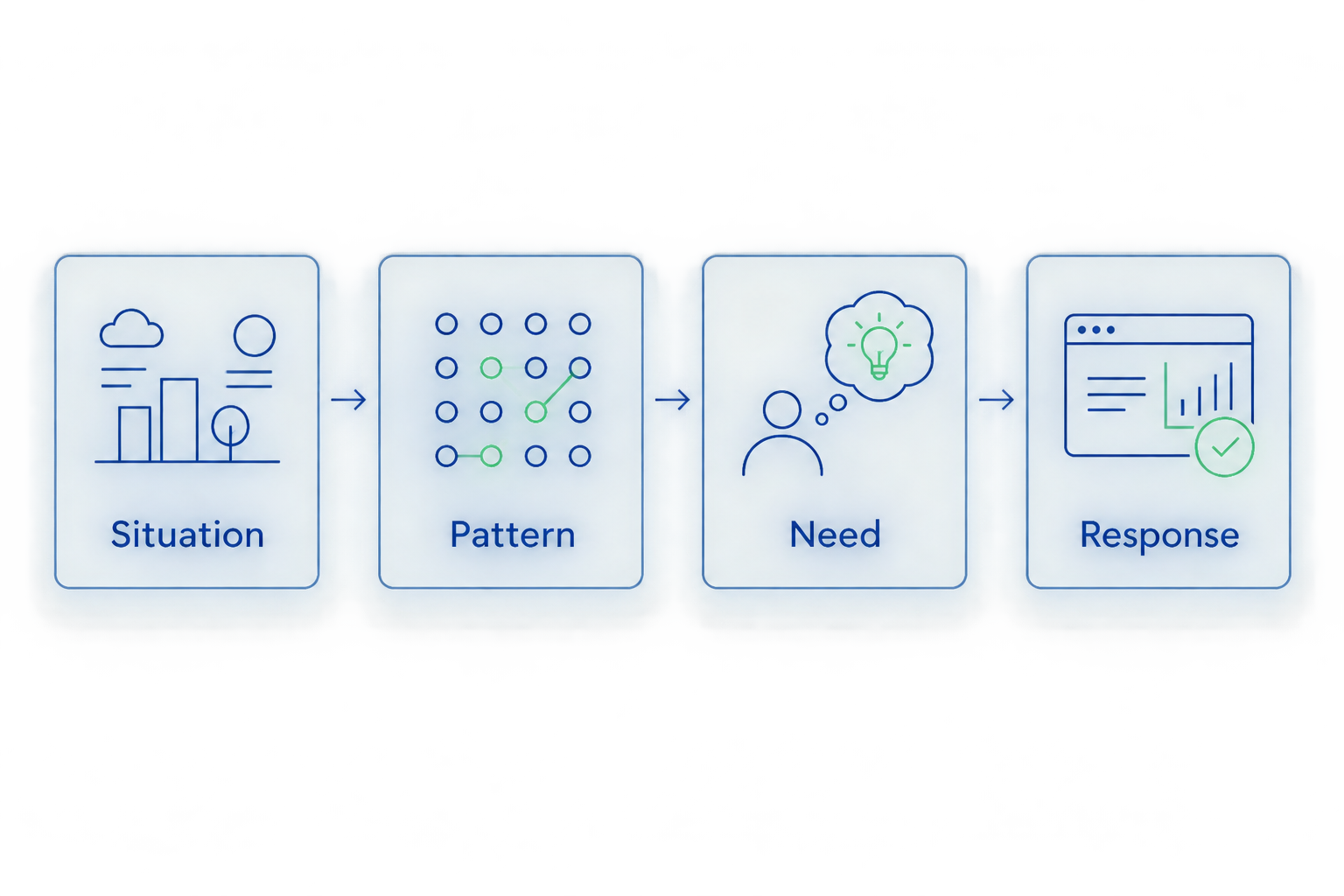
- Create a simple document with these fields: Session date, Client intention, Diagram context, Situation, Pattern, Need, Response and Review. Keep interpretation separate from direct observations.
- Under Diagram context, record when the client completed the quiz, if they know, and what was happening in their life. Do not assign a meaning to that context before asking them.
- Ask: “What would make this conversation useful in your everyday life?” Record their answer under Client intention, using their own words rather than replacing them with model terminology.
- Confirm that the client can decline a question, challenge an interpretation or set the diagram aside. Agree on any subjects they do not want to discuss.
Expected result: you have a shared purpose, clear permission and a worksheet that separates the client’s experience from your interpretation.
Use a dated record rather than a permanent identity label. For example, a worksheet headed “Session reflection, November 2026” describes a particular conversation; a heading such as “Your true type” makes a much larger claim than the exercise supports.
Establish your role
Explain your actual experience with the model without implying credentials you do not hold. Reading a guide does not establish competence to interpret every feature or to work beyond your training.
If an unfamiliar diagram feature becomes central to the discussion, pause that interpretation. You can still ask about an everyday situation without inventing what a symbol or relationship means.
Diagram exploration and a real-life example
Let the client lead the interpretation
- Invite the client to look at the diagram quietly, then ask what draws their attention. Begin with observation, not an explanation of what you think they are like.
- Ask which descriptions feel familiar and which feel inaccurate. Record disagreement as useful information, not resistance to the model.
- Explore a strength before a difficulty. Ask where a familiar pattern helps the client, and where relying on it becomes less useful.
- Ask for one recent, manageable example connected with their intention. Choose a specific interaction or decision rather than their whole life story.
Expected result: the diagram has opened a conversation about experience without becoming an authority over the client.
If receptive and active energies arise, describe them as possibilities available to anyone. Do not translate feminine and masculine language into gender prescriptions, relationship roles or assumptions about how someone should behave.
Map the example into four fields
- Write observable events under Situation. For example: a colleague asked for an answer before the client felt ready. Keep assumptions about the colleague’s motives out of this field.
- Under Pattern, record what the client noticed themselves doing. An illustrative answer is agreeing immediately, then wishing they had asked for time.
- Under Need, invite the client to name what mattered: time to consider, clearer information or space to express uncertainty. Do not tell them what they must have needed.
- Under Response, draft an alternative they genuinely want to try. In this example, that is asking when an answer is needed before agreeing.
Expected result: a broad archetype discussion becomes a concrete account of a situation and a possible choice.
These four worksheet fields are a facilitation structure for this guide, not a claim about the model’s official diagram layout. Keep the original diagram available, but use the worksheet to make the conversation practical.
Self-regulation experiment and session close
Choose a response the client can recognise
- Return to Client intention. Check that the chosen example still serves the purpose the client brought to the session.
- Make Response specific enough to notice in daily life. Asking for clarification is observable; becoming completely balanced is not a usable session task.
- Identify the cue for trying it. In the example above, the cue is receiving a request before feeling ready to answer.
- Invite a brief rehearsal if the client wants one. Let them practise the wording, change it or decide that another response feels more appropriate.
- Ask what would make the experiment impractical. Adjust it together rather than treating hesitation as a failure of commitment.
Expected result: the client leaves with one chosen action linked to a recognisable situation, not an instruction to become a different person.
As an optional exercise, allow 2 minutes for the client to write their preferred wording. This is a suggested facilitation interval, not a validated protocol or a promise about how quickly self-regulation develops.
Agree on a review method
- Under Review, record what the client wants to notice: whether the situation arose, what they tried and how they experienced the result.
- Choose a review point together. A 7-day experiment is one possible starting structure, not a required schedule.
- Ask the client to summarise the plan in their own language. Revise anything that sounds like your instruction rather than their choice.
- Confirm which notes they want to keep and what you will retain under the privacy agreement.
Expected result: both people know what will be reviewed and understand that an unhelpful experiment can be changed.
For a 2026 practice log, record observations rather than success scores. “Asked for more information before answering” tells you what happened; “became more mature” adds an interpretation that needs much more discussion.
Returning-client workflow: review experience before the diagram
A follow-up session does not require another quiz. Start with the agreed experiment, then decide together whether the existing diagram remains useful or whether the client wants to revisit their reflections.
| Workflow | Best for | Useful feature | Limitation |
|---|---|---|---|
| First-session diagram exploration | Adults beginning a shared reflection | Gives the conversation a visual starting point | Can encourage premature labels if interpretation comes first |
| Returning-client experiment review | Adults who have tried an agreed response | Connects reflection with an actual experience | Depends on the client’s account and does not establish causation |
- Ask what happened without assuming the client used the planned response. If the situation never arose, there is no failed experiment to explain.
- Explore what felt useful, awkward or irrelevant. Invite an example rather than seeking approval of the model.
- Return to the diagram only if it helps clarify the experience. Keep an interpretation provisional when it does not fit.
- Agree to keep, adapt or stop the experiment. Record the reason in the client’s words.
Expected result: the follow-up responds to the person’s experience instead of defending the previous interpretation.
If the client brings a newly completed diagram in December 2026, keep its date distinct from the earlier record. Do not call a difference proof of progress, regression or improved emotional balance; discuss what the client notices and what else has changed.
Troubleshooting
The client says the diagram is wrong
Accept the disagreement. Ask which parts do not fit and whether any part remains useful. Continue with the client’s chosen situation or set the diagram aside; you do not need to persuade them that the framework is accurate.
The conversation stays abstract
Ask for the most recent example the client feels comfortable discussing. Separate what happened from what they thought it meant, then return to Situation, Pattern, Need and Response. If no example comes to mind, leave the interpretation open.
The client asks what their strongest feature proves
Explain that the diagram is a reflection aid, not proof of character, ability or future behaviour. Ask where the suggested pattern fits and where it does not. Avoid turning a visual feature into a permanent identity.
The discussion moves beyond your role
Pause diagram interpretation and state your boundary clearly. Do not use spiritual explanations to diagnose distress or promise treatment. Where appropriate, encourage the client to seek support from a suitably qualified professional rather than extending the session beyond your competence.
The client agrees with everything you suggest
Make room for disagreement explicitly. Ask what feels inaccurate, unhelpful or too strong, and give the client time to answer. Replace leading questions with invitations to describe their own experience.
Customize your workflow
Keep the core sequence stable while changing the example to match the client’s intention. Someone exploring work boundaries and someone reflecting on a difficult conversation can use the same worksheet without receiving the same interpretation.
For your 2026 template, add only fields you will actually use. A longer intake form does not make an interpretation more reliable. If you add questions about relationships, keep the focus on the client’s experience rather than diagnosing an absent partner or predicting compatibility.
For facilitators and teachers, preserve individual choice when adapting the exercise. Do not require people to display personal diagrams or disclose private experiences to a group. A private written reflection is an alternative to sharing aloud, with the limitation that you cannot clarify material the participant chooses not to discuss.
FAQ
How do I structure an archegram diagram coaching session?
Begin with consent and a client-chosen intention, explore the diagram together, then connect one pattern with an everyday situation. Finish with a practical response and an agreed way to review the experience.
Do clients need to complete the quiz before the session?
A completed diagram is needed for diagram interpretation, but it is not required for an initial conversation about goals and boundaries. If the client wants to use the model, allow space for the 24-question quiz before exploring their diagram.
Is Archegram a validated psychological assessment?
No. Archegram is a spiritual self-regulation and self-understanding framework, not a validated diagnostic assessment or treatment.
What if my client disagrees with the diagram?
Accept the disagreement and ask what does not fit their experience. Use only the parts they find useful, or set the diagram aside rather than persuading them to accept a label.
Should a client retake the quiz before every coaching session?
This workflow does not require a new quiz before every session. Review the client’s experience first, and revisit the diagram only when it serves a clear reflective purpose.
Can I interpret a client’s diagram after reading this guide?
This guide provides a conversation structure, not a professional qualification or complete interpretation training. Work within your actual knowledge and seek further model-specific learning before interpreting unfamiliar features.
Can the diagram predict relationship compatibility?
No predictive guarantee should be attached to the diagram. Use it to invite reflection on dynamics and possible conflicts, not to decide whether a relationship will succeed.
One last thing
A client’s disagreement can be the most useful moment in the session. It gives you a chance to stop interpreting and listen more carefully to the person in front of you. Leave room in the worksheet for what the diagram does not explain.
Related guides
- Diagram to a self-regulation routine
- Tools for interpreting your archetype diagram
- Archetype diagrams for life coaches
